Marketing Best in category 1 results Decision Intelligence AI Tool

Popular AI tools in the Decision Intelligence field of Marketing include RevScope, etc., helping you quickly improve efficiency.

RevScope

RevScope

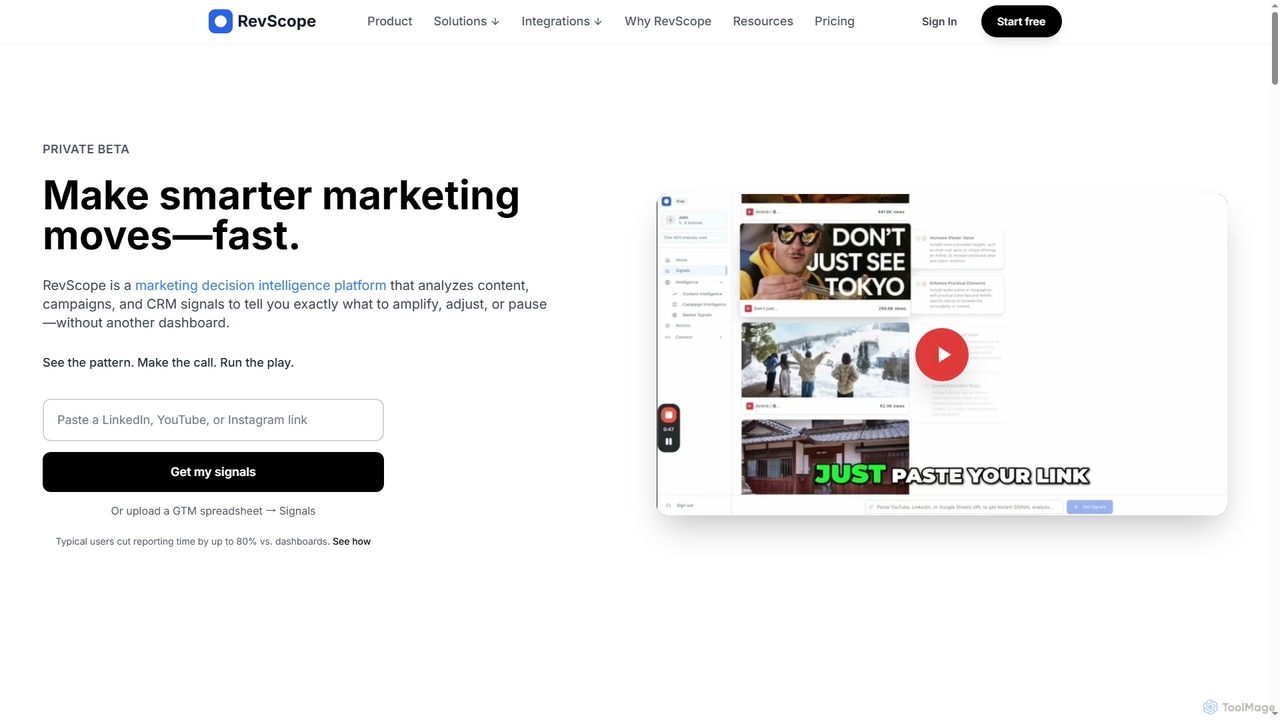
RevScope is an AI-powered marketing decision intelligence platform that analyzes content, campaigns, and CRM signals to provide clear, …

3.8K

About Decision Intelligence

Decision Intelligence tools are AI-powered platforms that transform raw data into actionable insights and optimal recommendations, enabling organizations to make more informed and strategic choices. These advanced systems leverage machine learning, predictive analytics, and prescriptive modeling to not only understand what happened and why, but also to suggest what should be done next to achieve specific business outcomes. Within the broader field of marketing, Decision Intelligence is crucial for optimizing campaigns, understanding customer behavior, and forecasting market trends with greater precision.

Core Features

  • Predictive Modeling: Forecasts future trends, customer behavior, and market shifts based on historical data patterns.
  • Prescriptive Analytics: Recommends specific actions or strategies to achieve desired business goals, such as optimizing ad spend or pricing.
  • Scenario Planning: Simulates various potential outcomes under different conditions, helping evaluate risks and opportunities before execution.
  • Performance Optimization: Continuously monitors key metrics and suggests adjustments to improve the effectiveness of ongoing operations or campaigns.
  • Risk Assessment: Identifies potential risks associated with different decision paths and quantifies their likely impact.

Applicable Scenarios

Decision Intelligence is vital for marketing professionals, business strategists, and data analysts seeking to move beyond descriptive reporting. It empowers marketing teams to optimize campaign ROI by predicting customer responses and allocating budgets effectively. Sales departments can use it for accurate forecasting and identifying high-potential leads. Furthermore, it assists executive leadership in strategic planning, market entry analysis, and resource allocation by providing data-backed recommendations.

How to Choose

When selecting a Decision Intelligence tool, consider its data integration capabilities with existing systems (CRM, ERP, marketing platforms), the transparency and explainability of its AI models, and its scalability to handle growing data volumes. Evaluate the level of customization offered for specific business rules and metrics, the intuitiveness of the user interface, and the quality of support and training available. Prioritize tools that offer clear, actionable recommendations rather than just complex data visualizations.

Decision IntelligenceUse Cases

1

Optimizing Marketing Campaign Spend

Marketing managers can utilize Decision Intelligence to analyze historical campaign performance, market trends, and customer segments. The tool predicts the ROI for various budget allocations across different channels (e.g., social media, email, PPC), recommending the most effective spend distribution to maximize conversions and minimize wasted ad spend, leading to a higher overall campaign efficiency.

2

Optimizing Digital Advertising Spend

A marketing manager needs to maximize the return on investment (ROI) for digital ad campaigns across multiple platforms. Decision Intelligence tools analyze historical campaign data, audience demographics, and real-time market signals to predict the most effective channels, ad creatives, and bidding strategies. This allows the manager to dynamically reallocate budget to top-performing segments, significantly improving campaign efficiency and reducing wasted spend.

3

Predicting Customer Churn

Customer success teams and marketing departments can deploy Decision Intelligence to identify customers at high risk of churning. By analyzing behavioral data, engagement patterns, and demographic information, the AI predicts churn likelihood and suggests proactive retention strategies, such as personalized offers, targeted communication, or specific support interventions, before customers disengage.

4

Personalizing Customer Journey Touchpoints

An e-commerce brand aims to create highly personalized experiences for its customers. Decision Intelligence analyzes individual customer browsing history, purchase patterns, and engagement data to predict their next likely action or product interest. The tool then prescribes the optimal content, product recommendations, or communication channel (email, SMS, in-app notification) for each customer, enhancing engagement and conversion rates.

5

Dynamic Product Pricing Strategy

E-commerce businesses and product managers can leverage Decision Intelligence to set optimal product prices in real-time. The system considers factors like competitor pricing, inventory levels, demand elasticity, seasonal trends, and customer segmentation to recommend dynamic price adjustments that maximize revenue and profit margins, adapting quickly to market changes.

6

Predicting Customer Churn and Retention Strategies

A subscription-based service wants to proactively identify customers at risk of churning. Decision Intelligence models analyze usage patterns, support interactions, and demographic data to predict which customers are likely to cancel their subscriptions. Based on these predictions, the tool recommends targeted retention strategies, such as personalized offers, proactive support outreach, or feature recommendations, to reduce churn and improve customer lifetime value.

7

Personalizing Customer Journeys

Digital marketers can use Decision Intelligence to tailor individual customer experiences across multiple touchpoints. By analyzing customer preferences, past interactions, and predicted future needs, the tool recommends the next best action, content, or product for each customer, guiding them through a personalized journey that enhances engagement and conversion rates.

8

Forecasting Market Demand and Inventory Planning

A retail business needs accurate forecasts for product demand to optimize inventory levels and avoid stockouts or overstock. Decision Intelligence tools integrate sales data, seasonal trends, promotional impacts, and external factors (e.g., economic indicators, social media sentiment) to generate highly accurate demand predictions. This enables better purchasing decisions, reduced carrying costs, and improved product availability.

9

Identifying New Market Opportunities

Business development and strategy teams can employ Decision Intelligence to uncover untapped market segments or emerging trends. The AI analyzes vast datasets, including social media sentiment, search queries, economic indicators, and competitor activities, to identify gaps in the market or underserved customer needs, providing data-backed insights for strategic expansion.

10

Developing Dynamic Pricing Strategies

An airline or hotel chain seeks to optimize pricing for maximum revenue. Decision Intelligence continuously analyzes real-time demand, competitor pricing, booking patterns, and external events to recommend dynamic price adjustments. This ensures that prices are always competitive and aligned with market conditions, maximizing occupancy rates and revenue per available unit.

11

Enhancing Supply Chain Resilience

Operations and procurement managers, especially in retail or manufacturing, can use Decision Intelligence to anticipate supply chain disruptions and optimize inventory. The tool predicts potential delays, demand fluctuations, or supplier risks, recommending proactive measures like adjusting order quantities, diversifying suppliers, or re-routing logistics to maintain operational continuity and reduce costs.

12

Evaluating New Product Launch Feasibility

A product development team is considering launching a new product and needs to assess its market potential and risks. Decision Intelligence tools analyze market research data, competitor offerings, consumer sentiment, and historical launch successes/failures. It provides insights into potential market size, optimal pricing, target demographics, and potential challenges, guiding strategic decisions before significant investment.

Decision IntelligenceFrequently Asked Questions