PloyD
PloyD is an enterprise AI operations platform designed to streamline the productionization of AI models and applications. It …
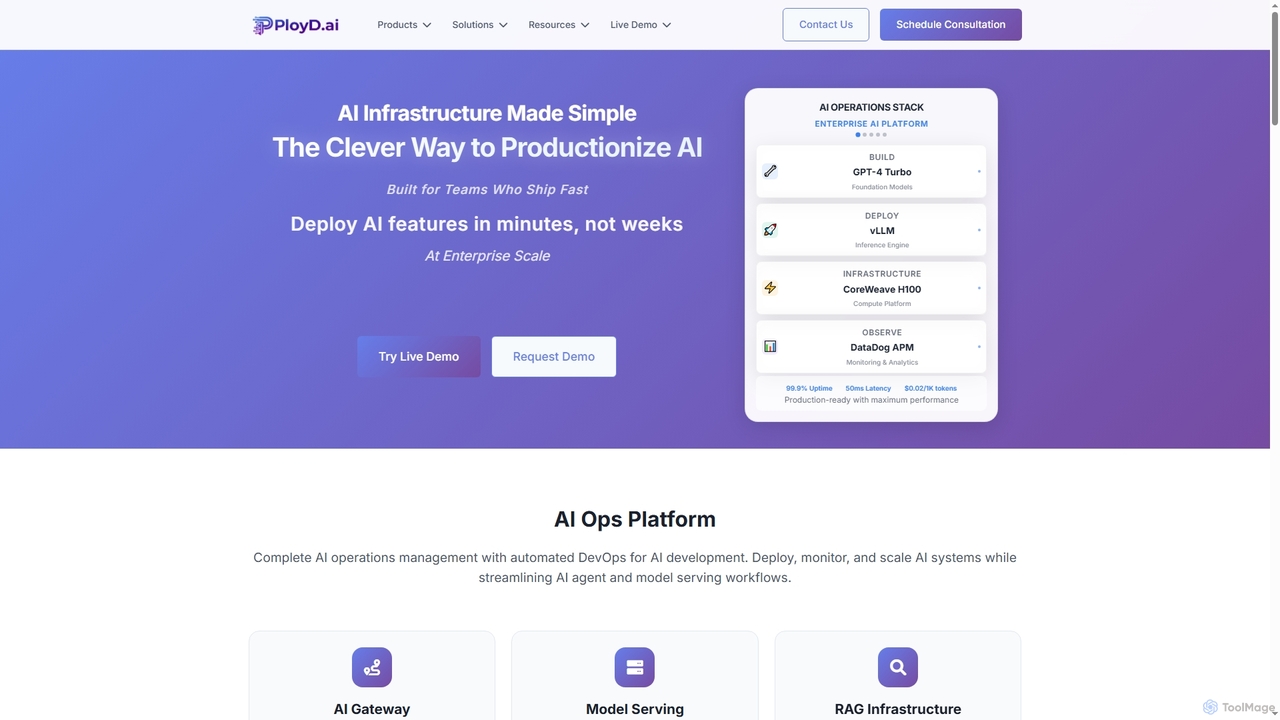
PloyD is an enterprise AI operations platform designed to streamline the productionization of AI models and applications. It tackles common challenges like developer velocity bottlenecks, infrastructure complexity, team efficiency, and security compliance, enabling organizations to deploy, manage, and scale AI solutions with confidence and speed.
About Infrastructure Management
Infrastructure Management tools for MLOps are specialized platforms for provisioning, scaling, and optimizing the computational resources required for machine learning lifecycles. These tools automate the management of hardware like GPUs and CPUs, whether on-premise or in the cloud, by orchestrating containerized environments. Their primary value lies in improving resource utilization, reducing cloud computing costs, and accelerating the experimentation-to-production pipeline for AI models. As the foundational layer of an MLOps stack, they provide the stable and scalable environment necessary for training, deploying, and managing models effectively.
Core Features
- Compute Resource Orchestration: Manages and schedules ML jobs across shared clusters of GPUs and CPUs to maximize utilization.
- Automated Environment Provisioning: Creates consistent and reproducible development and production environments using containers like Docker.
- Auto-Scaling Capabilities: Automatically adjusts the allocation of compute resources based on the real-time demands of training or inference workloads.
- Cost and Usage Monitoring: Provides detailed dashboards to track resource consumption, analyze spending, and identify opportunities for cost optimization.
- Hybrid and Multi-Cloud Support: Offers a unified interface to manage resources seamlessly across on-premise data centers and multiple cloud providers (e.g., AWS, GCP, Azure).
Use Cases
These tools are essential for MLOps engineers, DevOps teams supporting AI initiatives, and data science teams in organizations that run numerous or large-scale machine learning models. Common scenarios include managing a shared GPU cluster in a research institution to ensure fair access, automating the infrastructure for training large language models (LLMs), or optimizing cloud spend for a company's AI department.
How to Choose
When selecting an Infrastructure Management tool, consider its compatibility with your existing setup (on-premise, specific cloud, or hybrid). Evaluate its integration capabilities with other MLOps tools for experiment tracking and CI/CD. Assess its underlying technology, such as its reliance on Kubernetes, and consider the user experience for both data scientists and dedicated engineers. Finally, analyze its cost management features to ensure it aligns with your budget optimization goals.

Infrastructure ManagementUse Cases
Manage a Shared GPU Cluster for a Research Team
A university's AI research lab has a limited pool of high-end GPUs shared among dozens of students and researchers. An MLOps administrator uses an infrastructure management tool to create a fair scheduling system. The tool allows them to set resource quotas, prioritize critical jobs, and provide a simple interface for users to submit their training tasks. This prevents resource conflicts, maximizes the utilization of expensive hardware, and provides clear visibility into who is using which resources at any given time.
Automate Scalable Training Environments for a Startup
An AI startup needs to train a new computer vision model on a large dataset. Instead of manually configuring cloud instances, their MLOps engineer defines a training environment template in the infrastructure management tool. When a data scientist starts a training run, the tool automatically provisions a cluster of 10 GPU instances on AWS, installs all necessary dependencies from a Docker image, runs the job, and then terminates all instances upon completion. This automation saves hours of manual setup and reduces cloud costs by ensuring resources are only active when needed.
Optimize Cloud Costs for Large-Scale Model Training
A large enterprise's monthly cloud bill for AI model training is excessively high. An MLOps team implements an infrastructure management tool to gain control. The tool's dashboard reveals that many powerful GPU instances are left idle overnight. They configure policies to automatically shut down or hibernate idle workspaces. Furthermore, the tool helps them leverage cheaper spot instances for non-critical training jobs by automatically handling interruptions and resumptions. Within three months, they reduce their cloud compute spending by over 30% without impacting team productivity.
Provision Consistent Development Environments
A data science team frequently encounters the "it works on my machine" problem, where code fails in production because of differing local environments. Using an infrastructure management tool, the team lead defines a standard, containerized development environment with specific versions of Python, CUDA, and key libraries. Now, every data scientist can launch an identical, pre-configured workspace with a single click, either locally or in the cloud. This ensures reproducibility, simplifies onboarding for new team members, and eliminates environment-related bugs during deployment.
Manage Hybrid Cloud Workloads for Data Sovereignty
A financial institution must train models on sensitive customer data that cannot leave their on-premise data center. However, they want to use the public cloud for less sensitive tasks like pre-training on public datasets. They use a hybrid-cloud infrastructure management tool that provides a single pane of glass to manage both their on-premise Kubernetes cluster and their GCP account. This allows them to seamlessly schedule jobs to the appropriate environment based on data security policies, while data scientists have a unified experience regardless of where the computation happens.
Ensure High Availability for Production Inference Services
A retail company deploys a real-time recommendation engine as a microservice on Kubernetes. Their infrastructure management tool is configured to monitor this production service. It automatically scales the number of inference pods based on incoming user traffic, ensuring low latency during peak shopping hours. If a pod becomes unresponsive, the system automatically detects the failure and replaces it with a healthy one, ensuring the service remains available to customers 24/7. This automated management is critical for maintaining a reliable, production-grade AI application.