
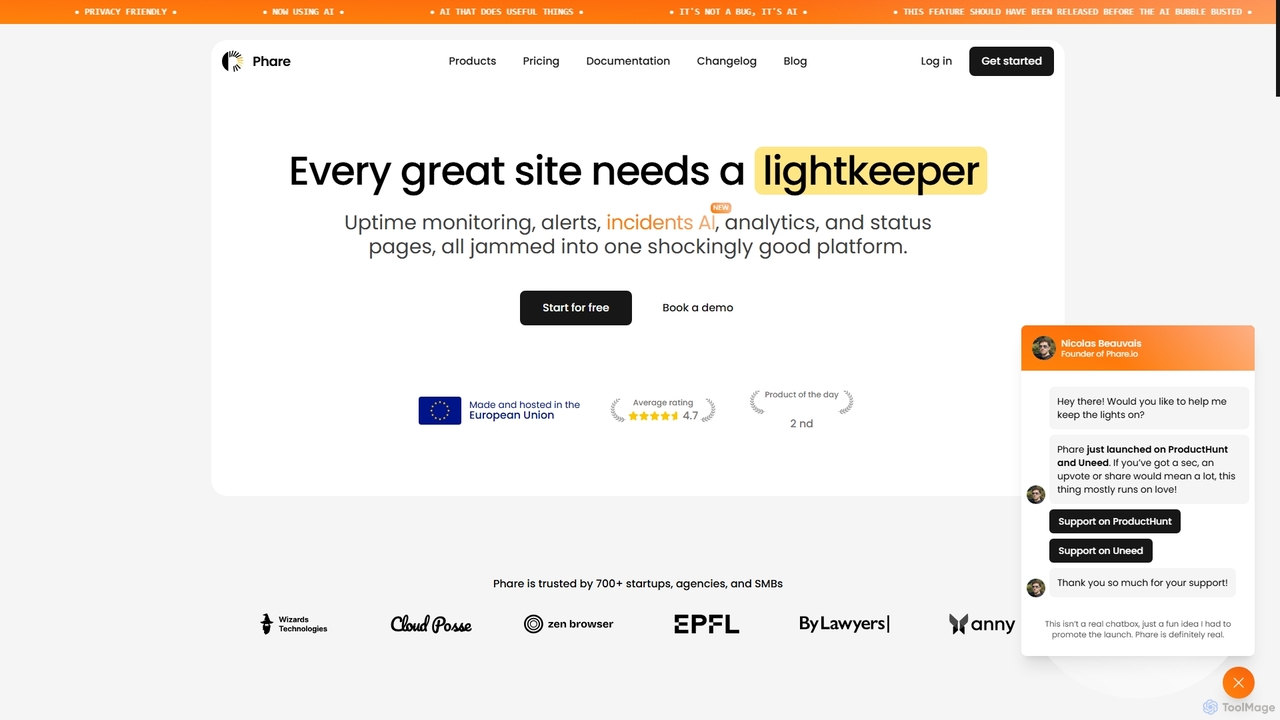
Phare
Phare is a comprehensive platform for website uptime monitoring, incident management, and custom status pages. It offers real-time …
Phare is a comprehensive platform for website uptime monitoring, incident management, and custom status pages. It offers real-time alerts, AI-powered incident summaries, and a flexible pricing model to ensure your online services run successfully and reliably.
About Uptime Monitoring
Uptime Monitoring tools are a specialized category within overall monitoring solutions, designed to continuously verify the availability and performance of websites, servers, applications, and network services. These tools proactively detect outages or performance issues, ensuring that critical digital assets remain accessible. By providing real-time alerts and detailed reports, Uptime Monitoring helps businesses minimize downtime and maintain service reliability.
Core Features
- Real-time Availability Checks: Continuously pings or requests services from various locations to confirm they are online and responsive.
- Multi-protocol Support: Monitors via HTTP/S, Ping, DNS, TCP ports, and other custom protocols to cover diverse service types.
- Instant Alerting: Notifies administrators via email, SMS, Slack, or webhooks immediately upon detecting downtime or performance degradation.
- Public Status Pages: Automatically updates and displays the current operational status of services to end-users, enhancing transparency.
- Performance Metrics: Tracks response times, load times, and other key performance indicators alongside availability to identify bottlenecks.
Use Cases
Organizations across various sectors rely on Uptime Monitoring to safeguard their digital presence. E-commerce platforms use it to ensure their online stores are always accessible, preventing lost sales. SaaS providers leverage these tools to guarantee service level agreements (SLAs) and maintain user trust. IT departments deploy them to monitor critical infrastructure like servers and databases, ensuring continuous operation.
How to Choose
When selecting an Uptime Monitoring solution, consider the breadth of monitoring protocols supported, the flexibility and reliability of its alerting system, and the granularity of its reporting capabilities. Evaluate the frequency of checks, the global distribution of monitoring locations, and the ease of integrating with existing incident management workflows. Scalability and pricing models based on the number of monitors or checks are also crucial factors.
Uptime MonitoringUse Cases
Ensuring E-commerce Website Availability
An e-commerce manager uses Uptime Monitoring to continuously check their online store's accessibility and response times. If the website goes down or slows significantly, the tool immediately sends alerts to the IT team, allowing them to resolve issues quickly and prevent revenue loss from missed sales opportunities, ensuring a seamless shopping experience for customers.
Maintaining SaaS Application Uptime
A SaaS company relies on Uptime Monitoring to guarantee its application's availability to global users, meeting strict Service Level Agreements (SLAs). The system monitors various endpoints and APIs, automatically updating a public status page and notifying engineers of any service interruptions, thus preserving customer trust and satisfaction by proactively addressing issues.
Monitoring Critical Server Infrastructure
An IT administrator deploys Uptime Monitoring to oversee the health and availability of core servers, databases, and network devices. The tool performs regular pings and port checks, alerting the admin to any server outages or unresponsive services, which is crucial for maintaining business continuity and data integrity across the entire IT environment.
Validating DNS and SSL Certificate Health
A webmaster utilizes Uptime Monitoring to track the expiration dates of SSL certificates and the correct resolution of DNS records. Automated alerts warn of impending certificate expirations or DNS propagation issues, preventing security warnings for users and ensuring uninterrupted website access, which is vital for maintaining trust and SEO rankings.
Tracking API Endpoint Performance
A development team integrates Uptime Monitoring to continuously test the availability and response times of their critical API endpoints. This helps identify performance bottlenecks or failures in microservices, ensuring that dependent applications function smoothly and providing a stable foundation for their ecosystem, crucial for maintaining service quality and developer experience.
Proactive Detection of Website Defacement
A security analyst configures Uptime Monitoring to not only check website availability but also to perform content checks for specific keywords or elements. If the website content is unexpectedly altered (e.g., defacement or unauthorized changes), the system triggers an alert, enabling rapid response to potential security breaches and protecting brand reputation.