Phare
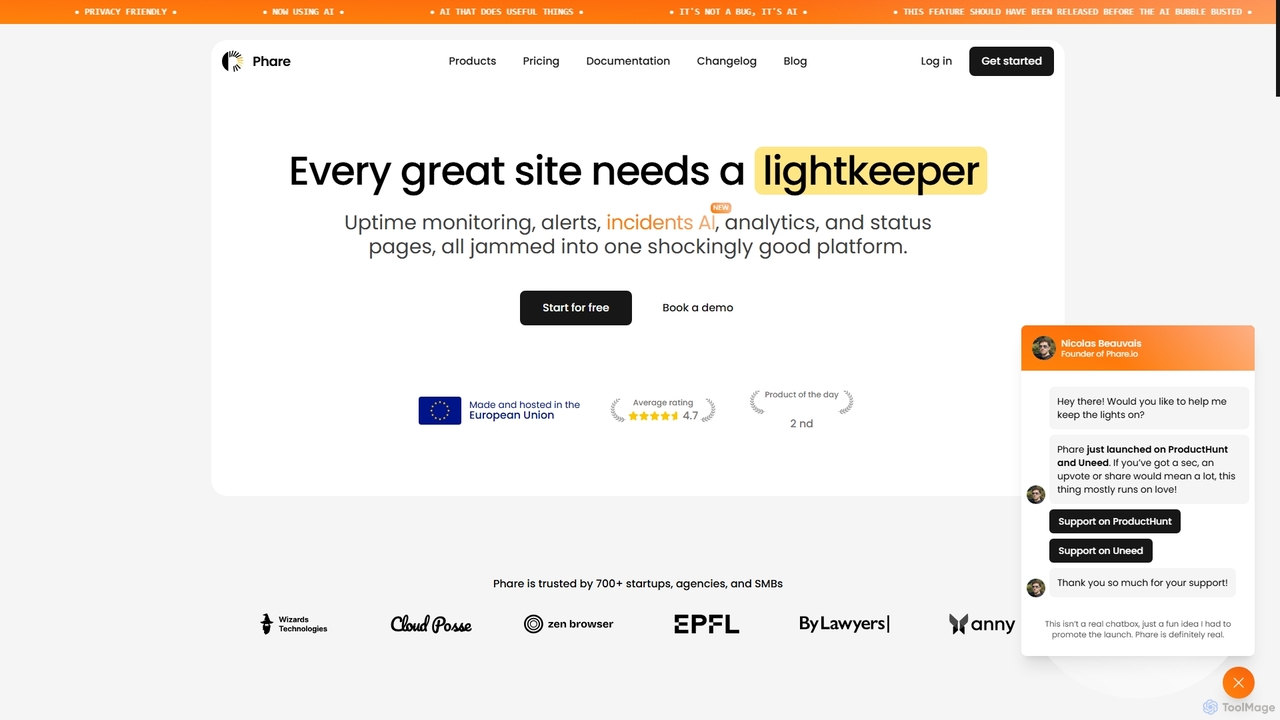
Phare is a comprehensive platform for website uptime monitoring, incident management, and custom status pages. It offers real-time …
Phare is a comprehensive platform for website uptime monitoring, incident management, and custom status pages. It offers real-time alerts, AI-powered incident summaries, and a flexible pricing model to ensure your online services run successfully and reliably.
About Api Monitoring
API Monitoring tools are specialized developer tools designed to continuously track the performance, availability, and correctness of Application Programming Interfaces. These tools employ real-time checks and synthetic transactions to identify issues like latency, errors, and downtime. By providing immediate insights and alerts, API monitoring ensures the reliability of critical services, prevents service disruptions, and maintains a seamless user experience for applications relying on APIs.
Core Features
- Uptime & Availability Monitoring: Continuously checks if APIs are accessible and responding, often from multiple global locations.
- Performance Metrics Tracking: Gathers data on response times, throughput, and latency to identify bottlenecks and degradation.
- Error Detection & Alerting: Automatically identifies API errors (e.g., 4xx, 5xx status codes) and sends immediate notifications to relevant teams.
- Synthetic Transaction Monitoring: Simulates user journeys or specific API call sequences to validate end-to-end functionality and performance.
- Payload & Response Validation: Verifies that API responses contain expected data and adhere to defined schemas.
Applicable Scenarios
API Monitoring is crucial for development teams managing microservices architectures, businesses relying on third-party APIs for core functionalities, and organizations needing to ensure the consistent performance of their public-facing APIs. It supports proactive issue resolution and maintains service level agreements (SLAs).
How to Choose
When selecting an API monitoring tool, consider the scope of monitoring (internal vs. external APIs), the types of checks offered (uptime, performance, synthetic), integration capabilities with existing CI/CD pipelines and alerting systems, the granularity of data and reporting, and the pricing model based on call volume or checks frequency. Evaluate its ability to provide actionable insights and support your team's incident response workflow.

Api MonitoringUse Cases
Ensuring Third-Party API Reliability for E-commerce
An e-commerce platform relies on various third-party APIs for payment processing, shipping, and inventory management. API monitoring tools continuously check the uptime and response times of these external services. If a payment gateway API experiences high latency or errors, the system immediately alerts the operations team, allowing them to switch to a backup provider or notify customers proactively, preventing lost sales and maintaining customer trust.
Monitoring Internal Microservices Performance
A large enterprise with a microservices architecture needs to ensure seamless communication between hundreds of internal APIs. Developers use API monitoring to track the performance and health of each service in real-time. This helps pinpoint bottlenecks, identify failing services before they impact the entire system, and optimize resource allocation, ensuring the smooth operation of complex distributed applications.
Validating API Changes in CI/CD Pipelines
During the continuous integration and continuous deployment (CI/CD) process, new API versions are frequently deployed. API monitoring tools are integrated into the pipeline to automatically run synthetic tests and validate the functionality and performance of updated APIs. This ensures that new deployments don't introduce regressions or performance degradations, catching issues early before they reach production.
Proactive Detection of API Security Vulnerabilities
Security teams utilize API monitoring to detect unusual traffic patterns, unauthorized access attempts, or unexpected API responses that might indicate a security breach or vulnerability. By setting up alerts for specific error codes, response sizes, or request volumes, they can identify and respond to potential threats in real-time, protecting sensitive data and maintaining compliance.
Optimizing API Performance for Mobile Applications
Mobile app developers depend on fast and reliable APIs to deliver a smooth user experience. API monitoring helps them track the latency and error rates of APIs specifically consumed by their mobile applications. By analyzing performance data from various geographic locations, they can identify regional issues, optimize API endpoints, and ensure that users worldwide experience consistent app responsiveness.
Verifying Service Level Agreements (SLAs) for API Providers
Companies offering APIs as a service need to guarantee specific uptime and performance levels to their clients, as outlined in SLAs. API monitoring tools provide objective, third-party verification of these metrics. The data collected can be used to generate reports, demonstrate compliance with SLAs, and proactively communicate with clients about any service interruptions or performance issues, building trust and transparency.