Developer Tools Best in category 1 results Agent Building AI Tool

Popular AI tools in the Agent Building field of Developer Tools include AgentLabs, etc., helping you quickly improve efficiency.

AgentLabs

AgentLabs

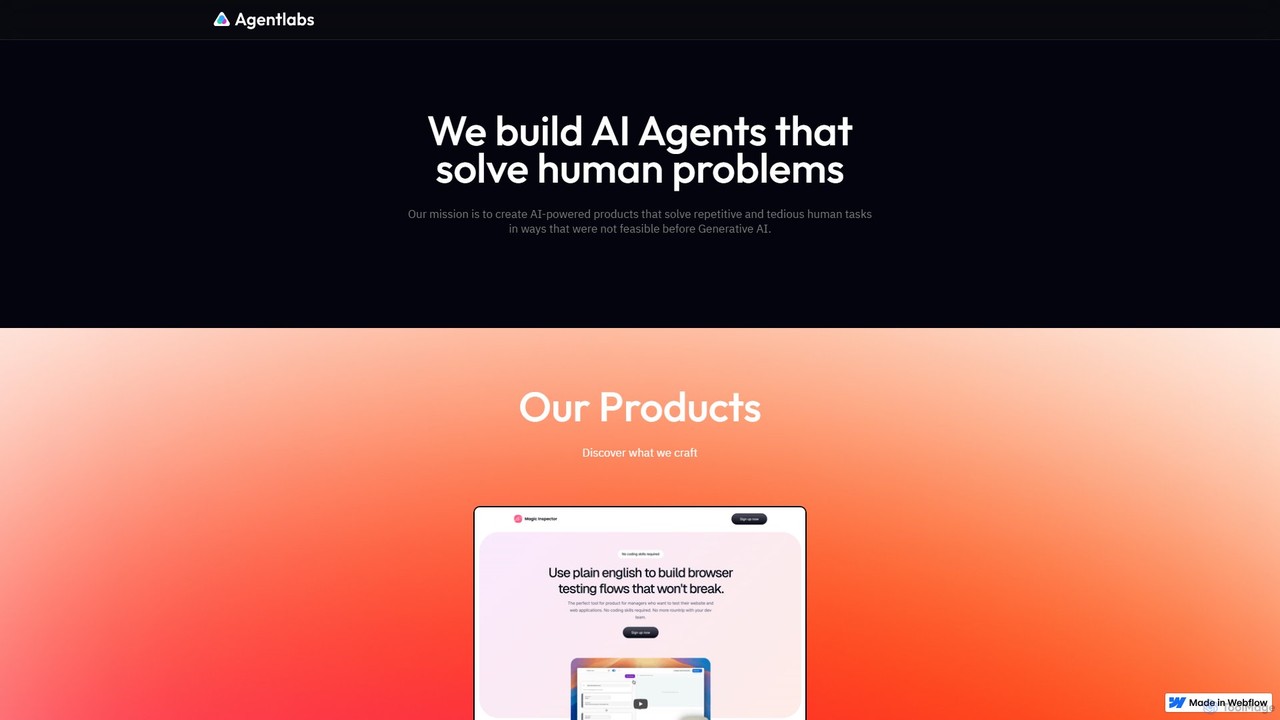
AgentLabs is a Frontend-as-a-Service (FaaS) platform for developers, enabling the rapid creation and deployment of professional, user-facing interfaces …

3.2K

About Agent Building

Agent Building tools are a specialized category of AI-powered platforms designed for the creation, deployment, and management of autonomous AI agents. These tools provide comprehensive frameworks and environments that enable developers to construct intelligent entities capable of perceiving their environment, reasoning, planning, and executing complex, multi-step tasks to achieve specific goals. Leveraging advanced AI models like large language models (LLMs), they facilitate the development of sophisticated software that can operate with a high degree of independence, adaptability, and proactive problem-solving capabilities within dynamic digital ecosystems.

Core Features

  • Agent Orchestration: Define and manage the flow, interaction, and collaboration between multiple sub-agents or modules to achieve overarching objectives.
  • Reasoning & Planning: Enable agents to understand high-level goals, break them down into actionable sub-tasks, and plan optimal sequences of actions.
  • Memory Management: Implement systems for agents to store and retrieve past experiences, learned knowledge, and contextual information for improved decision-making over time.
  • Tool Integration: Provide robust frameworks to allow agents to seamlessly utilize external APIs, databases, web services, and other software tools to perform tasks.
  • Monitoring & Debugging: Offer comprehensive features to track agent performance, identify errors, analyze behavior patterns, and refine agent logic and prompts.

Applicable Scenarios

Developers and AI engineers utilize Agent Building tools to construct intelligent systems that automate complex, multi-stage workflows, enhance strategic decision-making, and provide highly personalized and dynamic interactions. These tools are crucial for creating advanced AI assistants that can autonomously perform research, manage intricate projects, generate creative content, or interact dynamically with users and other software systems in a goal-oriented manner.

How to Choose

When selecting Agent Building tools, consider the inherent complexity of the autonomous agents you intend to build, the required level of decision-making autonomy, and the ease of integrating with your existing external tools and diverse data sources. Evaluate the sophistication of available reasoning and planning capabilities, the flexibility of memory management features, and the robustness of monitoring, debugging, and prompt engineering functionalities. Additionally, assess the platform's scalability, community support, and the learning curve for your development team.

Agent BuildingUse Cases

1

Automated Research Assistant Development

AI researchers or data scientists can use Agent Building tools to create autonomous research agents. These agents can be tasked with continuously monitoring academic papers, synthesizing information from various sources, identifying emerging trends in specific fields, and generating summarized reports or even drafting preliminary research proposals, significantly accelerating the literature review and ideation phases of research projects.

2

Dynamic Customer Support Agents

Businesses can leverage Agent Building platforms to develop sophisticated customer support agents that go beyond simple FAQ chatbots. These agents can understand complex customer queries, access multiple internal knowledge bases and CRM systems, diagnose issues, offer personalized solutions, and even initiate follow-up actions like scheduling appointments or processing returns, providing a more proactive and comprehensive support experience.

3

Personalized Learning & Tutoring Agents

Educators and e-learning platforms can build intelligent tutoring agents tailored to individual student needs. These agents can assess a student's learning style and progress, adapt teaching materials, provide personalized explanations, generate practice problems, and offer targeted feedback, creating a highly adaptive and engaging learning environment that optimizes educational outcomes.

4

Complex Project Management & Task Automation

Project managers and team leads can deploy agents to automate multi-step project tasks and manage workflows. An agent could monitor project progress, identify bottlenecks, assign sub-tasks to team members, generate status reports, and even proactively suggest resource reallocations or schedule adjustments, ensuring projects stay on track and resources are optimally utilized.

5

Creative Content Generation & Iteration

Content creators and marketing teams can utilize Agent Building tools to develop agents capable of generating diverse creative content. An agent might take a brief, research relevant topics, draft blog posts, social media updates, or marketing copy, and then iterate on these drafts based on feedback, exploring different styles or tones, significantly boosting content production efficiency and creativity.

6

Autonomous Software Development Assistants

Software developers can create agents that act as intelligent coding assistants. These agents could understand high-level feature requests, break them down into coding tasks, generate code snippets, perform unit tests, identify bugs, and even suggest refactorings. This significantly streamlines the development lifecycle, allowing human developers to focus on architectural design and complex problem-solving.

Agent BuildingFrequently Asked Questions