Soaring Titan
Soaring Titan introduces Promethia, an advanced AI agent orchestration platform that assembles specialized AI teams to replicate human …
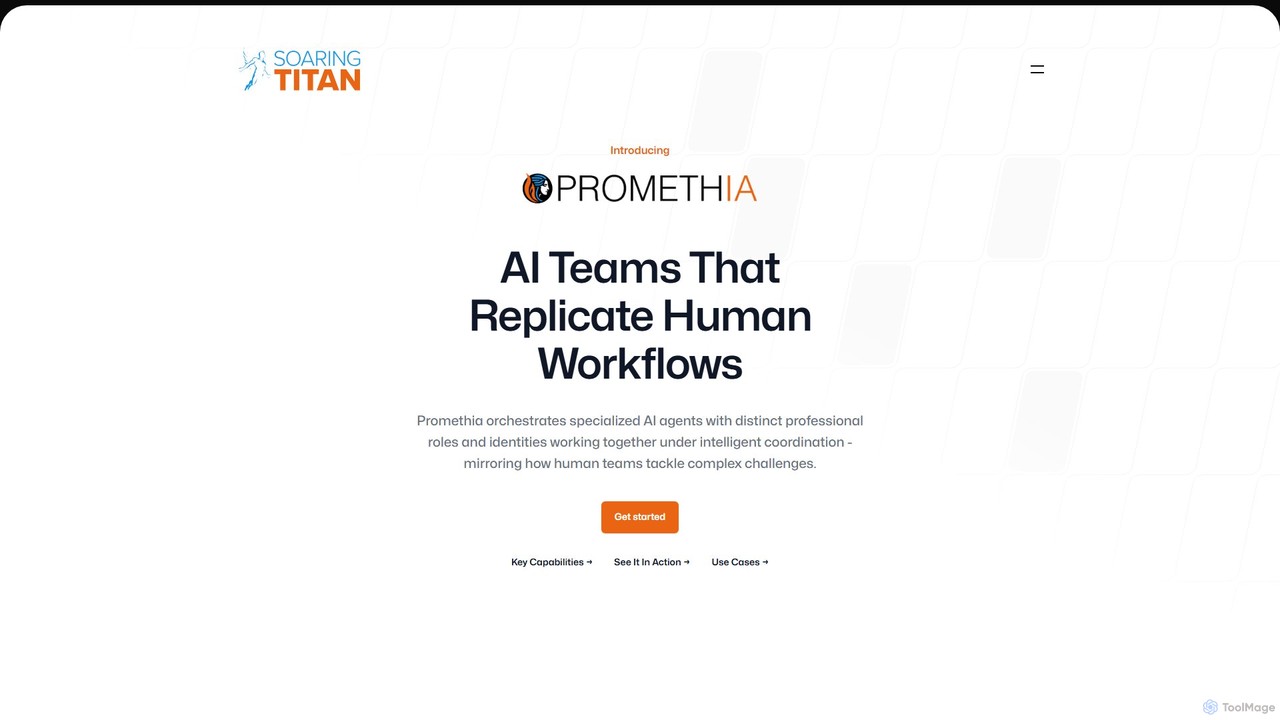
Soaring Titan introduces Promethia, an advanced AI agent orchestration platform that assembles specialized AI teams to replicate human workflows. It tackles complex business challenges by coordinating agents with distinct roles, using a sophisticated 6-layer architecture. This platform automates tasks like market research, strategic planning, and content creation, delivering polished, enterprise-ready documents instead of raw outputs. It's designed for businesses seeking to leverage collaborative AI for in-depth analysis and decision-making.
About Agent Framework
Agent Frameworks are specialized developer tools designed to build, manage, and orchestrate autonomous AI agents. These frameworks provide a structured environment and a set of pre-built components that enable developers to create intelligent systems capable of planning, reasoning, memory management, and tool utilization. They empower the development of sophisticated AI applications that can perform complex, multi-step tasks with minimal human intervention, making them invaluable for automating intricate workflows and creating highly adaptive intelligent systems.
Core Features
- Agent Orchestration: Manages the lifecycle, communication, and collaboration of multiple AI agents.
- Tool Integration: Allows agents to interact with external APIs, databases, and services to extend their capabilities.
- Memory Management: Provides mechanisms for agents to store and retrieve past interactions, observations, and learned knowledge.
- Planning & Reasoning: Equips agents with the ability to break down complex goals into actionable steps and adapt to dynamic environments.
- Human-in-the-Loop: Facilitates seamless human oversight and intervention when agents require clarification or approval.
Use Cases
Agent Frameworks are crucial for developers aiming to build advanced AI applications that go beyond simple prompt-response systems. They are particularly useful in scenarios requiring agents to maintain context, execute long-running processes, or interact with diverse external systems. These frameworks streamline the development of robust, scalable, and intelligent automation solutions across various industries.
How to Choose
When selecting an Agent Framework, consider its modularity and extensibility for future growth, the breadth of its tool integration ecosystem, and the level of community support available. Evaluate its capabilities for complex task planning, memory persistence, and ease of debugging. Additionally, assess the framework's performance characteristics and its compatibility with your existing technology stack to ensure seamless integration and efficient operation.

Agent FrameworkUse Cases
Automating Complex Business Workflows
Enterprise developers can leverage Agent Frameworks to automate multi-stage business processes, such as lead qualification, supply chain optimization, or financial reporting. An agent can autonomously gather data from CRM, ERP, and market intelligence systems, analyze information, make recommendations, and even initiate actions like sending personalized emails or updating records, significantly reducing manual effort and accelerating operational cycles.
Developing Intelligent Personal Assistants
Individual developers or startups can use Agent Frameworks to build highly personalized and proactive AI assistants. Unlike simple chatbots, these agents can learn user preferences, anticipate needs, manage schedules, book appointments, and even execute tasks across various applications (e.g., ordering groceries, managing smart home devices) by integrating with relevant APIs, offering a truly intelligent and adaptive user experience.
Building Adaptive Customer Service Bots
Customer service teams can deploy Agent Frameworks to create advanced support agents capable of handling complex inquiries beyond predefined scripts. An agent can access customer history, product databases, and troubleshooting guides, diagnose issues, provide step-by-step solutions, and escalate to human agents only when necessary, leading to faster resolution times and improved customer satisfaction.
Creating Autonomous Research Agents
Researchers and analysts can utilize Agent Frameworks to develop agents that autonomously conduct literature reviews, gather data from scientific databases, synthesize information, and even generate hypotheses. These agents can navigate vast amounts of information, identify patterns, and present structured insights, dramatically accelerating the research process in fields like medicine, material science, or market analysis.
Orchestrating Multi-Agent Collaboration
Teams working on complex projects can benefit from Agent Frameworks that enable multiple specialized AI agents to collaborate towards a common goal. For instance, in software development, one agent might handle code generation, another for testing, and a third for documentation, all coordinated by the framework. This distributed intelligence approach allows for more efficient problem-solving and parallel task execution.
Enabling Dynamic Data Analysis and Reporting
Data scientists and business intelligence professionals can employ Agent Frameworks to build agents that dynamically analyze streaming data, identify anomalies, and generate real-time reports. An agent can monitor various data sources, apply machine learning models, and automatically trigger alerts or create visualizations, providing timely insights for critical decision-making in areas like fraud detection, network security, or market trend analysis.