Developer Tools Best in category 1 results Agentic Development AI Tool

Popular AI tools in the Agentic Development field of Developer Tools include usebrainbase, etc., helping you quickly improve efficiency.

usebrainbase

usebrainbase

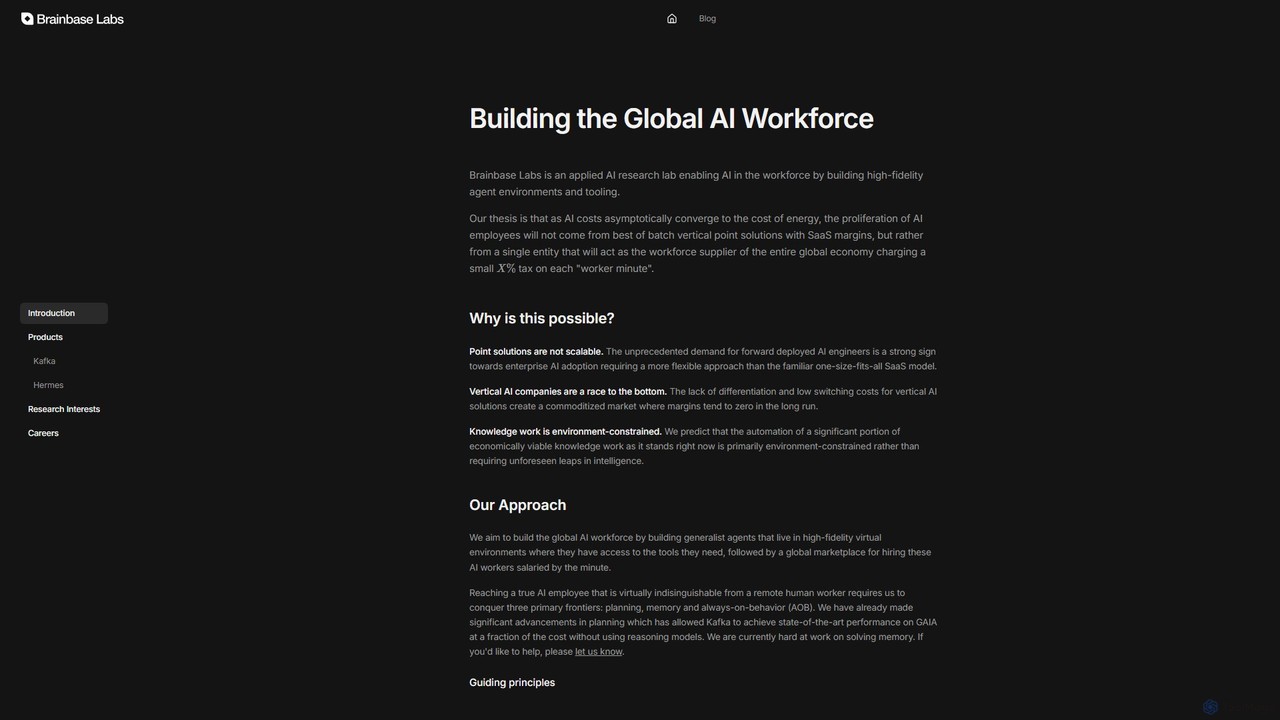
Brainbase Labs is an AI research lab developing a global AI workforce. Its flagship products include Kafka, an …

8.0K

About Agentic Development

Agentic Development refers to AI-powered tools that enable the creation of autonomous systems capable of planning, executing, and adapting complex tasks without constant human intervention. These tools leverage advanced AI models and orchestration frameworks to empower developers to build intelligent agents that can interact with various environments and achieve high-level goals. By automating multi-step processes and decision-making, Agentic Development significantly enhances the efficiency and sophistication of software solutions, pushing the boundaries of what AI can achieve in real-world applications.

Core Features

  • Autonomous Planning: Tools allow agents to break down complex goals into actionable sub-tasks and strategize execution paths.
  • Multi-step Execution: Agents can perform a sequence of operations, interacting with APIs, databases, and other tools to complete tasks.
  • Self-Correction & Adaptation: Systems can monitor their progress, identify errors, and adjust their plans or actions dynamically to overcome challenges.
  • Context & Memory Management: Agents maintain a persistent understanding of past interactions and current state to inform future decisions.
  • Tool Integration: Seamlessly connect with external tools, services, and data sources to extend agent capabilities.

Applicable Scenarios

Agentic Development is crucial for software engineers, data scientists, and researchers aiming to build highly autonomous and intelligent systems. It's applied in scenarios requiring complex decision-making, dynamic task execution, and interaction with diverse digital environments, such as automating intricate development workflows or creating adaptive data analysis pipelines.

How to Choose

When selecting Agentic Development tools, consider the level of autonomy required for your project, the ease of integrating with existing systems and APIs, the robustness of error handling and self-correction mechanisms, and the flexibility for custom agent behaviors. Evaluate the available frameworks for their community support, scalability, and the learning curve involved for your development team.

Agentic DevelopmentUse Cases

1

Automated Software Testing & Debugging

Software development teams can utilize agentic tools to autonomously generate test cases, execute complex test suites across various environments, and even identify and suggest fixes for bugs. This significantly reduces manual testing effort and accelerates the development cycle by providing continuous, intelligent feedback on code quality and functionality.

2

Intelligent Data Pipeline Orchestration

Data engineers and analysts can deploy AI agents to manage and optimize complex data ingestion, transformation, and loading (ETL) pipelines. Agents can dynamically adapt to schema changes, handle data quality issues, and re-route data flows based on real-time conditions, ensuring data integrity and availability without constant human oversight.

3

Personalized Learning Path Generation

Educational technology platforms can leverage agentic development to create AI tutors that dynamically generate personalized learning paths for students. These agents assess individual progress, identify knowledge gaps, and recommend tailored resources or exercises, adapting the curriculum in real-time to maximize learning outcomes.

4

Autonomous Research Assistant

Researchers in various fields can employ AI agents to conduct literature reviews, synthesize information from multiple sources, and even formulate hypotheses based on collected data. Agents can autonomously search databases, extract relevant findings, and present structured summaries, dramatically accelerating the initial stages of research projects.

5

Dynamic Customer Support Automation

Customer service departments can implement agentic systems that go beyond simple chatbots. These agents can autonomously diagnose complex customer issues, access multiple internal systems (CRM, knowledge base, order history), and even initiate resolution steps like issuing refunds or scheduling service appointments, providing a more comprehensive and proactive support experience.

6

Automated Cloud Resource Optimization

DevOps engineers can use agentic tools to build systems that autonomously monitor cloud infrastructure, identify underutilized resources, and dynamically scale services up or down based on real-time demand and cost-efficiency goals. This ensures optimal performance and cost management without continuous manual intervention.

Agentic DevelopmentFrequently Asked Questions