Natural Language Processing Best in category 1 results Business Analytics AI Tool

Popular AI tools in the Business Analytics field of Natural Language Processing include Claribi, etc., helping you quickly improve efficiency.

Claribi

Claribi

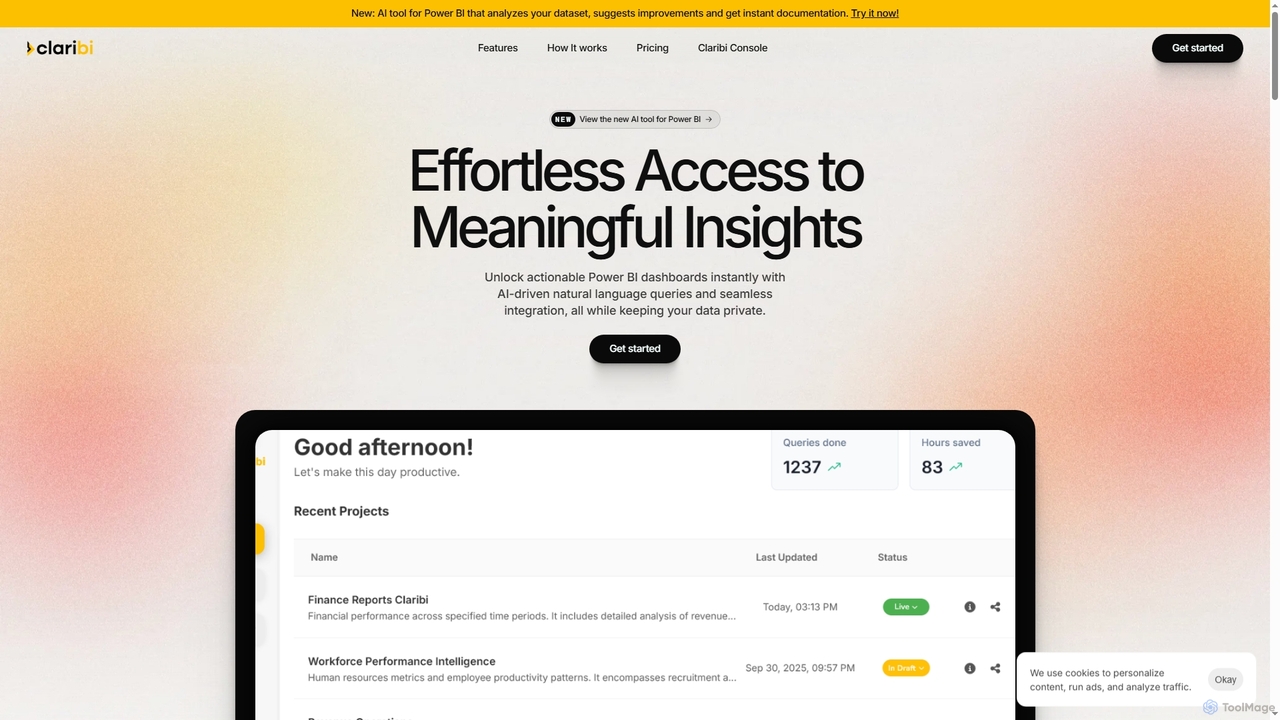
Claribi is an AI-powered tool that transforms Power BI usage by enabling natural language queries, automating documentation, and …

2.7K

About Business Analytics

Business Analytics tools are AI-powered solutions that leverage natural language processing (NLP) to extract actionable insights from vast amounts of unstructured and structured business data. These tools analyze text, speech, and numerical data to identify trends, predict outcomes, and inform strategic decision-making. By automating complex data interpretation, they empower organizations to gain a competitive edge and optimize operations, moving beyond traditional business intelligence to proactive, AI-driven insights.

Core Features

  • Sentiment Analysis: Automatically detects and quantifies emotional tone in text data from customer reviews, social media, and surveys.
  • Predictive Modeling from Text: Forecasts future trends and behaviors by analyzing patterns in textual data, such as market reports or news articles.
  • Automated Report Generation: Compiles and summarizes key findings from various data sources into comprehensive, easy-to-understand reports.
  • Customer Behavior Insights: Analyzes customer interactions, feedback, and purchasing patterns to understand preferences and predict churn.
  • Market Trend Identification: Scans vast datasets, including news, social media, and industry reports, to pinpoint emerging market opportunities and risks.

Applicable Scenarios

Business Analytics tools are indispensable for marketing teams analyzing campaign performance and customer sentiment, product managers identifying feature gaps from user feedback, and financial analysts predicting market shifts based on news and economic reports. They are also crucial for operations managers optimizing supply chains by analyzing logistical data and customer service departments improving satisfaction through feedback analysis.

How to Choose

When selecting Business Analytics tools, prioritize solutions with robust NLP capabilities for processing diverse text data. Evaluate their integration with existing CRM, ERP, and BI systems, as well as their scalability to handle growing data volumes. Consider the clarity of their visualization and reporting features, the accuracy of their predictive models, and the level of customization offered to fit specific business needs.

Business AnalyticsUse Cases

1

Analyzing Customer Feedback for Product Improvement

Product managers utilize Business Analytics tools to process thousands of customer reviews, support tickets, and social media comments. Leveraging NLP, these tools identify common pain points, emerging feature requests, and overall sentiment towards specific product aspects, enabling data-driven prioritization of development efforts and enhancing product roadmaps based on real user needs.

2

Predicting Market Trends from News and Reports

Financial analysts and market researchers employ Business Analytics tools to scan vast amounts of financial news, industry reports, and economic indicators. By applying NLP, these tools can detect subtle shifts in sentiment, identify emerging patterns, and correlate textual information with market data, providing early warnings of potential market movements or investment opportunities, thereby informing strategic financial decisions.

3

Optimizing Marketing Campaigns with Sentiment Analysis

Marketing teams leverage Business Analytics tools to monitor social media, online reviews, and campaign responses. Using NLP, these tools perform sentiment analysis on vast amounts of text data, identifying public perception of brands, products, and campaigns. This allows marketers to quickly adapt strategies, address negative feedback, and capitalize on positive trends, leading to more effective and targeted marketing efforts.

4

Enhancing Customer Service through Automated Feedback Analysis

Customer service departments deploy Business Analytics tools to automatically process customer inquiries, chat logs, and call transcripts. By applying NLP, these tools can categorize common issues, identify recurring problems, and even gauge customer frustration levels. This enables faster resolution times, proactive problem-solving, and the identification of areas for service improvement, ultimately boosting customer satisfaction and loyalty.

5

Identifying Operational Inefficiencies from Internal Communications

Operations managers can use Business Analytics tools to analyze internal communications, such as emails, meeting transcripts, and project management notes. With NLP, these tools can pinpoint bottlenecks, identify redundant processes, and uncover communication gaps that hinder productivity. This leads to data-driven process improvements, streamlined workflows, and a more efficient allocation of resources across the organization.

6

Automating Risk Assessment from Compliance Documents

Compliance officers and legal teams leverage Business Analytics tools to analyze vast libraries of regulatory documents, contracts, and internal policies. Using NLP, these tools can automatically identify potential compliance risks, highlight discrepancies, and extract key clauses or obligations. This significantly reduces manual review time, enhances accuracy in risk assessment, and ensures adherence to complex regulatory frameworks, minimizing legal exposure.

Business AnalyticsFrequently Asked Questions