ToolMage
Sign in

Best 1 Office Software

Popular Office Software include Xtractpdfai, helping you work more efficiently.

Xtractpdfai
Freemium

Xtractpdfai

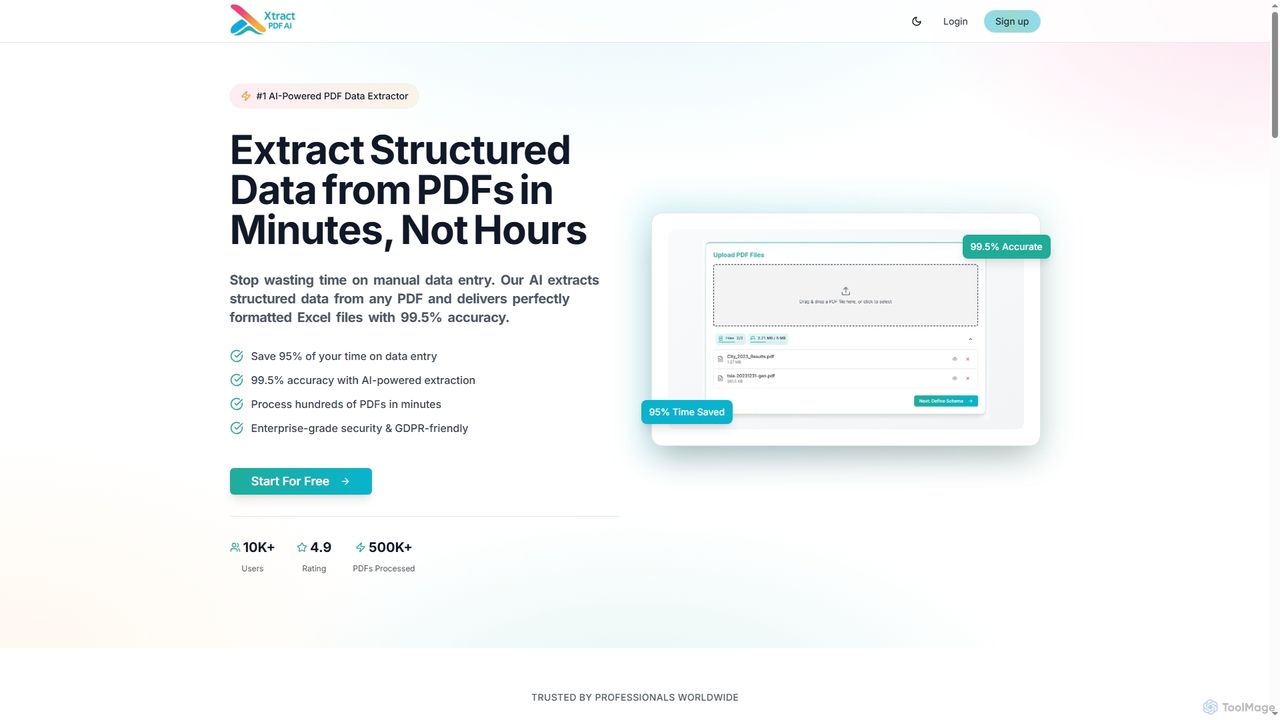
Xtractpdfai is an AI-powered tool designed to extract structured data from PDF documents and convert them into perfectly formatted Excel, CSV, or JSON files. It boasts 99.5% accuracy and significantly reduces manual data entry time, making document processing efficient and secure for professionals.

Data Automation
Visits 4.7KFavorites 111Likes 99

About Office Software

AI Office Software is a class of tools that uses artificial intelligence to automate, enhance, and streamline administrative and creative tasks. These tools integrate machine learning and large language models to assist with document drafting, data analysis in spreadsheets, presentation design, and email management. They significantly boost productivity by generating content, summarizing complex information, and providing intelligent suggestions for daily workflows. Unlike traditional office suites, AI-powered versions can understand context, predict user needs, and generate novel content, transforming tasks from manual execution to strategic supervision.

Core Features

  • Intelligent Document Generation: Automatically create reports, emails, and articles from simple text prompts.
  • Automated Data Analysis: Analyze spreadsheet data, identify trends, and generate formulas or charts using natural language commands.
  • AI-Powered Presentation Design: Instantly generate slides, layouts, and visuals based on a text outline or topic.
  • Smart Meeting Assistance: Provide real-time transcription, generate summaries, and identify action items from meetings.

Use Cases

AI Office Software is utilized across various industries by professionals such as project managers, marketing specialists, financial analysts, and administrative assistants. For instance, a marketing team can use it to draft campaign briefs and social media posts, while a financial analyst can interpret sales data in a spreadsheet by asking questions in plain language. It's also valuable for creating internal documentation and managing team communications.

How to Choose

When selecting AI Office Software, first consider its integration capabilities with your existing ecosystem, such as Microsoft 365 or Google Workspace. Evaluate the specific functionalities you need—whether a comprehensive suite or a specialized tool for presentations or data analysis. Also, review the provider's data security and privacy policies, especially for handling sensitive corporate information. Finally, assess the tool's collaboration features to ensure it supports your team's workflow.

Featured tool rankings

Office Software use cases

1

Automating Monthly Business Reports

A project manager needs to create a comprehensive monthly progress report for stakeholders. Instead of spending hours manually compiling data and writing summaries, they use an AI document editor. They input key performance indicators (KPIs), raw data from spreadsheets, and brief notes from team meetings. The AI tool automatically structures the report, generates concise summaries for each section, creates data visualizations like charts, and drafts an executive summary. This process reduces report creation time by over 70%, allowing the manager to focus on strategic analysis and planning rather than manual document formatting.

2

Creating a Sales Pitch Presentation in Minutes

A sales representative needs to quickly prepare a personalized presentation for a potential client. Using an AI presentation tool, they simply type in a prompt like, 'Create a 10-slide presentation on our CRM software for a small retail business.' The AI generates a complete slide deck, including a title slide, problem statement, solution overview, key features, pricing, and a call to action. It also suggests relevant icons and images and applies the company's branding. The representative can then make minor adjustments, saving several hours of design and content creation work and ensuring a professional, consistent look for every pitch.

3

Analyzing Customer Feedback in Spreadsheets

A product manager has a spreadsheet with hundreds of rows of raw customer feedback. To identify trends, they use an AI-powered spreadsheet tool. Instead of writing complex formulas, they ask in natural language, 'What are the top 5 most mentioned feature requests?' or 'Categorize feedback into bugs, feature requests, and positive comments.' The AI instantly analyzes the text, categorizes the data into new columns, and generates a summary pivot table or chart. This allows the product manager to quickly gain actionable insights from qualitative data without needing advanced data science skills, accelerating the product development cycle.

4

Generating Meeting Summaries and Action Items

An executive assistant manages a schedule packed with back-to-back meetings. They use an AI meeting assistant that integrates with their video conferencing tool. The AI records, transcribes, and identifies different speakers during the meeting. Immediately after the call ends, the tool automatically generates a concise summary highlighting key decisions, open questions, and action items with assigned owners and deadlines. This eliminates the need for manual note-taking and ensures that all participants have a clear, accurate record of the meeting's outcomes, improving accountability and follow-through on tasks.

5

Drafting and Personalizing Email Campaigns

A marketing coordinator is tasked with creating a follow-up email sequence for webinar attendees. Using an AI writing assistant within their email client, they provide a simple prompt: 'Write a 3-email sequence to thank attendees, share the recording, and offer a special discount.' The AI generates drafts for all three emails, maintaining a consistent tone. The coordinator can then use the AI to further personalize each email for different audience segments (e.g., 'make this more casual for attendees from startups') in seconds. This automates the bulk of the writing process, allowing for more sophisticated segmentation and personalization, which can lead to higher engagement rates.

6

Streamlining Internal Knowledge Base Creation

An HR specialist needs to create a comprehensive onboarding guide for new hires. They have scattered documents, policy notes, and FAQs. Using an AI-powered document tool, they can paste all the raw text into a single document. The AI helps by structuring the content with appropriate headings and subheadings, rewriting sections for clarity and consistent tone, and generating a table of contents. It can also identify frequently asked questions and automatically format them into a dedicated FAQ section. This transforms a time-consuming content organization task into a streamlined process, resulting in a professional and easy-to-navigate knowledge base in a fraction of the time.

Office Software FAQ

What is AI Office Software?

AI Office Software refers to a category of applications that use artificial intelligence to enhance traditional office productivity tasks. Unlike standard software that requires manual input for every action, these tools can generate text, design presentations, analyze data, and automate workflows based on natural language prompts. Key features often include content creation, data interpretation, meeting summarization, and intelligent task automation. They act as a proactive assistant, helping users complete work faster and with greater accuracy.

How to choose the right AI Office Software?

Choosing the right AI Office Software depends on your specific needs. Consider these factors:

  • Integration: Does it integrate smoothly with your current ecosystem (e.g., Google Workspace, Microsoft 365)? Seamless integration prevents workflow disruption.
  • Functionality: Identify your primary use case. Do you need a powerful document writer, a spreadsheet data analyst, or a presentation designer? Some tools are all-in-one suites, while others specialize.
  • Data Security: Verify the software's data privacy and security policies. This is crucial if you handle sensitive or confidential information.
  • User Interface (UI): The tool should be intuitive and easy to adopt for your team. A complex interface can negate productivity gains.
What's the difference between AI Office Software and traditional office suites?

The primary difference lies in their core functionality. Traditional office suites (like standard Microsoft Word or Google Docs) are passive tools that require users to manually perform every task, such as typing, formatting, and creating formulas. AI Office Software, in contrast, is an active partner. It can understand high-level commands, generate entire documents from a prompt, suggest content, analyze data without explicit formulas, and automate multi-step processes. Essentially, traditional software is a tool for execution, while AI software is a collaborator in creation and analysis.

What are the key functions of AI Office Software?

AI Office Software typically offers several key functions to boost productivity. The most common include:

  • Content Generation: Drafting emails, reports, articles, and other documents based on simple prompts.
  • Data Analysis & Visualization: Interpreting data in spreadsheets, identifying trends, and creating charts using natural language commands.
  • Presentation Creation: Automatically designing slides, including layouts, images, and text, from an outline.
  • Summarization: Condensing long documents, email threads, or meeting transcripts into concise summaries.
  • Task Automation: Automating repetitive tasks like data entry, scheduling, and generating follow-up communications.
Who can benefit from using AI Office Software?

A wide range of users can benefit from AI Office Software. This includes professionals in roles like marketing, sales, project management, and finance who can automate report generation and data analysis. Content creators and writers can accelerate their drafting and editing processes. Administrative staff can streamline scheduling and communication tasks. Students can use it for research, writing papers, and creating presentations. Essentially, anyone who performs knowledge-based work involving document creation, data handling, or communication can see significant productivity improvements.