Open Source Best in category 1 results Frameworks AI Tool

Popular AI tools in the Frameworks field of Open Source include Protocol Lattice, etc., helping you quickly improve efficiency.

Protocol Lattice

Protocol Lattice

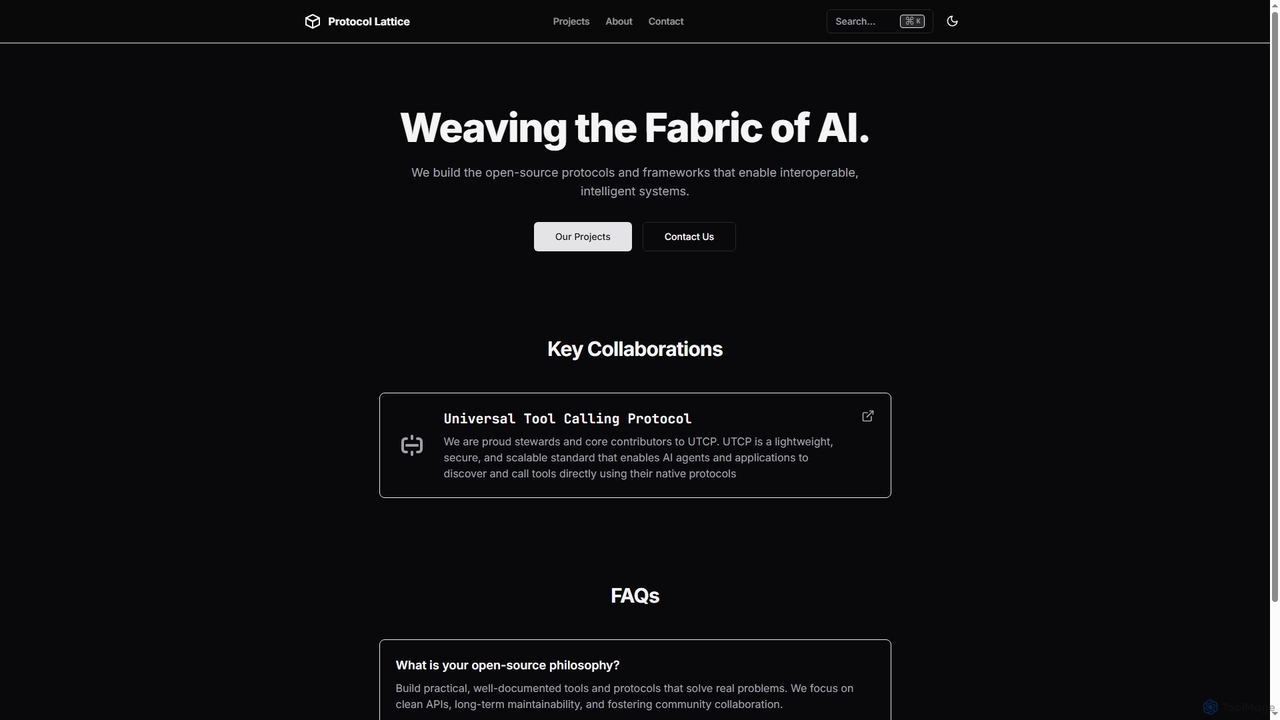
Protocol Lattice is an organization dedicated to building open-source protocols and frameworks that foster interoperable, intelligent AI systems. …

2.1K

About Frameworks

AI Frameworks are foundational software libraries that provide developers with the essential building blocks and structure to create, train, and deploy machine learning models. As a core component of the open-source AI ecosystem, they offer pre-written code for common operations, such as neural network layers and optimization algorithms, significantly accelerating the development process. This allows developers and researchers to focus on the unique logic of their models rather than building everything from scratch. Frameworks enable the creation of a wide range of applications, from complex computer vision systems to sophisticated natural language processing models.

Core Features

  • Modular Components: Provides pre-built and optimized layers, activation functions, and loss functions for rapid model construction.
  • Automatic Differentiation: Automatically calculates gradients, which is essential for training models using backpropagation.
  • Hardware Acceleration: Seamlessly integrates with GPUs and TPUs to dramatically speed up model training and inference.
  • Deployment Tools: Includes utilities for saving, loading, and serving models in production environments, including on mobile and edge devices.

Use Cases

AI Frameworks are primarily used by data scientists, machine learning engineers, and academic researchers. They are essential for tasks like developing custom computer vision algorithms, building unique natural language processing (NLP) models for sentiment analysis or translation, and conducting research into new neural network architectures.

How to Choose

When selecting an AI Framework, consider the ecosystem's maturity, including the availability of pre-trained models and community support. Also evaluate the learning curve—some frameworks offer high-level APIs for ease of use, while others provide low-level control for flexibility. Finally, check its compatibility with your target deployment platform, such as cloud servers, mobile devices, or web browsers.

FrameworksUse Cases

1

Building a Custom NLP Model for Sentiment Analysis

A data scientist at an e-commerce company needs to analyze thousands of customer reviews daily. Instead of using a generic API, they use an open-source framework like PyTorch or TensorFlow to build a custom sentiment analysis model. This allows them to train the model specifically on their product-related terminology and customer language nuances. By leveraging the framework's pre-built layers and training loops, they can develop and iterate on the model quickly, achieving over 95% accuracy on their specific dataset, leading to more precise business insights.

2

Developing a Computer Vision Application for Defect Detection

A manufacturing company wants to automate its quality control process. A machine learning engineer uses a framework like Keras with a TensorFlow backend to develop an image classification model that detects defects in products on the assembly line. The framework provides tools for data augmentation to expand their limited dataset of defective product images. After training, the model is deployed using the framework's serving utilities, allowing for real-time analysis and reducing manual inspection costs by up to 70%.

3

Academic Research into Novel Neural Network Architectures

A university researcher is exploring a new type of neural network for more efficient language translation. They use a flexible, low-level framework like PyTorch to implement their custom architecture from scratch. The framework's dynamic computation graph is ideal for experimentation, allowing them to easily modify the model's structure during runtime. This flexibility is crucial for research and development, enabling them to test hypotheses quickly and publish novel findings that would be difficult to achieve with more restrictive, high-level tools.

4

Creating a Generative AI Application with a Private Knowledge Base

A developer is tasked with building an internal chatbot for a large corporation that can answer questions based on private company documents. They use an application framework like LangChain or LlamaIndex, which integrates with foundational models (like GPT-4) and vector databases. The framework simplifies the process of document loading, text splitting, embedding creation, and querying. This allows the developer to build a robust Retrieval-Augmented Generation (RAG) system in weeks instead of months, providing employees with accurate, context-aware answers from internal data sources.

5

Optimizing and Deploying Models on Edge Devices

An IoT startup is developing a smart camera that identifies objects locally without cloud connectivity. An ML engineer uses a framework like TensorFlow Lite or PyTorch Mobile to convert a pre-trained computer vision model into a lightweight format suitable for on-device inference. The framework provides tools for quantization, which reduces the model size and speeds up computation with minimal loss in accuracy. This enables the deployment of powerful AI capabilities directly onto resource-constrained hardware, ensuring low latency and data privacy.

6

Large-Scale Distributed Training for Enterprise Models

A large technology company is training a massive language model with billions of parameters. To handle the computational load, their ML engineering team uses a framework's distributed training capabilities, such as TensorFlow's `tf.distribute.Strategy` or PyTorch's `DistributedDataParallel`. This allows them to parallelize the training process across a cluster of hundreds of GPUs. The framework manages the complexities of data sharding, gradient synchronization, and model replication, enabling the team to train the model in days instead of months and push the boundaries of AI research and product development.

FrameworksFrequently Asked Questions