Ai Best in category 1 results Interoperability AI Tool

Popular AI tools in the Interoperability field of Ai include Protocol Lattice, etc., helping you quickly improve efficiency.

Protocol Lattice

Protocol Lattice

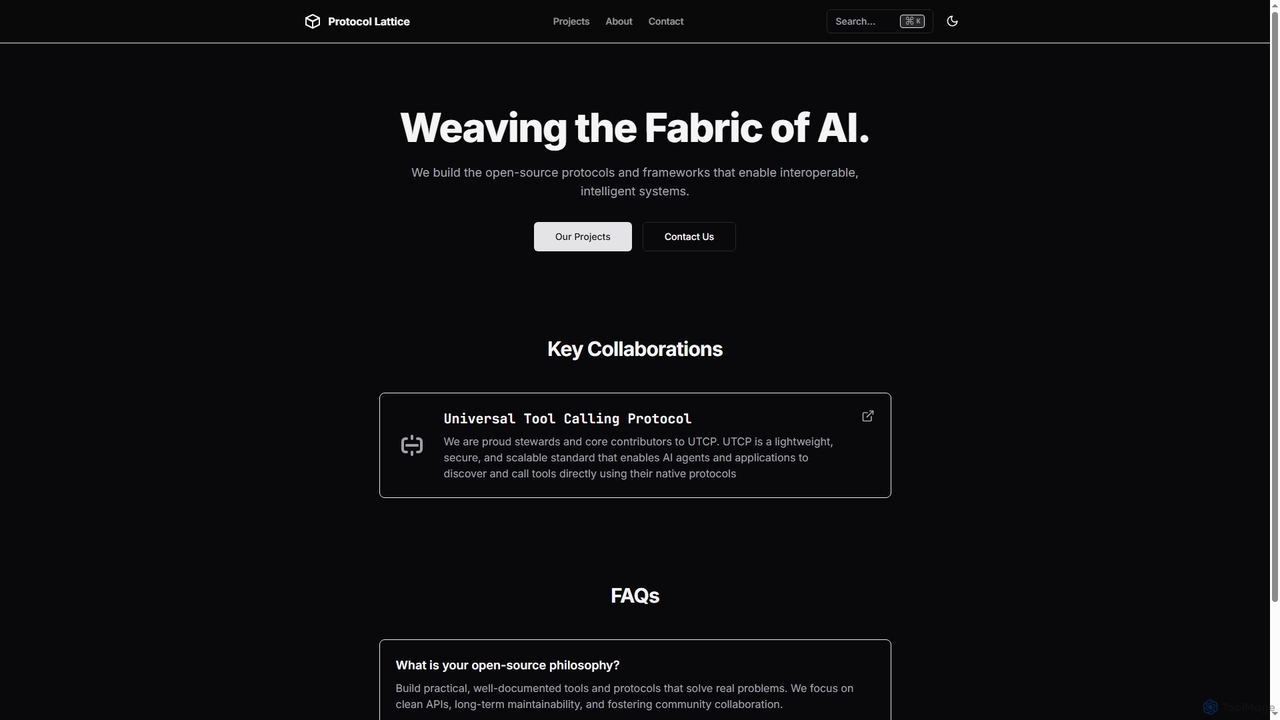
Protocol Lattice is an organization dedicated to building open-source protocols and frameworks that foster interoperable, intelligent AI systems. …

2.1K

About Interoperability

AI Interoperability tools are platforms designed to connect disparate AI systems, applications, and data sources, enabling them to communicate and work together seamlessly. These tools function as a middleware layer, using APIs, data mapping, and workflow automation to bridge compatibility gaps between different AI models and services. Their primary value lies in creating integrated, end-to-end automated solutions by combining the strengths of multiple specialized AI tools. This allows for the construction of complex, powerful workflows that a single, monolithic system could not achieve.

Core Features

  • API Integration & Orchestration: Connects to various AI services (LLMs, image recognition, etc.) and orchestrates complex sequences of API calls.
  • Data Transformation & Mapping: Converts data from one system's format to another, ensuring compatibility and seamless information flow.
  • Low-Code/No-Code Workflow Builder: Provides a visual interface for designing, building, and automating multi-step processes involving different AI tools.
  • Unified Monitoring & Logging: Offers a centralized dashboard to track the performance, errors, and data flow across all connected systems.
  • Conditional Logic & Branching: Enables the creation of intelligent workflows that can make decisions and change paths based on AI-generated outputs or predefined rules.

Use Cases

These tools are crucial for enterprises aiming to build composite AI applications. For instance, a developer can link a natural language processing (NLP) model for sentiment analysis with a customer relationship management (CRM) system and a notification service to automatically escalate negative feedback. They are also used by data engineers and IT architects to create robust data pipelines that integrate various AI-powered analytics and reporting tools, breaking down data silos.

How to Choose

When selecting an AI Interoperability tool, first evaluate its library of pre-built connectors for the specific AI services and platforms you use. Assess the sophistication of its data transformation capabilities and the flexibility of the workflow builder (e.g., support for custom code). Also, consider its scalability to handle high volumes of transactions, its security features for protecting data in transit, and whether its pricing model aligns with your expected usage patterns.

InteroperabilityUse Cases

1

Automating a Multi-AI Content Creation Pipeline

A marketing team needs to produce a high volume of content for different channels. They use an interoperability tool to create an automated workflow. The process starts when a new topic is added to a project management board. The tool triggers a text generation AI to write a draft article, then sends the text to a summarization AI to create social media captions. Simultaneously, it instructs an image generation AI to create relevant visuals based on the article's keywords. Finally, all assets are compiled into a draft post on their content management system for final review, reducing manual coordination by over 80%.

2

Integrating AI for Intelligent Customer Support Routing

A customer service department wants to improve response times for urgent issues. They deploy an interoperability platform to connect their email inbox, a sentiment analysis AI, and their ticketing system (e.g., Zendesk). When a new email arrives, the platform sends its content to the AI for analysis. If the AI detects a highly negative sentiment or keywords like 'urgent' or 'cancel', the platform automatically creates a high-priority ticket and assigns it to a senior support agent. This ensures critical issues are addressed immediately without manual triage.

3

Building a Composite AI for Financial Data Analysis

A financial analyst needs to combine market data, news sentiment, and internal company reports to generate investment insights. Using an interoperability tool, they build a workflow that pulls real-time stock data from an API, scrapes financial news headlines, and connects to an internal database. The tool then sends the news headlines to a sentiment analysis model and all structured data to a forecasting AI. The outputs from both AIs are then combined and formatted into a single, unified report, providing a comprehensive view that would otherwise require hours of manual data aggregation.

4

Orchestrating Smart Factory Operations

In a manufacturing plant, an operations manager uses an interoperability platform to connect IoT sensor data from machinery, a predictive maintenance AI model, and the inventory management system. The platform continuously feeds sensor data (e.g., temperature, vibration) to the AI model. If the model predicts a potential machine failure, the platform automatically triggers two actions: it creates a maintenance work order in the ERP system and simultaneously checks the inventory system for the required spare parts. This proactive approach minimizes downtime and streamlines maintenance logistics.

5

Streamlining HR Onboarding with Multiple AI Services

An HR department automates its new hire onboarding process. They use an interoperability tool to connect their HRIS (Human Resource Information System), an AI document analysis tool, and a chatbot. When a new employee is added to the HRIS, the tool triggers the workflow. It sends the employee's contract to the AI document tool to extract key information like start date and job title. This information is then used to personalize a welcome message delivered by the chatbot, which also answers the new hire's common questions. This creates a consistent and efficient onboarding experience.

6

Connecting Sales and Marketing AIs for Lead Nurturing

A B2B company wants to create a seamless lead nurturing process. They use an interoperability platform to link their CRM, a marketing automation platform, and an AI-powered lead scoring tool. When a new lead is captured on their website, it's sent to the AI tool for scoring based on demographic and behavioral data. The interoperability platform uses this score to trigger a specific action: high-scoring leads are instantly assigned to a sales representative in the CRM, while lower-scoring leads are enrolled in a targeted email nurturing sequence via the marketing automation platform. This ensures every lead receives the appropriate follow-up automatically.

InteroperabilityFrequently Asked Questions