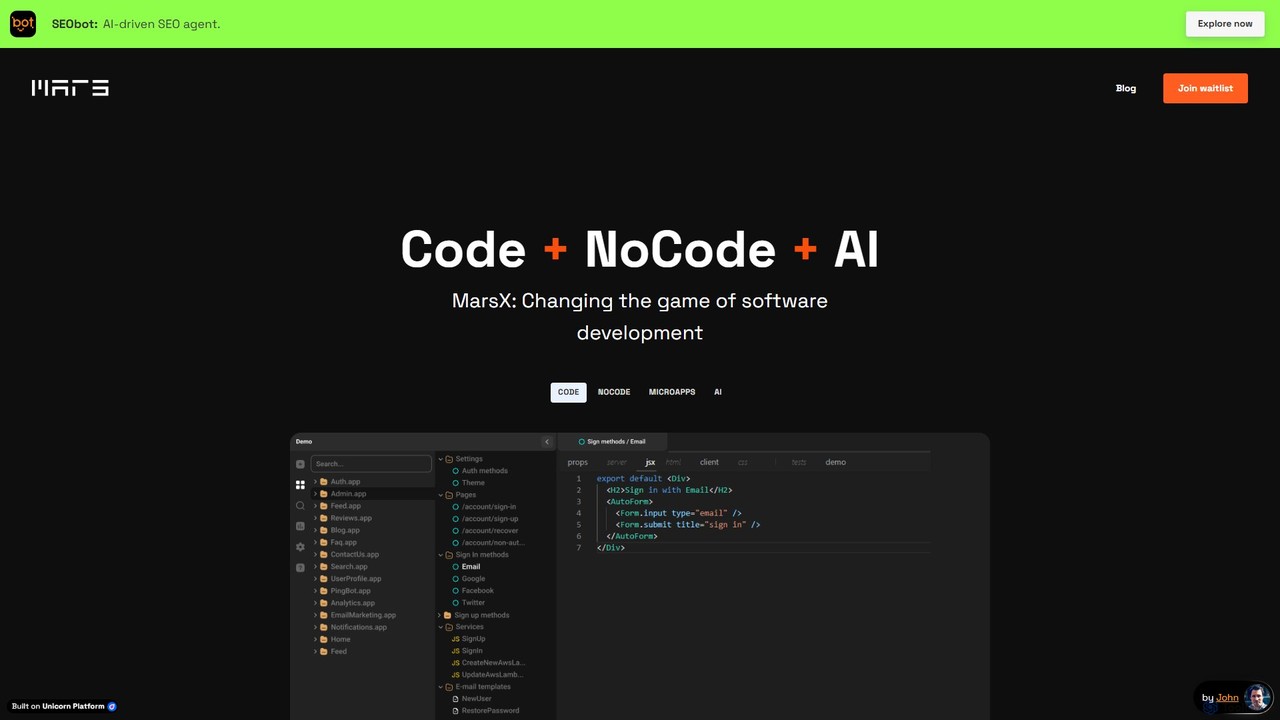
AI App Building refers to a category of tools designed to simplify and accelerate the creation of intelligent applications, often leveraging pre-built AI models and low-code/no-code interfaces. These platforms empower users, from citizen developers to seasoned engineers, to integrate sophisticated AI capabilities like natural language processing, computer vision, and predictive analytics into their software solutions. They significantly reduce the technical barriers and development time traditionally associated with deploying AI, enabling rapid prototyping and deployment of AI-powered features across various industries.
Core Features
- Pre-built AI Models: Access to a library of trained AI models for common tasks like sentiment analysis, object detection, or text generation.
- Visual Development Interfaces: Drag-and-drop builders and graphical workflows to design application logic and integrate AI components without extensive coding.
- Data Integration & Management: Tools to connect, prepare, and manage data sources for training custom models or feeding pre-trained ones.
- Deployment & Scaling: Capabilities for deploying AI applications to various environments (cloud, edge) and managing their performance and scalability.
- Monitoring & Retraining: Features to track AI model performance, identify drift, and facilitate continuous improvement through retraining.
Use Cases
These tools are invaluable for businesses and individuals looking to infuse intelligence into their operations without deep AI expertise. They are used by product managers to quickly prototype new AI features, by small businesses to automate customer interactions, and by developers to accelerate the integration of complex AI functionalities into larger systems. The focus is on democratizing AI development, making it accessible for a wider range of creators to build innovative, smart applications.
How to Choose
When selecting an AI App Building platform, consider its ease of use and whether it supports no-code or low-code development for your team's skill level. Evaluate the breadth and quality of its pre-built AI model library, ensuring it covers your specific application needs. Assess its integration capabilities with existing data sources and other software, as well as its scalability options for future growth. Finally, compare pricing models and the level of community support or documentation available.