Alter
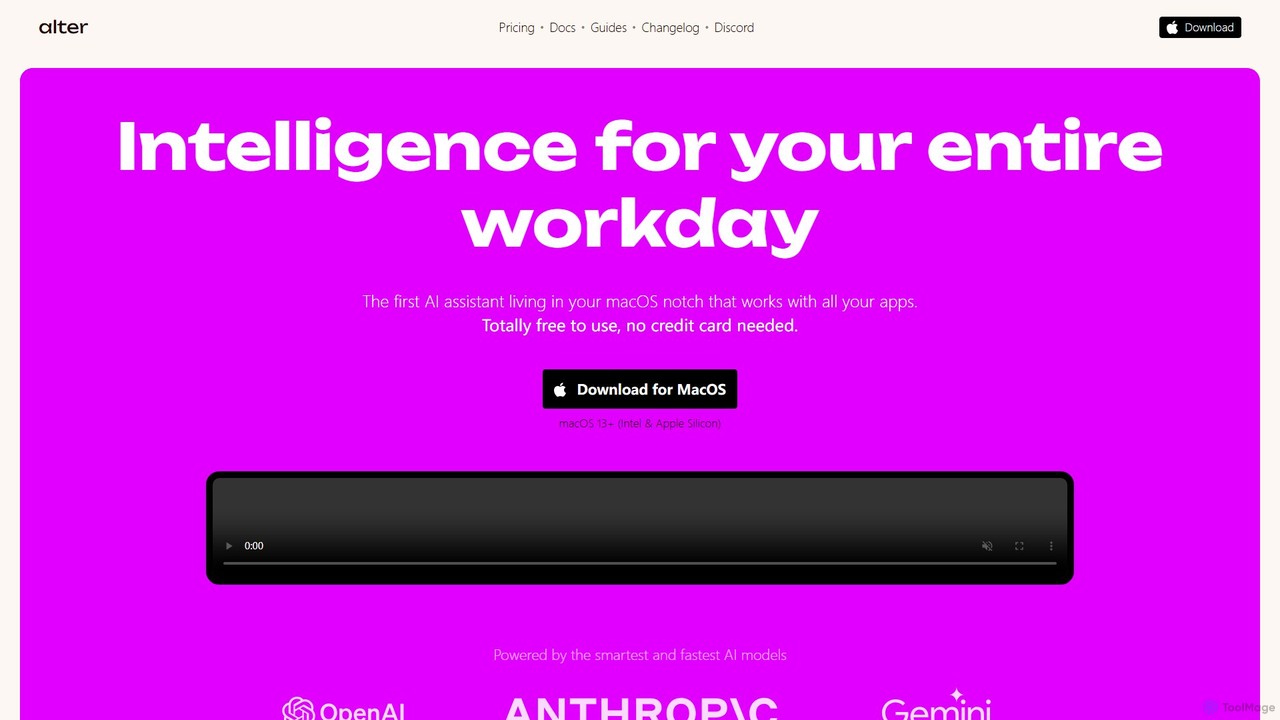
Alter is a native macOS AI assistant designed to streamline your entire workday. It's context-aware, understanding your apps, …
Alter is a native macOS AI assistant designed to streamline your entire workday. It's context-aware, understanding your apps, files, and browser activity to provide relevant assistance. With voice-first commands, meeting recording and summarization, and deep system integration, Alter turns your Mac into an AI powerhouse, boosting productivity while prioritizing privacy with local model support.

Apple
Apple integrates 'Apple Intelligence,' a personal intelligence system, across its ecosystem. It enhances user experience on iPhone, iPad, …
Apple integrates 'Apple Intelligence,' a personal intelligence system, across its ecosystem. It enhances user experience on iPhone, iPad, and Mac with powerful AI features like advanced Writing Tools, Image Playground, and a more capable Siri, all designed with a primary focus on privacy and seamless integration.
About Operating Systems
Operating Systems, in the context of AI, refer to sophisticated software frameworks or platforms that leverage artificial intelligence to manage, optimize, and automate complex digital environments, resources, and interactions. These AI-powered systems go beyond traditional operating functions by integrating machine learning, natural language processing, and predictive analytics to enhance performance, security, and user experience. They often act as a central intelligence layer, orchestrating various AI agents and applications to achieve seamless and intelligent operations across diverse computing landscapes.
Core Features
- Intelligent Resource Management: Dynamically allocates CPU, memory, and network resources based on real-time AI workload demands.
- Predictive Maintenance & Optimization: Uses AI to anticipate system failures, optimize performance, and automate routine maintenance tasks.
- Enhanced Security & Threat Detection: Employs machine learning for anomaly detection, proactive threat identification, and automated response mechanisms.
- Adaptive User Interfaces: Personalizes user experiences and automates interactions based on learned user behavior and preferences.
- AI Agent Orchestration: Manages and coordinates multiple AI agents and services, enabling complex workflow automation and inter-agent communication.
Use Cases
These AI-enhanced operating systems are crucial in environments requiring high levels of automation and intelligent decision-making. They are applied in smart infrastructure management, autonomous vehicle control systems, and large-scale data centers where dynamic resource allocation and predictive insights are paramount. Businesses also utilize them to create highly adaptive and secure enterprise computing environments.
How to Choose
When selecting an AI-powered operating system, consider its integration capabilities with existing infrastructure, the breadth of its AI features (e.g., ML, NLP, vision), scalability for future growth, and its security framework. Evaluate the level of automation offered, developer support, and compliance with industry standards to ensure it meets specific operational and strategic needs.
Operating SystemsUse Cases
Optimizing Data Center Resource Allocation
Data center administrators use AI-powered operating systems to dynamically allocate computing resources (CPU, GPU, memory) to various workloads based on real-time demand and predictive analytics. This ensures optimal performance for critical AI models and applications, reducing energy consumption by up to 30% and preventing resource bottlenecks.
Enhancing Cybersecurity Posture
Security teams deploy AI-integrated operating systems to continuously monitor system behavior, detect anomalies, and identify potential cyber threats in real-time. The AI learns normal patterns, flagging suspicious activities with high accuracy, and can automate responses like isolating compromised systems, significantly reducing incident response times.
Managing Autonomous Vehicle Software Stacks
Automotive engineers utilize AI-driven operating systems to manage the complex software stack of autonomous vehicles, from sensor data processing to navigation and decision-making. The OS intelligently prioritizes critical tasks, ensures real-time responsiveness, and adapts to changing road conditions, enhancing safety and operational efficiency.
Personalizing User Experiences in Smart Devices
Device manufacturers integrate AI operating system components to create highly personalized and adaptive user interfaces for smartphones, smart home hubs, and wearables. The AI learns user habits, anticipates needs, and automates routine tasks, providing a seamless and intuitive experience that improves user satisfaction and engagement.
Automating Industrial Control Systems
Industrial engineers implement AI-powered operating systems to automate and optimize complex manufacturing processes and robotic operations. The OS uses AI to monitor equipment health, predict maintenance needs, and dynamically adjust production parameters, leading to increased uptime, reduced operational costs, and improved product quality.
Orchestrating AI Agent Workflows
Developers and researchers leverage AI operating system frameworks to orchestrate complex workflows involving multiple specialized AI agents. The OS manages data flow, task scheduling, and inter-agent communication, enabling the creation of sophisticated AI applications that can perform multi-step reasoning, data analysis, and automated decision-making across various domains.