ToolMage
Sign in

Best 1 Organization AI tools

Popular Organization AI tools include Capacities, helping you work more efficiently.

Capacities
Freemium

Capacities

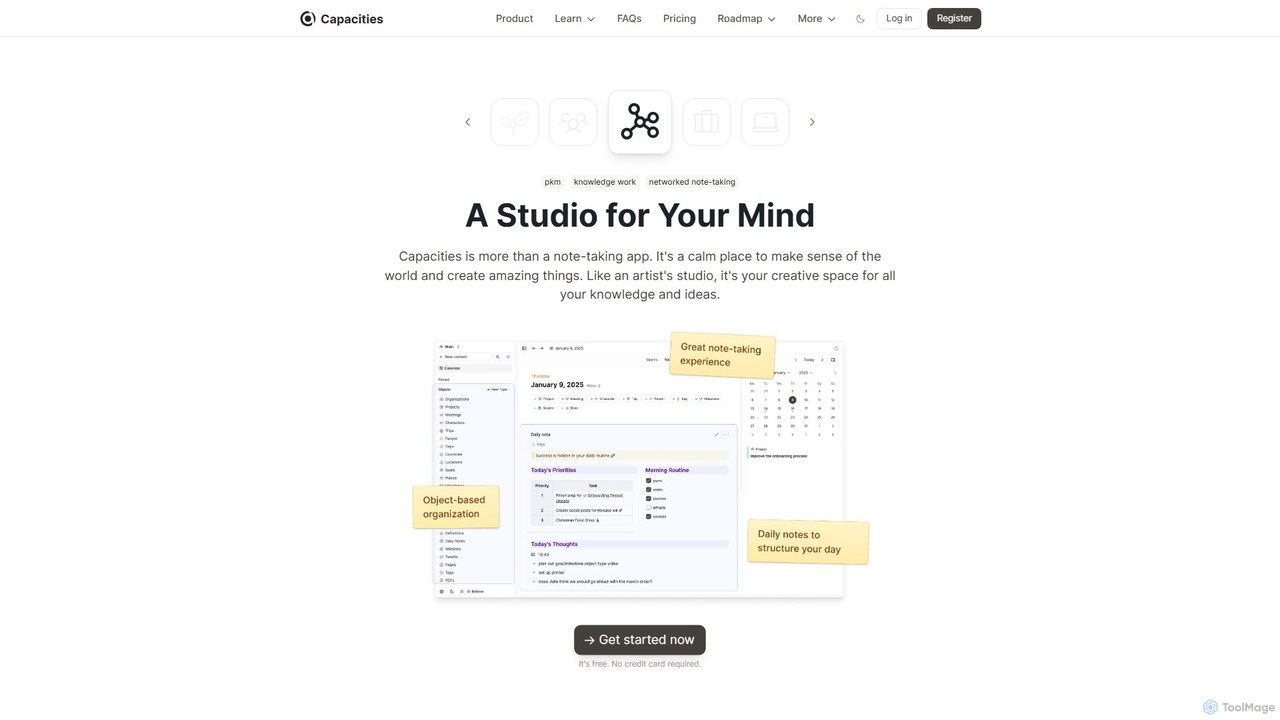
Capacities is a next-generation note-taking and knowledge management tool designed as a "studio for your mind." It replaces traditional folders with a flexible, object-based network, allowing you to connect ideas naturally. Features include an integrated AI assistant, powerful linking, custom content types, and cross-platform availability, making it ideal for building a personal knowledge base or "second brain."

Second Brain
Visits 473.2KFavorites 112Likes 135

About Organization

Organization AI tools are AI-powered solutions designed to streamline, automate, and enhance various aspects of business and personal management. Leveraging advanced machine learning, natural language processing, and predictive analytics, these tools transform how tasks are managed, workflows are optimized, and data is utilized. They provide intelligent assistance for everything from automating routine administrative duties and managing complex projects to optimizing resource allocation and improving strategic decision-making, ultimately boosting productivity and fostering a more efficient working environment.

Core Features

  • Automated Task Management: Intelligently assigns, tracks, and prioritizes tasks based on deadlines and dependencies.
  • Workflow Optimization: Analyzes existing processes to identify bottlenecks and suggest improvements for greater efficiency.
  • Intelligent Document Management: Categorizes, tags, and retrieves documents using AI, simplifying information access.
  • Predictive Scheduling: Forecasts optimal times for meetings and tasks, considering availability and project timelines.
  • Communication & Collaboration Enhancement: Facilitates smoother team interactions through smart summaries and content suggestions.

Applicable Scenarios

These tools are invaluable for businesses of all sizes, from startups to large enterprises, as well as individuals seeking to enhance personal productivity. They are widely adopted in project management for agile teams, human resources for automating recruitment and onboarding, marketing for campaign planning, and administrative roles for daily operational efficiency.

How to Choose

When selecting an AI organization tool, consider its integration capabilities with your existing software ecosystem, its scalability to grow with your needs, and the level of customization it offers to fit unique workflows. Evaluate its security features for data protection, user-friendliness for quick adoption, and the quality of its AI models for accuracy and reliability in task automation and insights.

Organization use cases

1

Automating Routine Administrative Tasks

Office managers and administrative assistants can utilize AI organization tools to automate repetitive tasks such as scheduling meetings, managing email responses, and processing expense reports. By integrating with calendars and communication platforms, the AI can suggest optimal meeting times, draft replies to common queries, and categorize financial documents, significantly reducing manual effort and freeing up time for more strategic initiatives.

2

Optimizing Project Management Workflows

Project managers and team leads can leverage AI tools to analyze project data, predict potential delays, and optimize resource allocation. The AI can automatically adjust timelines based on task dependencies and team availability, identify critical paths, and suggest reassignments to keep projects on track. This leads to more efficient project execution, reduced risks, and improved delivery times for complex projects.

3

Enhancing Internal Communication & Collaboration

Teams can use AI organization tools to improve communication flow and collaboration efficiency. Features like AI-powered meeting summaries, automated action item extraction, and intelligent content recommendations ensure that all team members are up-to-date and have access to relevant information. This fosters better decision-making, reduces miscommunication, and enhances overall team synergy, especially for distributed teams.

4

Streamlining HR & Onboarding Processes

HR professionals can deploy AI organization tools to automate various stages of the employee lifecycle, from recruitment to onboarding. The AI can screen resumes, schedule interviews, and personalize onboarding experiences by delivering relevant information and training modules. This reduces the administrative burden on HR staff, accelerates the hiring process, and ensures a smoother, more engaging start for new employees.

5

Intelligent Document Organization & Retrieval

Knowledge workers and legal professionals can use AI organization tools to automatically categorize, tag, and index vast amounts of digital documents. The AI employs natural language processing to understand document content, making it easy to search for specific information, identify related files, and ensure compliance. This drastically cuts down the time spent on document management and improves access to critical information.

6

Personalized Task & Time Management

Individuals and busy professionals can benefit from AI organization tools that offer personalized task prioritization and time management. The AI learns user habits and preferences, suggesting optimal times for focused work, scheduling breaks, and reminding about important deadlines. This helps users maintain focus, manage their workload effectively, and achieve a better work-life balance by intelligently structuring their day.

Organization FAQ

What are AI Organization tools?

AI Organization tools are software applications that utilize artificial intelligence to automate, optimize, and enhance various organizational tasks and processes. They leverage machine learning, natural language processing, and data analytics to provide intelligent assistance in areas like task management, workflow automation, resource allocation, and document handling. Their primary goal is to boost productivity, reduce manual effort, and improve decision-making within businesses and for individuals.

How do AI tools improve organizational efficiency?

AI tools improve organizational efficiency by automating repetitive and time-consuming tasks, thereby freeing up human resources for more complex and creative work. They optimize workflows by identifying inefficiencies and suggesting improvements, provide predictive insights for better planning, and enhance data management through intelligent categorization and retrieval. This leads to faster execution, reduced errors, better resource utilization, and overall streamlined operations across an organization.

What types of tasks can AI Organization tools automate?

AI Organization tools can automate a wide range of tasks, including but not limited to: scheduling meetings and appointments, managing email responses, processing expense reports, categorizing and tagging documents, generating meeting summaries, assigning and tracking project tasks, screening resumes in HR, and providing personalized reminders. Essentially, any repetitive, rule-based, or data-intensive task can be a candidate for AI automation, significantly reducing manual workload.

How to select the best AI Organization tool for my business?

To select the best AI Organization tool, first assess your specific organizational needs and pain points. Key factors to consider include: Integration: Does it seamlessly connect with your existing software (CRM, ERP, communication tools)? Scalability: Can it grow with your business? Customization: Does it allow tailoring to your unique workflows? Security: What data protection measures are in place? User Experience: Is it intuitive and easy for your team to adopt? Cost: Does it fit your budget while offering necessary features? A trial period can also be beneficial.

What are the main challenges when implementing AI for organization?

Implementing AI for organization can present several challenges. One major hurdle is data quality and availability, as AI models rely on vast amounts of clean, relevant data to function effectively. Another challenge is integration with existing legacy systems, which can be complex. Resistance to change from employees, ethical considerations regarding data privacy, and the need for skilled personnel to manage and maintain AI systems are also significant factors. Ensuring the AI aligns with specific business goals and provides measurable ROI is crucial for successful adoption.