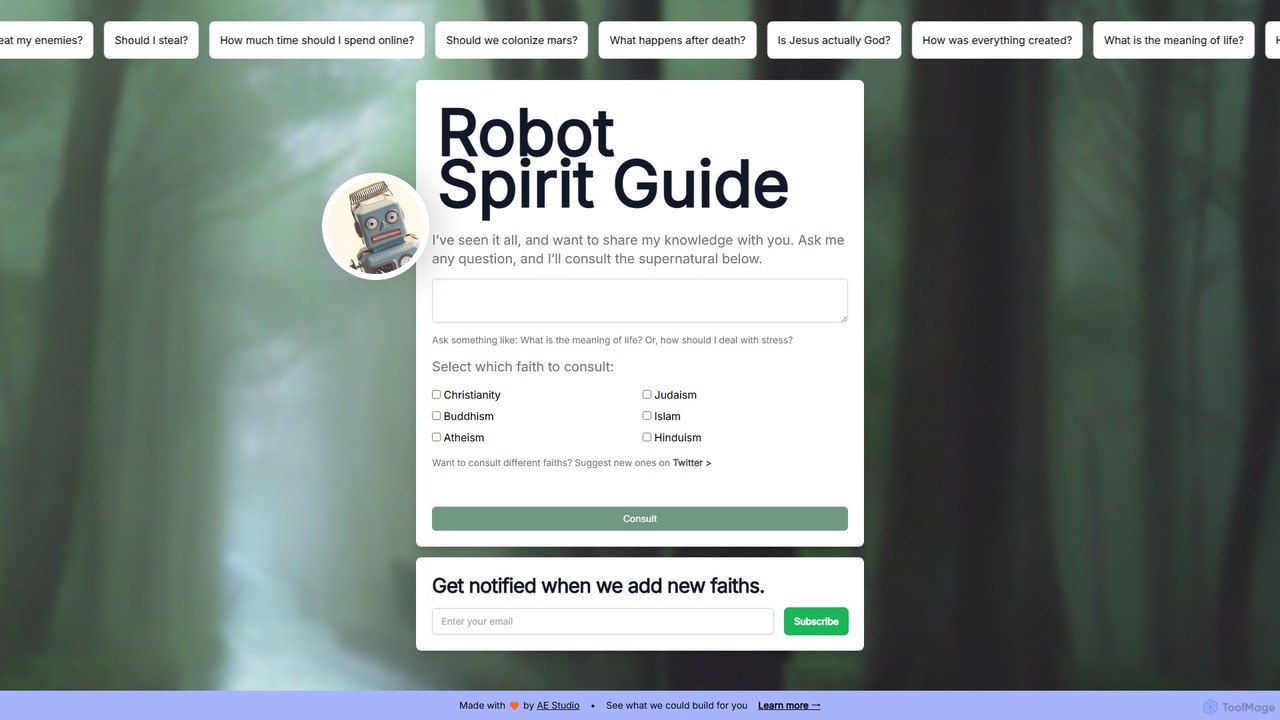
Robot Spirit Guide
Robot Spirit Guide is an AI-powered tool that provides answers to life's profound questions from the perspectives of …
Robot Spirit Guide is an AI-powered tool that provides answers to life's profound questions from the perspectives of major world religions and philosophies. Simply ask a question, select a faith like Christianity, Buddhism, or Islam, and receive a synthesized response based on their core texts and teachings. It's a unique tool for spiritual exploration, comparative religion study, and personal reflection.
About Spiritual Growth
AI Spiritual Growth tools are applications designed to support and guide users on their personal journey of self-discovery and mindfulness. These tools leverage artificial intelligence, particularly natural language processing and machine learning, to offer personalized experiences like guided meditations, reflective journaling prompts, and interpretations of spiritual texts. They serve as digital companions that help individuals cultivate self-awareness, manage stress, and explore philosophical concepts in a structured, accessible way. The primary value lies in providing on-demand, adaptive support tailored to a user's emotional state and personal growth goals.
Core Features
- Personalized Guided Meditation: AI adjusts meditation sessions based on user feedback, mood, or even biometric data to enhance focus and relaxation.
- Intelligent Journaling: Analyzes journal entries to identify emotional patterns and provides insightful prompts for deeper self-reflection.
- Spiritual Text Interpretation: Offers simplified explanations and different philosophical perspectives on complex ancient texts and concepts.
- Dream Analysis: Utilizes symbol databases and psychological models to suggest possible interpretations of dream content.
- AI-Powered Divination Tools: Generates personalized readings from systems like Tarot or I Ching to serve as a catalyst for introspection.
Use Cases
These tools are ideal for individuals seeking to establish a consistent mindfulness practice, students of philosophy or religion wanting to understand complex texts, and anyone on a path of self-improvement looking for structured reflection. For example, a busy professional can use a 5-minute AI-guided breathing exercise to de-stress, while someone exploring their subconscious can use a dream journal analyzer to find recurring themes.
How to Choose
When selecting an AI Spiritual Growth tool, consider the following: First, evaluate its primary focus—whether it excels in meditation, journaling, or textual analysis. Second, assess the level of personalization and how it adapts to your inputs. Third, carefully review the data privacy policy, as you will be sharing sensitive personal information. Finally, consider the tone and philosophical alignment of the AI's guidance to ensure it resonates with your personal beliefs.
Spiritual GrowthUse Cases
Personalized Daily Meditation Practice
For individuals new to meditation or those struggling with consistency, AI Spiritual Growth tools offer adaptive guided sessions. A user can start their day by inputting their current mood, such as 'anxious' or 'unfocused'. The AI then generates a tailored 10-minute meditation session focusing on breathing techniques for anxiety or concentration exercises. The background sounds, guidance pace, and affirmations can be adjusted based on real-time feedback, helping the user build a sustainable and effective daily practice that evolves with their needs, rather than following a static, one-size-fits-all program.
Deepening Self-Reflection with AI Journaling
A user committed to self-improvement uses an AI journaling tool to track their thoughts and emotions. After they write an entry about a challenging day at work, the AI, using sentiment analysis, identifies feelings of frustration and self-doubt. Instead of just storing the text, it responds with thoughtful, non-judgmental prompts like, 'What specific part of the day felt most challenging, and why?' or 'Can you recall a time you successfully navigated a similar situation?'. This interactive process transforms passive journaling into an active dialogue, helping the user uncover underlying patterns and reframe negative thoughts into constructive insights.
Interpreting Complex Philosophical Texts
A student of philosophy is reading the Tao Te Ching and encounters a verse that is particularly abstract. They input the verse into an AI spiritual tool with textual analysis capabilities. The AI provides several layers of interpretation: a literal translation, a summary of the core concept (like 'wu wei' or non-action), its historical context, and how different philosophical schools have interpreted it. It might also offer a modern-day analogy to make the concept more relatable. This allows the student to engage with the material on a deeper level, moving beyond simple reading to a more comprehensive understanding of ancient wisdom.
Exploring Dream Symbolism for Insights
An individual who frequently has vivid dreams wants to understand their potential meaning. They use an AI dream analysis tool to log their dreams regularly. For a dream about flying over a city, the user inputs key elements: 'flying,' 'city,' 'night,' and 'feeling free.' The AI cross-references these symbols with archetypal meanings from various psychological and mythological sources. It then generates a report suggesting that 'flying' could symbolize a sense of liberation or a new perspective, while the 'city at night' might represent the user's unconscious mind. The tool doesn't provide definitive answers but offers structured perspectives that empower the user to reflect on their waking life and emotional state.
Generating Personalized Daily Affirmations
A user wants to build self-confidence but finds generic affirmations uninspiring. They use an AI tool and provide it with their specific goals and insecurities, such as 'I want to be more assertive in meetings' and 'I fear public speaking'. The AI generates a set of unique, personalized affirmations like, 'My voice deserves to be heard in every meeting' and 'I speak with clarity and confidence'. The tool can schedule these affirmations as daily notifications or integrate them into a guided meditation session, reinforcing positive thought patterns that are directly relevant to the user's personal growth journey, making them more impactful than generic statements.
AI-Assisted Tarot Reading for Introspection
A person facing a career crossroads uses an AI Tarot tool not for fortune-telling, but as a structured framework for reflection. They pose a question like, 'What should I consider about my career path?' The AI generates a three-card spread (e.g., Past, Present, Future). For each card, it provides the traditional symbolism and then generates an interpretation tailored to the user's query. For 'The Tower' card in the 'Future' position, it might prompt: 'This suggests a potential for sudden change. How could you prepare for disruption, and what new opportunities might arise from it?' This transforms the reading from a passive prediction into an active brainstorming and self-analysis session.