Podmod
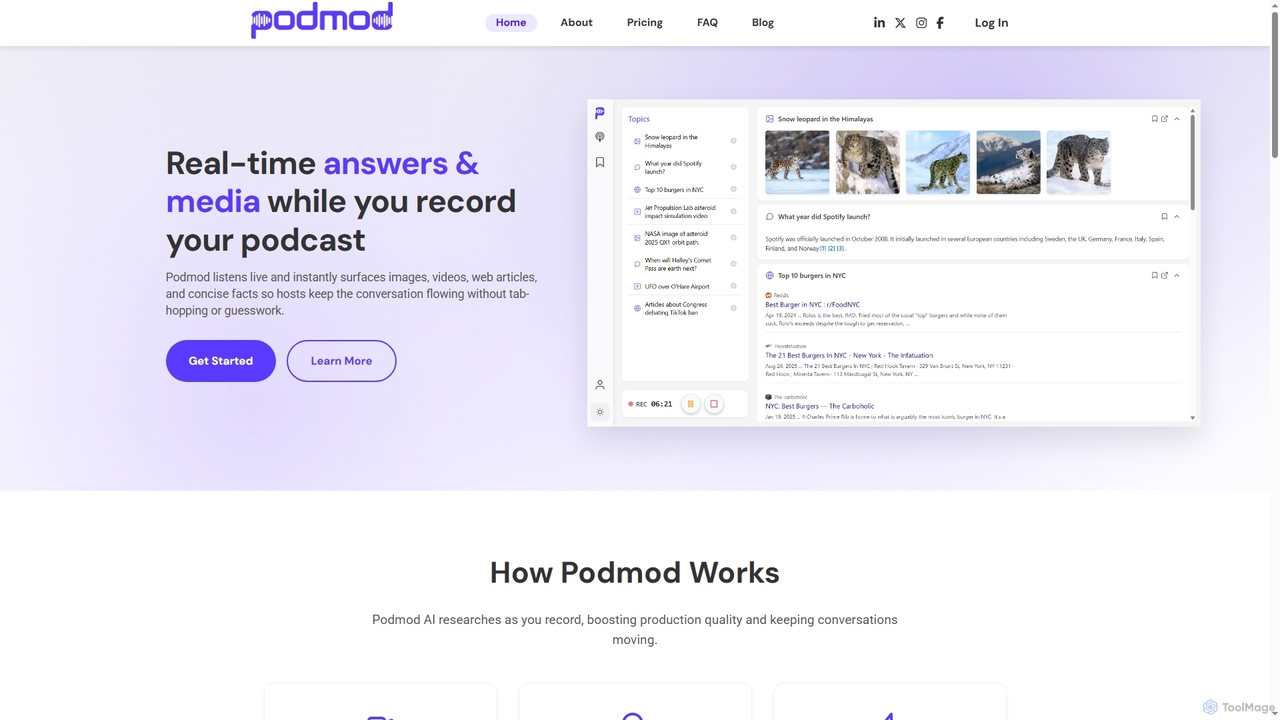
Podmod is an AI-powered podcast assistant that provides real-time research, fact-checking, and content retrieval during live recording sessions. …
Podmod is an AI-powered podcast assistant that provides real-time research, fact-checking, and content retrieval during live recording sessions. It helps podcasters lead conversations with confidence, surfacing context, sources, media, and on-the-spot answers without breaking the flow. Podmod also automates show notes generation and offers full transcripts, streamlining the entire podcast production workflow.
About Podcast Production
AI Podcast Production tools are a suite of applications that leverage artificial intelligence to automate and enhance the creation of audio content. These tools utilize technologies like speech-to-text for transcription, natural language processing for content analysis, and machine learning for audio editing. They significantly reduce manual labor in post-production, enabling creators of all skill levels to produce professional-quality podcasts more efficiently. Key features often include automated filler word removal, background noise reduction, and AI-generated show notes.
Core Features
- AI Audio Enhancement: Automatically removes background noise, levels volume, and reduces echo for clear, consistent sound.
- Automated Editing: Identifies and removes filler words (ums, ahs), long pauses, and other disfluencies with high accuracy.
- Speech-to-Text Transcription: Generates accurate, time-stamped transcripts for accessibility, show notes, and content repurposing.
- AI Content Repurposing: Creates short video clips, audiograms, and social media captions from the main podcast episode.
- Voice Cloning & Correction: Allows for correcting misspoken words or generating audio segments using a synthesized version of a speaker's voice.
Use Cases
These tools are ideal for individual podcasters, content creation teams, marketing agencies, and educational institutions. They streamline workflows from recording to distribution, making professional podcasting more accessible for tasks like interview editing, narrative storytelling, and corporate communications.
How to Choose
When selecting an AI Podcast Production tool, consider the accuracy of its editing and transcription features. Evaluate its integration capabilities with your recording software and hosting platforms. Also, assess the workflow model—whether it's an all-in-one platform or a plugin for a Digital Audio Workstation (DAW)—and choose based on your existing setup and technical needs.
Podcast ProductionUse Cases
Automating Post-Production for Solo Creators
A solo podcaster records a 60-minute weekly interview, which typically requires 4-5 hours of manual editing. By uploading the raw audio files to an AI production tool, the system automatically performs several tasks. It removes filler words like 'ums' and 'ahs', shortens long pauses to improve pacing, and applies noise reduction and equalization to balance the audio levels between the host and guest. This process reduces the total editing time to under 30 minutes, freeing the creator to focus on content strategy and promotion rather than tedious technical work.
Generating Transcripts for Accessibility and SEO
A content manager for a corporate podcast needs to make every episode accessible and improve its search engine visibility. Using an AI tool, the final audio is processed to generate a time-stamped transcript automatically. The manager can quickly review the text, correct any minor errors in speaker labels or technical jargon, and then publish it alongside the episode on the company's blog. This not only ensures compliance with accessibility standards like WCAG but also provides keyword-rich content that search engines can index, boosting the podcast's discoverability without hours of manual transcription.
Repurposing Episodes into Social Media Content
A social media marketer for a podcast network is tasked with promoting new episodes across TikTok, Instagram, and YouTube Shorts. Instead of manually listening to find highlights, they use an AI tool that analyzes the episode's transcript to identify key moments, compelling quotes, or insightful segments. The tool then automatically generates multiple vertical video clips with animated captions for these highlights. This allows the marketer to produce 5-10 shareable, engaging clips per episode in minutes, dramatically increasing promotional output and audience reach with minimal effort.
Correcting Audio Errors with Voice Cloning
A producer for a high-production narrative podcast discovers that a host misstated a critical date in an otherwise perfect take. Re-recording the segment is logistically difficult and costly. Using an AI tool with voice cloning capabilities, the producer types the correct date. The AI generates the corrected phrase in a synthesized voice that perfectly matches the host's tone, pitch, and pacing. This new audio clip is seamlessly inserted into the original recording, fixing the error undetectably and saving the significant time and expense of a re-recording session.
Creating AI-Generated Show Notes and Summaries
A podcast assistant is responsible for writing detailed show notes, including a summary, key takeaways, and chapter markers for each episode. This task can take hours of careful listening. By using an AI production tool, the process is streamlined. After transcribing the episode, the AI uses language models to summarize the conversation, extract main topics as bullet points, and suggest timestamps for important segments. This generates a comprehensive draft of the show notes in under five minutes, requiring only a quick review and polish instead of being written from scratch.
Multi-Track Editing for Interview Podcasts
An editor for an interview podcast receives separate audio tracks for the host and guest, recorded remotely with different audio quality. Instead of complex timeline editing in a DAW, they use a text-based AI editor. The tool transcribes both tracks and combines them into a single script. The editor can then cut, copy, or delete parts of the conversation simply by editing the text. Deleting a guest's sentence automatically removes the corresponding audio from their track while keeping the host's track intact. This simplifies the editing of overlapping speech and makes creating a clean, coherent dialogue significantly faster.