Paperz
Paperz is an AI-powered writing assistant designed to help students and researchers write academic papers 10x faster. It …
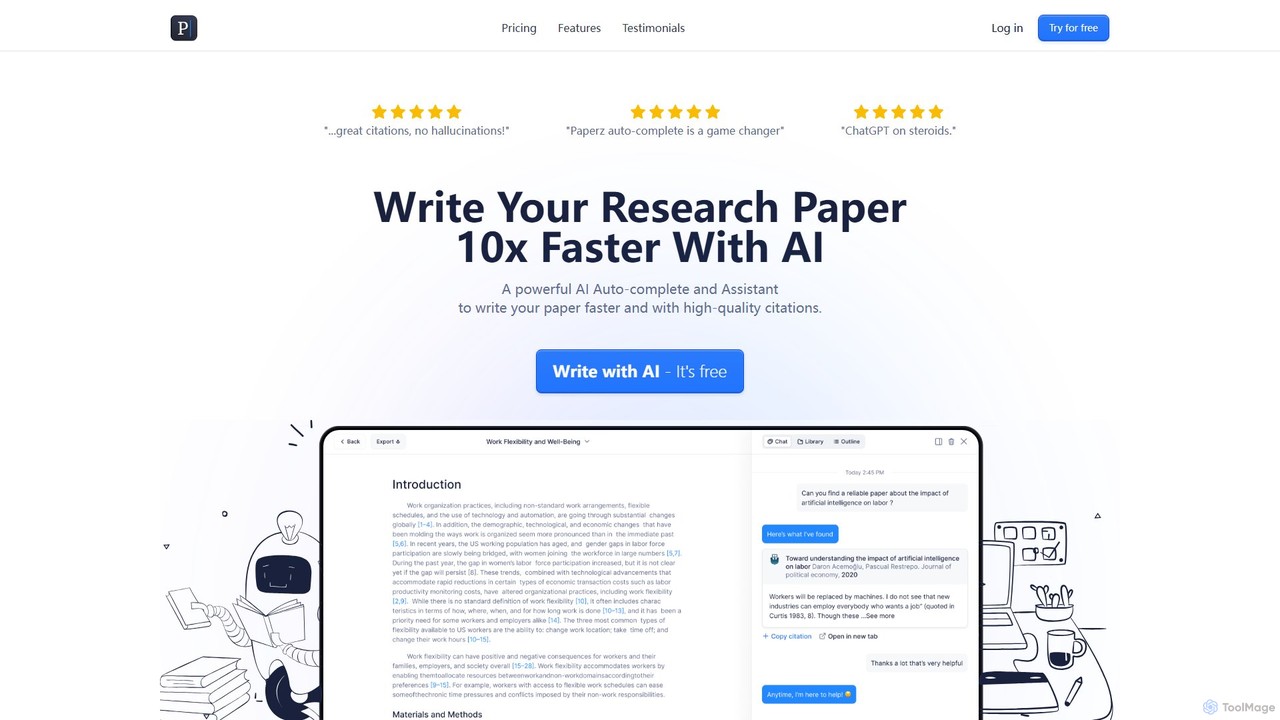
Paperz is an AI-powered writing assistant designed to help students and researchers write academic papers 10x faster. It features intelligent AI autocomplete, one-click citation generation from peer-reviewed sources, and an AI chatbot to overcome writer's block. Paperz streamlines the research and writing process, ensuring high-quality, well-cited work without hallucinations.
About Academic Writing
AI Academic Writing tools are specialized software designed to assist students, researchers, and academics throughout the scholarly writing process. These tools leverage natural language processing (NLP) to streamline tasks such as literature discovery, citation management, grammar correction, and plagiarism checking. They help improve the clarity, accuracy, and integrity of research papers, theses, and dissertations, ultimately accelerating the path to publication. Their focus on academic conventions distinguishes them from general writing assistants.
Core Features
- Literature Search & Summarization: Finds and condenses relevant academic papers, helping to build a strong theoretical foundation quickly.
- Citation & Bibliography Management: Automatically generates and formats in-text citations and bibliographies in various styles (e.g., APA, MLA, Chicago).
- Advanced Grammar & Style Check: Offers suggestions tailored to formal academic tone, clarity, and conciseness, beyond basic spell-checking.
- Paraphrasing & Rewriting Assistant: Helps rephrase sentences to avoid plagiarism and improve flow while preserving the original meaning.
- Plagiarism Detection: Scans documents against a vast database of scholarly articles and web sources to ensure originality.
Applicable Scenarios
These tools are essential for individuals in higher education and research institutions. PhD candidates use them for dissertation writing, researchers for drafting journal articles, and students for preparing essays and term papers. They are valuable across all disciplines, from humanities to hard sciences, where rigorous citation and clear argumentation are paramount.
Selection Criteria
When choosing an AI Academic Writing tool, consider the breadth of its supported citation styles and the accuracy of its generator. Evaluate its integration capabilities with word processors like Microsoft Word or Google Docs. Assess the reliability of its plagiarism checker and the quality of its paraphrasing suggestions. Finally, consider the user interface and whether its pricing model aligns with your budget and project duration.

Academic WritingUse Cases
Accelerating Literature Review for a Thesis
A PhD candidate is beginning their thesis and faces the daunting task of reviewing hundreds of academic papers. Using an AI Academic Writing tool, they input keywords and research questions. The tool scans multiple databases, identifies the most relevant papers, and generates concise summaries for each. This allows the candidate to quickly grasp key arguments and identify research gaps, building a comprehensive annotated bibliography in days instead of weeks, significantly speeding up the initial research phase.
Drafting and Formatting a Research Paper
A researcher is writing a manuscript for a scientific journal with strict formatting guidelines. They use an AI tool to manage citations. As they write, they insert placeholders for references, and the tool automatically formats them as in-text citations and builds the bibliography in the required style (e.g., IEEE). The tool also suggests alternative phrasing for complex sentences to improve clarity and provides a style check to ensure the tone is consistently academic, reducing the time spent on tedious formatting and proofreading.
Ensuring Originality for a Student Essay
An undergraduate student has just finished their final essay. Before submitting, they use an AI tool's plagiarism checker. The tool scans the document and highlights sentences that are too similar to existing publications, providing links to the original sources. For flagged sections, the student uses the integrated paraphrasing feature to rephrase the ideas in their own words, ensuring they properly credit the source. This process helps them learn about academic integrity and submit their work with confidence, knowing it is original.
Polishing a Grant Proposal for Clarity
A principal investigator is finalizing a grant proposal where clarity and persuasiveness are critical. They use an AI Academic Writing tool to refine the language. The tool identifies jargon that could be simplified, flags overly long sentences for restructuring, and suggests more impactful vocabulary. By accepting these suggestions, the investigator ensures the proposal is easily understood by a diverse review committee, enhancing its overall quality and increasing the likelihood of securing funding.
Collaborative Writing with Consistent Formatting
A team of researchers is co-authoring a paper, with each member contributing different sections. Maintaining a consistent citation style manually is challenging. They use a collaborative AI writing platform where all members can add and edit content. The tool centralizes the bibliography, automatically applying the correct format (e.g., APA 7th ed.) to every new citation added by any author. This eliminates inconsistencies and saves hours of manual checking, allowing the team to focus on the scientific content rather than formatting details.
Overcoming Writer's Block with AI Outlining
A student is struggling to start a term paper, feeling overwhelmed by the blank page. They use an AI Academic Writing tool's outlining feature. By inputting the paper's topic and a few key points, the AI generates a structured outline, including a potential introduction, logical section headings, and a conclusion. This AI-generated structure provides a clear roadmap, breaking the complex task into manageable parts. It helps the student overcome writer's block and begin drafting the paper with a coherent and organized framework.