Productivity Best in category 4 results Critical Thinking AI Tool

Popular AI tools in the Critical Thinking field of Productivity include DebateAI、masterdebater、Debatia、DebateBot, etc., helping you quickly improve efficiency.

Free
DebateAI

DebateAI

DebateAI is an AI-powered platform designed to help users practice and enhance their debating, argumentation, and critical thinking …

6.3K
Debatia

Debatia

Debatia is an AI-powered debate coach and argumentation partner. It helps users practice debating, generate compelling arguments, identify …

4.5K
DebateBot

DebateBot

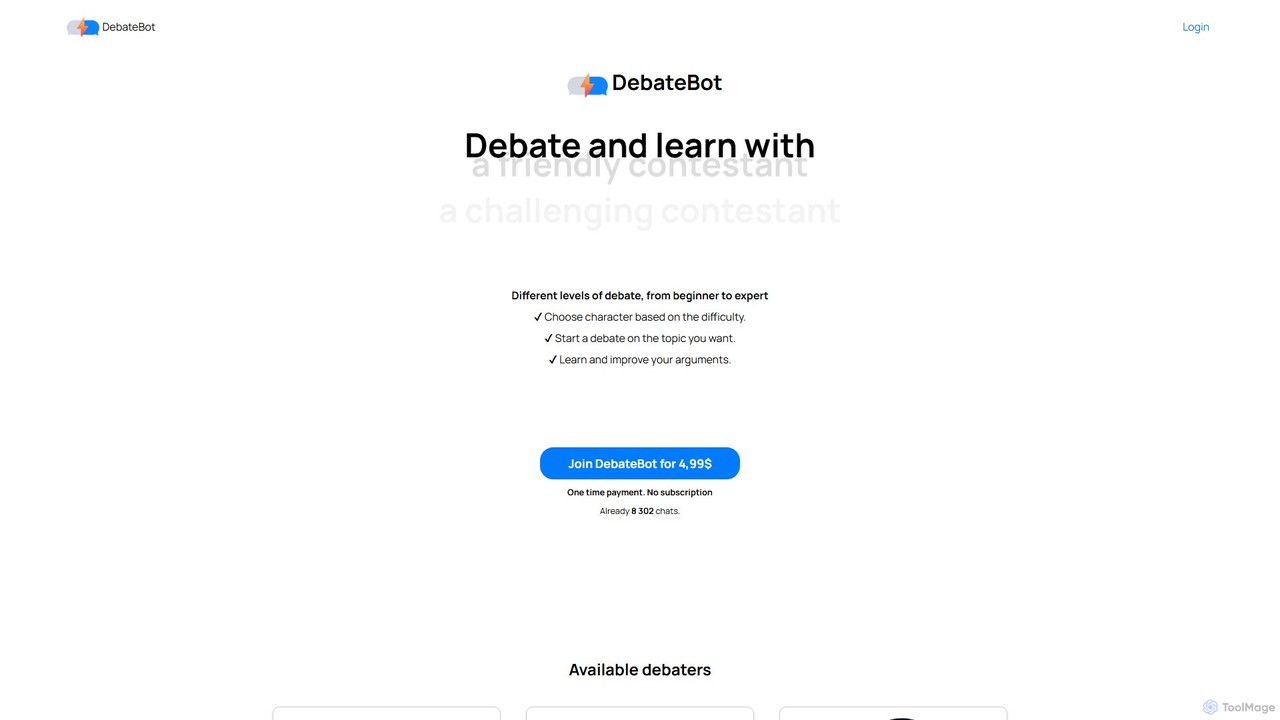
DebateBot is an AI-powered platform designed to sharpen your critical thinking and argumentation skills. Engage in debates with …

2.9K
Free
masterdebater

masterdebater

masterdebater is an AI-powered debate partner designed to help you sharpen your argumentation and critical thinking skills. Engage …

5.0K

About Critical Thinking

AI Critical Thinking tools are a specialized class of software designed to analyze information, deconstruct arguments, and identify logical inconsistencies. These tools leverage Natural Language Processing (NLP) and knowledge graphs to evaluate text for biases, fallacies, and the strength of evidence. Their primary value lies in enhancing the quality of decision-making by providing a structured framework for reasoning. This moves beyond simple productivity, ensuring that conclusions in research, strategy, and analysis are logically sound and well-supported.

Core Features

  • Argument Mapping: Visually breaks down complex arguments into premises, evidence, and conclusions to clarify their logical structure.
  • Fallacy and Bias Detection: Automatically scans text to identify common logical fallacies and potential cognitive biases in reasoning.
  • Evidence Evaluation: Assesses the quality and relevance of cited sources and data used to support claims.
  • Hypothesis Analysis: Provides a structured environment to test various hypotheses against available information and identify the most plausible one.
  • Socratic Questioning: Generates probing questions to challenge assumptions, explore alternative viewpoints, and deepen understanding of a topic.

Use Cases

These tools are particularly valuable in fields requiring rigorous analysis. Legal professionals use them to dissect opposing arguments, academics to critique research papers, and intelligence analysts to evaluate complex information. In business, strategists employ them to vet market analysis reports and business plans for hidden assumptions or logical flaws before making significant investments.

How to Choose

When selecting an AI Critical Thinking tool, consider the depth of analysis required; some tools excel at simple fallacy checking while others offer complex argument visualization. Evaluate its integration capabilities with your existing research platforms or document editors. Also, assess the user interface for its ability to handle complex information without becoming cluttered, and consider the transparency of its analytical models.

Critical ThinkingUse Cases

1

Validating Academic Research Literature

A graduate student preparing a literature review inputs several key research papers into an AI Critical Thinking tool. The tool maps out the core arguments of each paper, highlighting the evidence used to support their claims. It then cross-references the papers, automatically flagging contradictory findings, unstated assumptions in methodologies, and potential author biases based on affiliations. This allows the student to move beyond simple summarization and construct a nuanced critique of the existing literature, identifying genuine gaps in research and strengthening their own thesis.

2

Deconstructing Legal Arguments for Case Preparation

A paralegal team uses an AI tool to analyze a lengthy brief submitted by opposing counsel. The tool ingests the document and generates a visual argument map, breaking down the main legal assertions into individual premises and supporting evidence. It flags sections where the reasoning is weak, identifies potential logical fallacies like 'straw man' arguments, and cross-references cited case law for relevance and accurate interpretation. This structured analysis saves hours of manual work and provides the legal team with a clear, actionable summary of weaknesses to target in their rebuttal.

3

Evaluating Business Plans for Investment Viability

A venture capitalist uses a critical thinking tool to assess a startup's business plan. The AI analyzes the document for logical coherence between the market analysis, product strategy, and financial projections. It flags unsupported claims, such as projected market share growth without sufficient backing data, and questions the core assumptions of the business model. The tool generates a report highlighting logical strengths and weaknesses, allowing the investor to conduct a more focused and rigorous due-diligence process, asking targeted questions that probe the plan's most critical vulnerabilities.

4

Fact-Checking News Articles and Reports

A journalist or fact-checker uses an AI critical thinking tool to analyze a politically charged news article. The tool scans the text, identifies key claims, and automatically searches for supporting or conflicting evidence from a database of reliable sources. It flags emotionally loaded language, identifies potential logical fallacies used to persuade the reader, and visualizes the network of sources to check for over-reliance on a single viewpoint. This provides a systematic first pass, enabling the journalist to focus their in-depth investigation on the most contentious and poorly supported claims.

5

Strengthening Arguments for Debate Preparation

A member of a university debate team uses a critical thinking tool to 'red team' their own arguments before a competition. They input their prepared speeches, and the AI acts as an adversary, identifying logical weaknesses, unstated assumptions, and potential counterarguments. The tool generates Socratic questions that probe the foundations of their position (e.g., 'What evidence contradicts this premise?'). This process helps the debater anticipate an opponent's attacks, find stronger evidence for their claims, and refine their reasoning to be more robust and persuasive under pressure.

6

Analyzing Customer Feedback for Product Strategy

A product manager uses a critical thinking tool to analyze thousands of pieces of customer feedback from surveys and reviews. Instead of just categorizing feedback, the tool identifies underlying assumptions and logical connections in customer reasoning (e.g., 'Customers who request feature X often assume it will solve problem Y'). It detects contradictory feedback patterns and highlights arguments based on emotion versus logical needs. This deeper analysis helps the product manager distinguish between popular feature requests and features that address a fundamental, evidence-backed user problem, leading to a more effective product roadmap.

Critical ThinkingFrequently Asked Questions