ToolMage
Sign in

Best 2 Debate Practice AI tools for Education

Popular Debate Practice AI tools in Education include masterdebater and DebateBot, helping you work more efficiently.

DebateBot
Paid

DebateBot

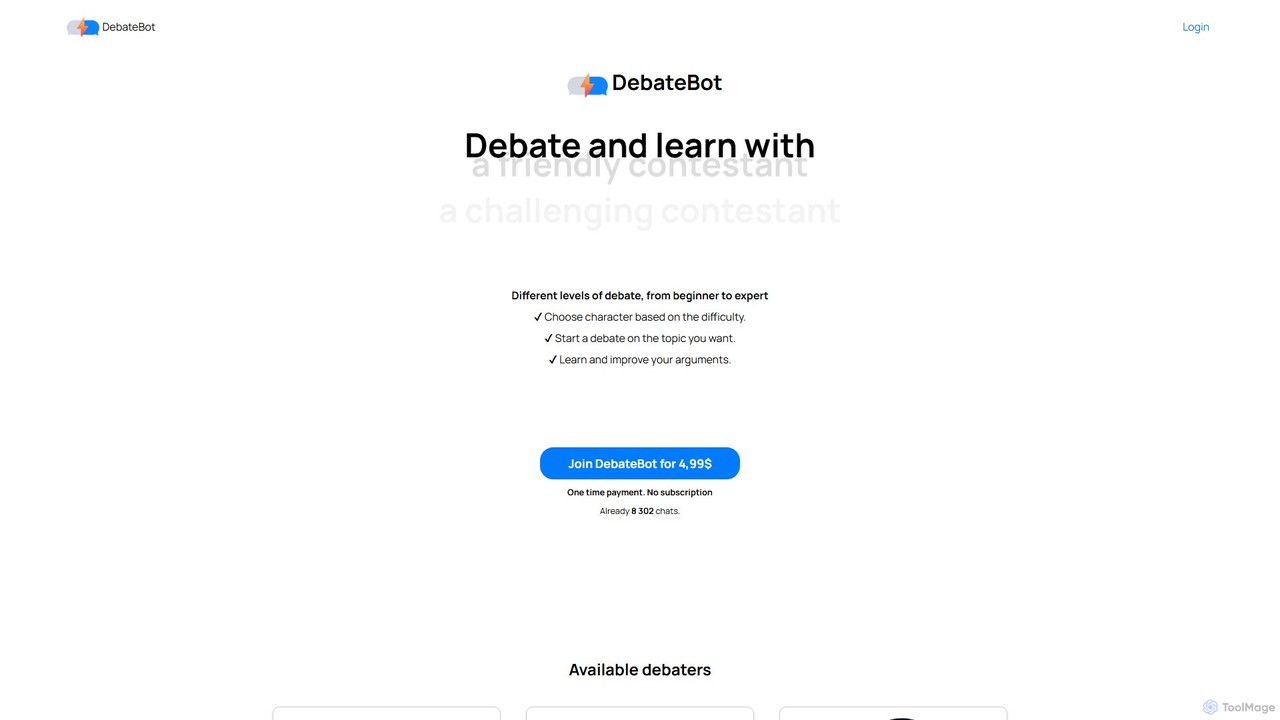
DebateBot is an AI-powered platform designed to sharpen your critical thinking and argumentation skills. Engage in debates with AI opponents of varying difficulty levels, from friendly contestants to challenging experts, on any topic you choose. It's a tool for students, professionals, and anyone looking to refine their ideas and become a more confident debater.

Debate Practice
Visits 4.2KFavorites 93Likes 104
masterdebater
Free

masterdebater

masterdebater is an AI-powered debate partner designed to help you sharpen your argumentation and critical thinking skills. Engage in real-time debates with a sophisticated AI on any topic you choose, or let the tool generate a random topic for you. It's a perfect platform for students, professionals, and anyone looking to practice persuasion in a safe, on-demand environment.

Debate Practice
Visits 5.1KFavorites 170Likes 140

About Debate Practice

AI Debate Practice tools are specialized simulators designed to help users sharpen their argumentation and public speaking skills. These platforms utilize advanced conversational AI and Natural Language Processing (NLP) to act as an intelligent sparring partner, challenging user arguments and providing constructive feedback. Users can engage in structured debates on various topics, allowing them to refine their reasoning, identify logical fallacies, and build confidence in a controlled environment. This makes them a valuable resource within the educational technology landscape for structured skill development.

Core Features

  • AI-Powered Opponent: Engages in a structured debate, presenting counter-arguments and challenging the user's position with varying difficulty levels.
  • Real-time Feedback: Provides instant analysis on argument strength, clarity, use of evidence, and rhetorical effectiveness.
  • Logical Fallacy Detection: Automatically identifies and explains common errors in reasoning, such as ad hominem or straw man arguments.
  • Performance Analytics: Tracks progress over time, offering insights into recurring weaknesses and areas of improvement in a user's debating style.
  • Topic Library: Offers a wide range of pre-defined debate topics across various domains, from politics to ethics and technology.

Use Cases

These tools are widely used by students in debate clubs and forensics teams to prepare for competitions. Professionals in fields like law, sales, and management use them to practice negotiation tactics and persuasive communication. They are also beneficial for academics and policymakers who need to test and strengthen their arguments before presenting them publicly.

How to Choose

When selecting an AI Debate Practice tool, consider the sophistication of the AI opponent—does it offer nuanced counter-arguments or just generic responses? Evaluate the depth and quality of the feedback provided, including its ability to detect specific logical fallacies. Also, check the variety of available debate formats and topics, and ensure the user interface is intuitive for effective practice sessions.

Featured tool rankings

Debate Practice use cases

1

Preparing for a School Debate Competition

A high school student on the debate team uses an AI Debate Practice tool to prepare for an upcoming tournament. They select a relevant topic from the tool's library, such as 'Universal Basic Income,' and engage in multiple practice rounds against the AI opponent. The AI challenges their arguments, points out logical fallacies in their reasoning, and provides a post-debate summary highlighting areas for improvement. This allows the student to refine their case, anticipate counter-arguments, and build confidence, transforming their preparation from static research into dynamic, interactive practice.

2

Refining Negotiation Skills for Professionals

A sales manager uses an AI debate tool to hone their negotiation skills. They set up a scenario simulating a high-stakes client negotiation, with the AI playing the role of a skeptical client. The manager practices presenting their value proposition, handling objections, and steering the conversation towards a mutually beneficial outcome. The tool provides feedback on the persuasiveness of their language and the logical structure of their responses. This practice helps the manager enter real negotiations with more polished arguments and a better strategy for overcoming resistance.

3

Practicing Legal Arguments for Court

A junior lawyer preparing for a court appearance uses an AI debate tool to practice their oral arguments. They input the core tenets of their case and engage the AI, which acts as opposing counsel. The AI rigorously cross-examines their points, forcing the lawyer to defend their position under pressure and identify weaknesses in their logic. The tool's feedback on argument coherence and evidence integration is particularly valuable. This simulation provides a safe yet challenging environment to rehearse before facing a real judge and jury, improving the lawyer's preparedness and courtroom performance.

4

Enhancing Critical Thinking Skills Daily

An individual looking to improve their critical thinking and mental agility uses an AI debate tool as a daily brain exercise. Each day, they select a random topic and engage in a short, timed debate. This forces them to quickly analyze a position, formulate coherent arguments, and respond to counter-points on the fly. The practice isn't about 'winning' but about strengthening the mental muscles for logical reasoning and quick thinking. The AI's ability to consistently provide a logical opponent makes it a more effective training partner than simply reading or thinking about topics alone.

5

Overcoming Public Speaking Anxiety

Someone with a fear of public speaking uses an AI debate tool to build confidence in a private, non-judgmental setting. They start with low-stakes topics and practice articulating their thoughts clearly and structuring arguments without the pressure of a live audience. The AI opponent provides a consistent and predictable interaction, allowing the user to focus solely on their delivery and content. Over time, repeated practice sessions help reduce their anxiety, improve their fluency, and prepare them to transition their skills to real-world conversations and presentations.

6

Testing Policy Arguments for Advocacy

A policy analyst working for a non-profit organization uses an AI debate tool to pressure-test arguments for a new environmental policy. Before presenting to stakeholders or government officials, they simulate debates where the AI takes on various opposing viewpoints (e.g., economic concerns, implementation challenges). This process helps the analyst identify potential weaknesses in their proposal, find stronger evidence to support their claims, and develop more persuasive responses to common objections. The tool acts as a critical but fair sparring partner, ensuring the final advocacy materials are robust and well-reasoned.

Debate Practice FAQ

What are AI Debate Practice tools?

AI Debate Practice tools are interactive software platforms that use artificial intelligence to simulate a debate opponent. They are designed to help users improve their argumentation, critical thinking, and public speaking skills in a controlled, low-pressure environment. Unlike a simple chatbot, these tools are built to challenge a user's reasoning, identify logical fallacies, and provide structured feedback on the strength and coherence of their arguments. They serve as a personal coach for anyone looking to become a more persuasive and effective communicator.

How to choose the right AI Debate Practice tool?

Choosing the right tool depends on your specific goals. Consider the following factors:

  • Quality of AI Opponent: Look for a tool with a sophisticated AI that can offer nuanced counter-arguments and adapt its style, rather than one that gives generic, repetitive responses.
  • Depth of Feedback: The best tools provide specific, actionable feedback. Check if it analyzes logical structure, detects fallacies, and offers suggestions for improvement.
  • Topic and Format Variety: A good tool should offer a wide range of topics and support different debate formats (e.g., Lincoln-Douglas, Parliamentary) to keep practice sessions engaging and relevant.
  • User Interface: The platform should be intuitive and easy to use, allowing you to focus on the debate itself rather than navigating a complex system.
What's the difference between an AI Debate tool and a standard chatbot?

The primary difference lies in their purpose and functionality. A standard chatbot (like a customer service bot) is designed to be cooperative and informational; its goal is to answer questions or complete tasks based on a predefined knowledge base. In contrast, an AI Debate Practice tool is designed to be adversarial and analytical. Its goal is to challenge your arguments, act as a critical opponent, and analyze the logical structure of your reasoning. While a chatbot provides answers, a debate tool provokes critical thinking and hones persuasive skills.

What key skills can be improved with AI Debate Practice tools?

These tools are effective for developing a range of cognitive and communication skills. Key areas of improvement include:

  • Argument Construction: Learning to structure arguments logically with clear claims, evidence, and reasoning.
  • Critical Thinking: Enhancing the ability to analyze positions, identify weaknesses in logic, and anticipate counter-arguments.
  • Persuasive Communication: Improving the ability to articulate ideas clearly and convincingly.
  • Quick Thinking: Developing the skill to think on your feet and respond coherently under pressure.
  • Logical Fallacy Recognition: Gaining a practical understanding of common reasoning errors in both your own and others' arguments.
Who can benefit from using AI Debate Practice tools?

A wide range of individuals can benefit from these tools. This includes:

  • Students: Especially those in debate clubs, law school, or political science, who need to practice formal argumentation.
  • Professionals: Lawyers, sales representatives, managers, and diplomats who rely on persuasive communication and negotiation in their daily work.
  • Public Speakers: Anyone looking to improve their ability to handle Q&A sessions and defend their ideas confidently.
  • Lifelong Learners: Individuals interested in sharpening their critical thinking skills and becoming more informed and articulate communicators in any context.