Productivity Best in category 1 results Customer Feedback AI Tool

Popular AI tools in the Customer Feedback field of Productivity include Discovery AI, etc., helping you quickly improve efficiency.

Discovery AI

Discovery AI

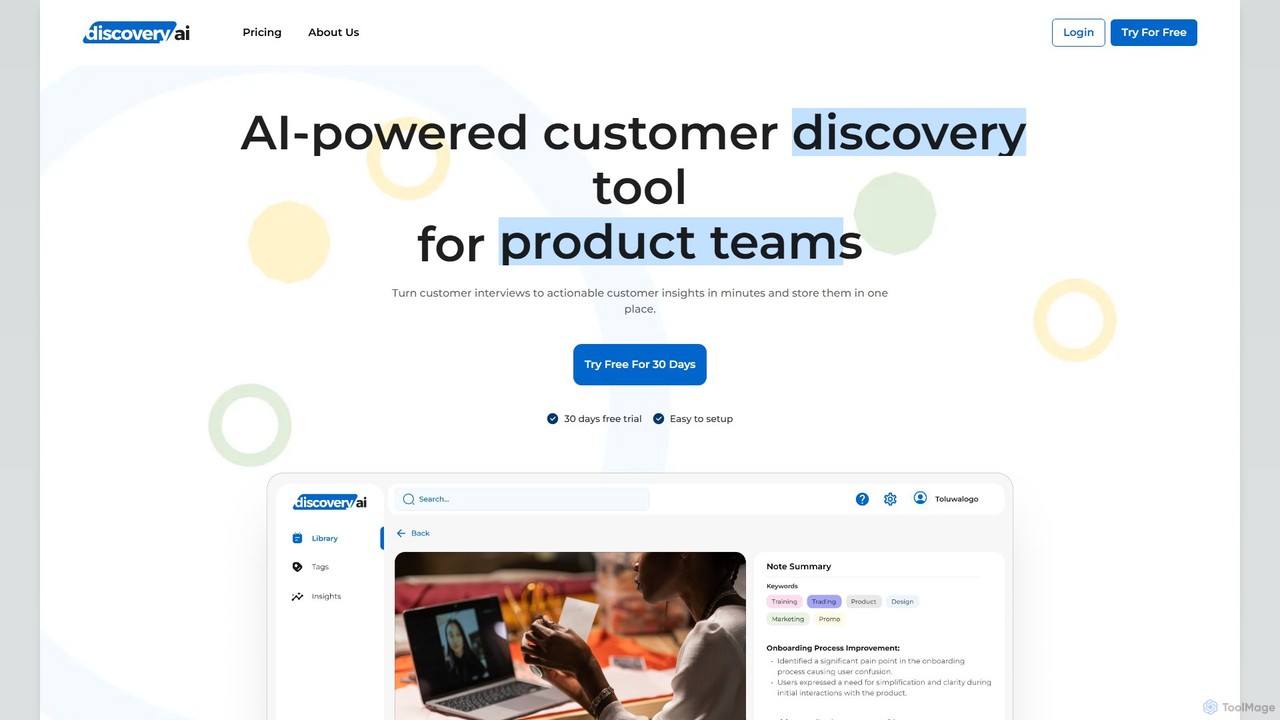
Discovery AI is an AI-powered platform for product teams to analyze customer interviews and centralize insights. It automatically …

3.2K

About Customer Feedback

AI Customer Feedback tools are a specialized class of productivity software that automates the analysis of user opinions from various sources. These tools utilize Natural Language Processing (NLP) to interpret unstructured text, identifying sentiment, key topics, and emerging trends in real-time. This allows businesses to quickly understand customer needs, prioritize product improvements, and enhance user experience without extensive manual analysis. By transforming qualitative data into structured insights, they provide a clear view of the voice of the customer.

Core Features

  • Sentiment Analysis: Automatically classifies feedback as positive, negative, or neutral to gauge overall customer satisfaction.
  • Topic & Keyword Extraction: Identifies and groups recurring themes, features, or issues mentioned by customers.
  • Multi-Channel Aggregation: Consolidates feedback from diverse sources like app stores, social media, surveys, and support tickets into one platform.
  • Trend Detection: Tracks the frequency and sentiment of specific topics over time to spot emerging issues or successes.
  • Automated Reporting: Generates visual dashboards and reports summarizing key findings for easy sharing and decision-making.

Applicable Scenarios

These tools are invaluable for product managers seeking to validate roadmaps, customer support teams aiming to identify root causes of common problems, and marketing professionals measuring campaign reception. For instance, a SaaS company can analyze support tickets to find the most requested features, while an e-commerce brand can monitor product reviews to improve item descriptions and quality.

Selection Criteria

When choosing an AI Customer Feedback tool, evaluate its integration capabilities with your existing platforms (e.g., Zendesk, Salesforce, App Stores). Assess the accuracy of its sentiment analysis and topic modeling, especially for industry-specific jargon. Also, consider the customization options for dashboards, the range of supported languages, and whether the pricing model aligns with your feedback volume.

Customer FeedbackUse Cases

1

Prioritizing Features for a Product Roadmap

A product manager at a SaaS company needs to decide which features to build next. They use an AI customer feedback tool to aggregate and analyze thousands of user comments from Intercom, support emails, and a public feature request board. The tool automatically identifies 'API Integration' and 'Dark Mode' as the most frequently requested features with high positive sentiment. The dashboard visualizes this data, showing that requests for API integration are growing 30% month-over-month. This data-driven insight allows the product manager to confidently prioritize these features for the upcoming development cycle, aligning the roadmap directly with user demand.

2

Detecting Critical Bugs from App Store Reviews

A mobile gaming company releases a major update for their popular game. Immediately after, the support team notices a surge in negative reviews on the App Store and Google Play. By feeding these reviews into an AI feedback tool, they bypass manual reading. The AI instantly identifies a cluster of reviews mentioning 'crashing on level 5' and 'login error 503'. The system flags this as a critical, high-urgency trend. The development team is alerted within an hour of the issue surfacing, allowing them to replicate the bug and push a hotfix patch much faster than if they had to sift through reviews manually, thus mitigating user churn and protecting revenue.

3

Improving Customer Support Agent Training

A customer support manager wants to improve their team's training program. They use an AI feedback tool to analyze thousands of post-interaction survey responses and support ticket transcripts. The AI identifies a recurring theme: customers frequently express confusion about the 'billing and invoicing process'. The sentiment analysis shows that interactions handled by junior agents on this topic have a 20% lower satisfaction score. Armed with this insight, the manager develops a specialized training module focused on billing, complete with role-playing scenarios. This targeted training helps new agents handle these specific queries more effectively, leading to a measurable increase in customer satisfaction scores within a quarter.

4

Gauging Public Reaction to a Marketing Campaign

A consumer brand launches a major new advertising campaign. The marketing team uses an AI feedback tool to monitor real-time conversations on Twitter, Instagram, and public forums related to the campaign hashtag. The tool's dashboard shows an initial spike in neutral and negative sentiment, with topic extraction highlighting keywords like 'confusing message' and 'unrelatable'. This early feedback allows the marketing team to quickly adjust their social media messaging to clarify the campaign's intent. They track the sentiment score over the next 48 hours and see it shift towards positive, confirming their adjustments were effective. This real-time monitoring prevents a potentially costly campaign from failing due to poor initial reception.

5

Optimizing E-commerce Product Descriptions

An online retailer wants to increase conversion rates for a popular electronics product. They use an AI feedback tool to analyze hundreds of customer reviews for that item. The tool extracts frequently mentioned positive keywords and phrases, such as 'long battery life,' 'bright screen,' and 'easy setup.' It also identifies a recurring negative theme related to 'confusing instructions.' The retailer revises the product description to prominently feature the positive phrases identified by the AI. They also create a simple, step-by-step setup guide and link to it from the page. This targeted optimization, based directly on customer voice, leads to a 15% increase in the product's add-to-cart rate.

6

Automating Voice of the Customer (VoC) Reporting

A large enterprise's Voice of the Customer (VoC) team spends weeks each quarter manually collecting and theming feedback from NPS surveys, online reviews, and call center transcripts. By implementing an AI feedback platform, they automate this entire process. The tool connects to all data sources, continuously ingests feedback, and applies consistent topic and sentiment tagging. It generates a real-time VoC dashboard showing customer health scores by region, product line, and customer segment. This automation reduces the time spent on manual reporting from 40 hours per month to just 2, freeing up the team to focus on strategic analysis and presenting actionable insights to leadership, rather than just data compilation.

Customer FeedbackFrequently Asked Questions