
Productivity Best in category 1 results Customer Success AI Tool

Popular AI tools in the Customer Success field of Productivity include Overhyped AI, etc., helping you quickly improve efficiency.

Overhyped AI

Overhyped AI

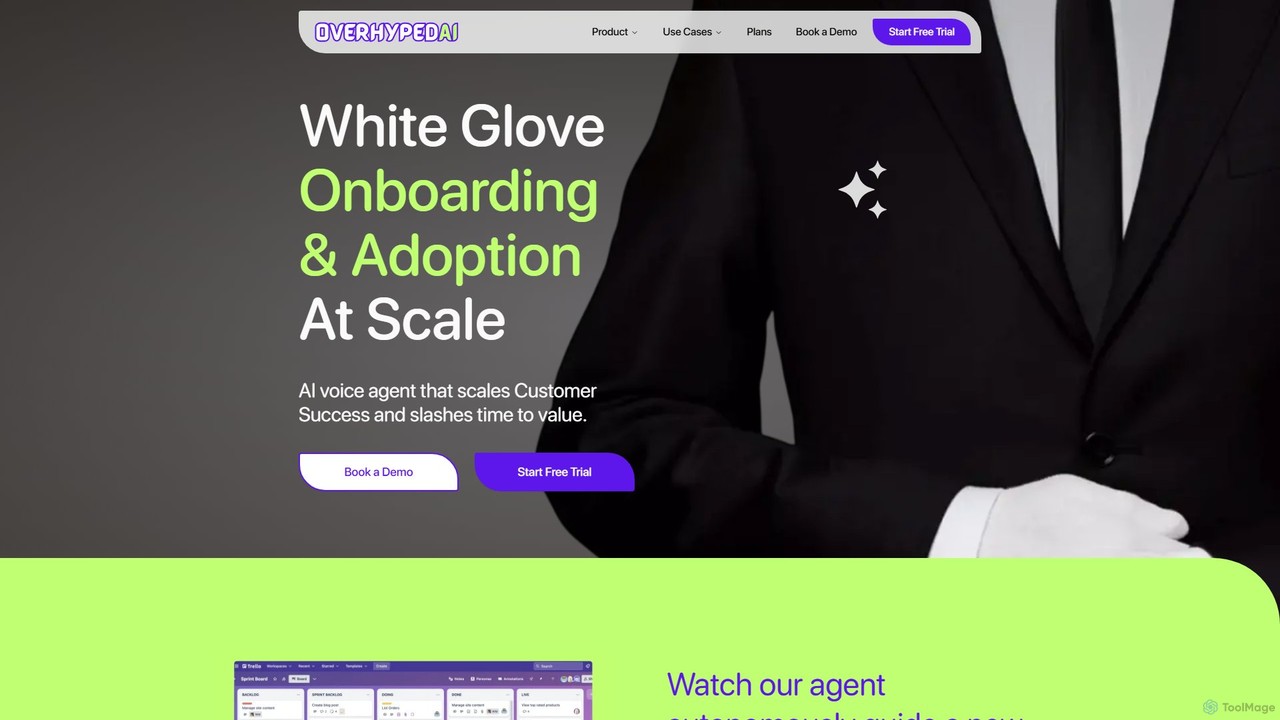
Overhyped AI is an intelligent voice agent designed to automate and scale user onboarding and product adoption. It …

4.9K

About Customer Success

Customer Success platforms are AI-powered tools designed to proactively manage and enhance the entire customer lifecycle. They leverage machine learning to analyze user behavior, predict churn risk, and identify opportunities for growth. By automating personalized communication and providing data-driven insights, these tools help businesses shift from reactive support to proactive value delivery. This focus on post-sale value realization makes them a critical component of modern productivity stacks for subscription-based companies.

Core Features

  • Predictive Churn Analysis: Uses historical data and usage patterns to identify customers at high risk of churning.
  • Customer Health Scoring: Automatically calculates a dynamic health score for each account based on multiple data points.
  • Automated Playbooks: Triggers predefined sequences of tasks and communications based on customer behavior or health changes.
  • Expansion Opportunity Identification: Analyzes product usage to pinpoint customers who are prime candidates for upsells or cross-sells.
  • Sentiment Analysis: Monitors support tickets, surveys, and other communications to gauge customer satisfaction at scale.

Applicable Scenarios

These tools are essential for B2B SaaS companies, subscription-based services, and any business focused on long-term customer relationships. Customer Success Managers (CSMs) use them to manage their portfolios, while leadership uses the analytics to track retention and revenue trends. They are particularly effective for scaling customer management as a company grows its user base.

Selection Criteria

When choosing a Customer Success tool, evaluate its integration capabilities with your existing CRM and helpdesk systems. Assess the sophistication and customizability of its health scoring and predictive models. Consider the flexibility of its automation engine for building custom playbooks. Finally, analyze its data ingestion capabilities to ensure it can connect to all your relevant customer data sources.

Customer SuccessUse Cases

1

Proactive Churn Risk Mitigation

A Customer Success Manager (CSM) at a SaaS company receives an AI-generated alert that a key account's product usage has dropped by 50% and their health score turned red. The platform provides context, highlighting low feature adoption and a recent negative sentiment support ticket. Armed with this specific data, the CSM schedules a targeted intervention call to address the user's issues directly, offer additional training, and demonstrate value, successfully preventing a potential churn and strengthening the relationship.

2

Automating Customer Onboarding at Scale

A fast-growing startup needs to onboard hundreds of new users each week without hiring more CSMs. They use an AI Customer Success tool to create an automated onboarding playbook. This playbook triggers a series of personalized welcome emails, in-app guided tours for key features, and milestone-based check-ins. The system monitors user progress and automatically assigns a human CSM only if a user gets stuck or shows low engagement, allowing the team to scale efficiently while maintaining a high-quality onboarding experience.

3

Identifying Expansion Revenue Opportunities

An AI tool analyzes a customer's usage data and identifies that they are consistently hitting the limits of their current plan and are frequently using features related to a premium tier. The platform automatically flags this as an upsell opportunity and creates a task for the assigned Account Manager. The task includes all the relevant data points, enabling the manager to have a highly relevant, value-driven conversation about upgrading, which results in increased expansion monthly recurring revenue (MRR).

4

Scaling Customer Health Monitoring

A mid-sized B2B company needs to monitor the health of over 5,000 accounts with a small CS team. The AI platform aggregates data from their CRM, helpdesk, and billing system to generate a real-time, multi-faceted health score for each customer. This allows the CS team to move away from manual check-ins and instead focus their efforts strategically: intervening with at-risk (red) accounts, nurturing neutral (yellow) accounts, and engaging high-potential (green) accounts for advocacy or upsells.

5

Personalizing Quarterly Business Reviews (QBRs)

A CSM preparing for a QBR with a major client uses an AI tool to automatically generate a data-driven presentation. The tool pulls key usage metrics, calculates the client's ROI based on their specific outcomes, and highlights feature adoption trends. It also benchmarks the client's performance against similar companies. This saves the CSM hours of manual data collection and allows them to lead a more strategic, value-focused conversation, reinforcing the partnership and identifying future growth areas.

6

Analyzing Customer Feedback at Scale

A product team wants to understand the most common feature requests and pain points from users. A Customer Success platform automatically ingests and analyzes thousands of support tickets, survey responses, and call transcripts using natural language processing (NLP). It identifies and categorizes key themes, such as 'requests for integration X' or 'difficulty with Y feature'. This provides the product team with a quantified, data-backed view of customer feedback, enabling them to prioritize their roadmap based on the true voice of the customer.

Customer SuccessFrequently Asked Questions