flightseatmaps
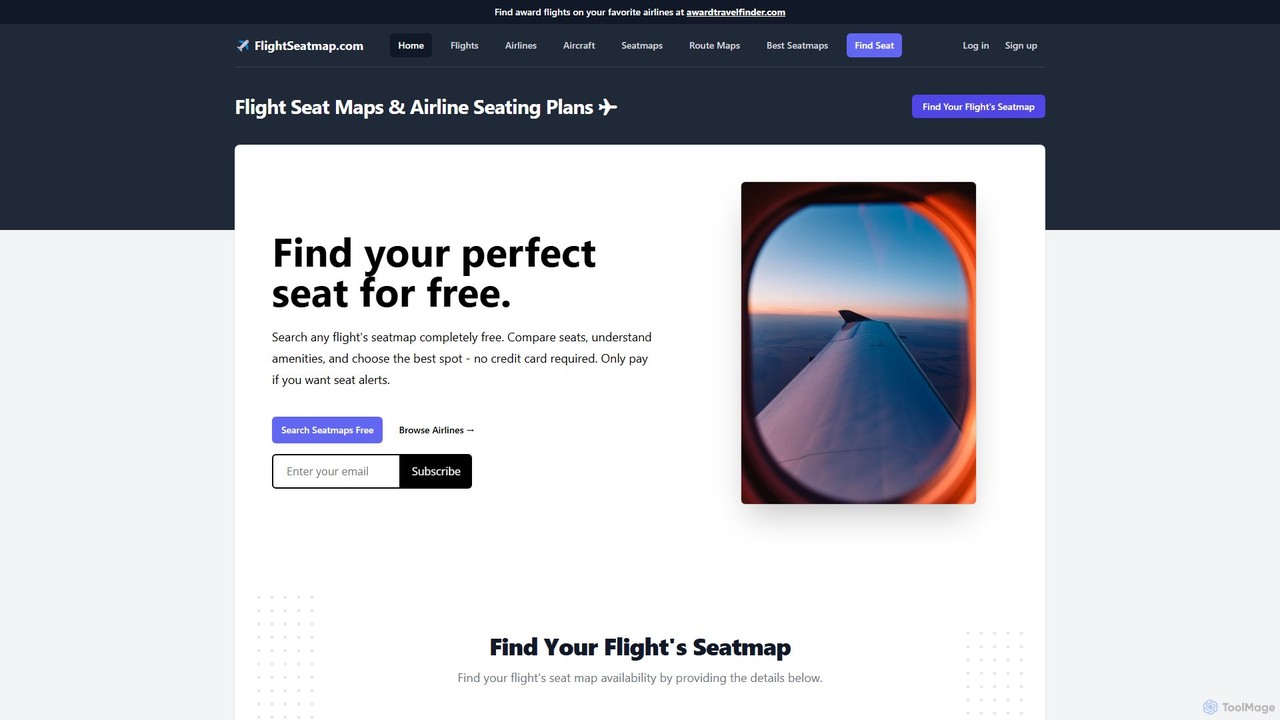
flightseatmaps is a comprehensive tool for air travelers to find, compare, and select the best airplane seats. Search …
flightseatmaps is a comprehensive tool for air travelers to find, compare, and select the best airplane seats. Search any flight's seat map for free to view detailed layouts, amenities, and passenger reviews. Upgrade for real-time seat availability tracking and instant alerts to secure your preferred spot, ensuring a more comfortable journey.
About Information Services
AI Information Services are a class of productivity tools that use large language models to provide direct, synthesized answers from vast data sources. Unlike traditional search engines that return a list of links, these tools analyze natural language queries to retrieve, consolidate, and summarize relevant information into a coherent response. This process significantly accelerates research, data analysis, and decision-making by delivering knowledge instead of just data pointers. Their ability to understand context and cite sources makes them powerful assistants for any knowledge-based task.
Core Features
- Conversational Search: Engage in a dialogue to ask questions and receive direct, contextual answers, allowing for follow-up inquiries.
- Information Synthesis: Aggregates and condenses information from multiple online sources into a single, easy-to-digest summary.
- Source Citation: Provides links and references to the original data sources, enabling users to verify facts and conduct deeper research.
- Multi-Format Analysis: Capable of processing and understanding queries related to text, code, and sometimes images or data tables.
- Natural Language Understanding: Interprets complex, nuanced user questions to deliver highly relevant and precise information.
Applicable Scenarios
These tools are widely used by researchers, market analysts, developers, and content creators. For instance, a market analyst can quickly gather competitive intelligence by asking for a summary of recent industry reports. A developer can debug code by pasting an error and asking for solutions with explanations, drawing from forums and documentation instantly.
Selection Criteria
When choosing an AI Information Service, evaluate the scope and quality of its data sources (e.g., general web, academic papers, code repositories). Assess the accuracy of its synthesis and the reliability of its citations. Also, consider the user interface, API availability for integration, and any specialization, such as a focus on scientific research or programming.

Information ServicesUse Cases
Accelerate Market Research for Analysts
A business analyst is tasked with understanding a new emerging market. Instead of spending days manually searching for reports, articles, and data, they use an AI Information Service. They ask a complex query like, 'What are the key growth drivers, major players, and regulatory challenges in the European synthetic biology market for 2024?' The tool scans thousands of sources, synthesizes the findings into a structured summary with key bullet points, and provides direct links to the source documents. This reduces the initial research time by over 80%, allowing the analyst to focus on deeper analysis and strategy.
Efficient Code Debugging for Developers
A software developer encounters a cryptic error message from a third-party library. Searching traditional forums could take hours. Instead, they use a developer-focused AI Information Service. They paste the error message along with the relevant code snippet. The AI analyzes the context, searches its knowledge base of programming documentation, GitHub issues, and Stack Overflow, and provides a direct explanation of the error's cause. It often suggests several potential code fixes, complete with explanations for each, turning a multi-hour debugging session into a matter of minutes.
Streamlining Academic Literature Reviews
A graduate student is beginning a literature review for their thesis. The topic is broad, and identifying seminal papers is daunting. Using an AI Information Service with access to academic databases, they ask, 'Summarize the key theories on cognitive load in multimedia learning from the last two decades.' The tool returns a synthesized overview, identifies key authors like Sweller and Mayer, and lists foundational papers with summaries of their contributions. The student can then ask follow-up questions like 'What are the main criticisms of Sweller's theory?' to quickly build a comprehensive and nuanced understanding of the field.
Fact-Checking and Research for Content Creators
A journalist is writing an in-depth article on the global supply chain's impact on inflation. They need accurate, up-to-date statistics and expert opinions. They use an AI Information Service to ask, 'What percentage of recent inflation is attributed to supply chain disruptions, according to major economic institutions?' The service provides specific data points from sources like the IMF, World Bank, and central bank reports, all with citations. This allows the journalist to quickly incorporate verified facts into their article, maintaining high standards of accuracy and saving valuable research time.
Quickly Grasping Complex Technical Concepts
A project manager with a non-technical background needs to understand the basics of 'zero-knowledge proofs' for an upcoming project. Reading technical papers is not feasible. They use an AI Information Service and ask it to 'Explain zero-knowledge proofs using a simple analogy.' The tool provides a clear, easy-to-understand explanation comparing it to a secret cave puzzle (the Ali Baba cave analogy). This allows the manager to grasp the core concept in minutes, enabling them to participate more effectively in technical discussions with the engineering team without needing a deep cryptographic background.
Performing Competitor Analysis for Product Strategy
A product manager is planning the next version of their software. To inform their strategy, they need to understand how a competitor's new feature is being received. They use an AI Information Service to ask, 'Summarize user sentiment for Competitor X's new feature based on social media posts and tech reviews from the last month.' The tool aggregates and analyzes data from various platforms, providing a concise summary that highlights common points of praise (e.g., 'intuitive UI') and criticism (e.g., 'slow performance'). This provides actionable insights for their own product roadmap in a fraction of the time it would take to do manually.