Seeora AI
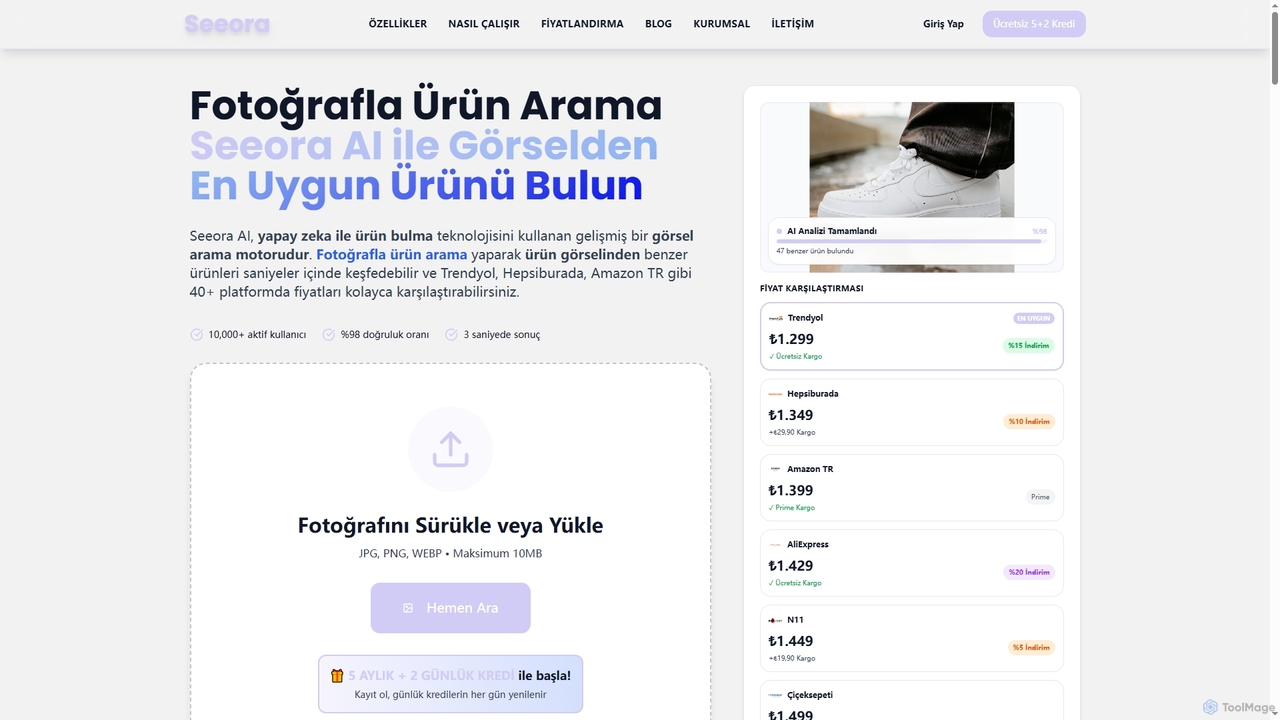
Seeora AI is an advanced AI-powered visual search engine that helps users find products by photo and compare …
Seeora AI is an advanced AI-powered visual search engine that helps users find products by photo and compare prices across over 40 e-commerce platforms, primarily focusing on the Turkish market. It offers a fast, accurate, and convenient way to discover items and secure the best deals, transforming the online shopping experience.
About Product Discovery
Product Discovery tools are AI-powered solutions designed to help businesses identify, validate, and prioritize new product ideas, features, or market opportunities. Leveraging advanced algorithms, these tools analyze vast datasets from market trends, competitor intelligence, and user feedback to provide actionable insights. Their primary value lies in streamlining the ideation-to-launch process, significantly reducing development risks, and ensuring products achieve optimal market fit by making data-driven decisions.
Core Features
- Market Trend Analysis: Identifies emerging industry trends and unmet customer needs to uncover new opportunities.
- Competitor Intelligence: Analyzes competitor product portfolios, pricing strategies, and market positioning for strategic insights.
- User Feedback Synthesis: Aggregates and processes customer reviews, survey responses, and support tickets to extract actionable insights.
- Idea Generation & Validation: Assists in brainstorming new product concepts and provides data-backed validation of their potential viability.
- Feature Prioritization: Ranks potential product features based on predicted user impact, market demand, and development effort.
Applicable Scenarios
Product Discovery tools are indispensable for product managers seeking to validate new features or entire product lines, ensuring they align with market demand. Startups utilize them to pinpoint initial market opportunities and define Minimum Viable Product (MVP) features with confidence. Additionally, R&D teams leverage these tools to explore innovative solutions driven by real-world market needs and technological advancements.
How to Choose
When selecting a Product Discovery tool, consider its data sources and breadth, ensuring it integrates with relevant market data, social media, and customer feedback platforms. Evaluate its analysis capabilities, looking for features like predictive analytics, sentiment analysis, and trend forecasting. Assess its integration potential with existing product management, CRM, or analytics tools. Finally, consider the level of customization offered for research parameters and report generation to match specific business needs.

Product DiscoveryUse Cases
Identifying Untapped Market Niches
Market researchers and entrepreneurs can leverage AI product discovery tools to scan vast amounts of market data, social media conversations, and search trends. By analyzing keywords, sentiment, and demographic information, these tools reveal underserved customer segments or emerging demands that traditional methods might miss. This allows businesses to pinpoint specific niche markets with high potential for new product development, reducing the risk of entering saturated markets and maximizing the chances of finding a unique selling proposition.
Validating New Product Concepts
Product managers can use AI product discovery tools to rigorously test the viability of new product ideas before significant investment. By inputting concept descriptions, target audiences, and proposed features, the AI can simulate market reception, predict potential demand, and identify critical flaws or areas for improvement based on existing market data and user sentiment. This proactive validation process helps refine product concepts, ensuring they resonate with the target market and possess a higher likelihood of success upon launch, saving considerable time and resources.
Prioritizing Feature Roadmaps
Product teams often face the challenge of deciding which features to develop next. AI product discovery tools assist by analyzing user feedback, competitor feature sets, and market trends to quantify the potential impact and demand for various features. They can generate data-driven recommendations, helping product managers prioritize features that offer the highest value to users and align with strategic business goals. This ensures development efforts are focused on features that will drive user satisfaction and market adoption, optimizing the product roadmap for maximum return on investment.
Analyzing Competitor Product Strategies
Business strategists and product marketers can utilize AI product discovery tools to gain deep insights into competitor product strategies. These tools monitor competitor launches, feature updates, pricing changes, and customer reviews across various platforms. By identifying patterns and shifts in competitor offerings, businesses can anticipate market moves, uncover competitive advantages or vulnerabilities, and refine their own product positioning and differentiation strategies. This intelligence is crucial for maintaining a competitive edge and making informed strategic decisions in a dynamic market.
Synthesizing User Feedback for Product Improvement
UX/UI designers and customer success teams can leverage AI product discovery tools to efficiently process and synthesize vast volumes of user feedback from various channels like app store reviews, social media, support tickets, and surveys. The AI can identify common themes, sentiment, and pain points, automatically categorizing feedback and highlighting critical issues or popular feature requests. This enables teams to quickly understand user needs, prioritize improvements, and make data-backed decisions to enhance product usability and satisfaction, leading to a more user-centric product evolution.
Forecasting Future Product Trends
Innovation labs and R&D departments can utilize AI product discovery tools for proactive trend forecasting. By analyzing historical data, emerging technologies, scientific publications, and global socio-economic indicators, these tools can identify subtle patterns and predict future shifts in consumer behavior, market demands, and technological advancements. This foresight enables businesses to anticipate long-term opportunities, invest in relevant research, and strategically position themselves to develop groundbreaking products that will meet future market needs, ensuring sustained innovation and competitive advantage.