HyperWhisper
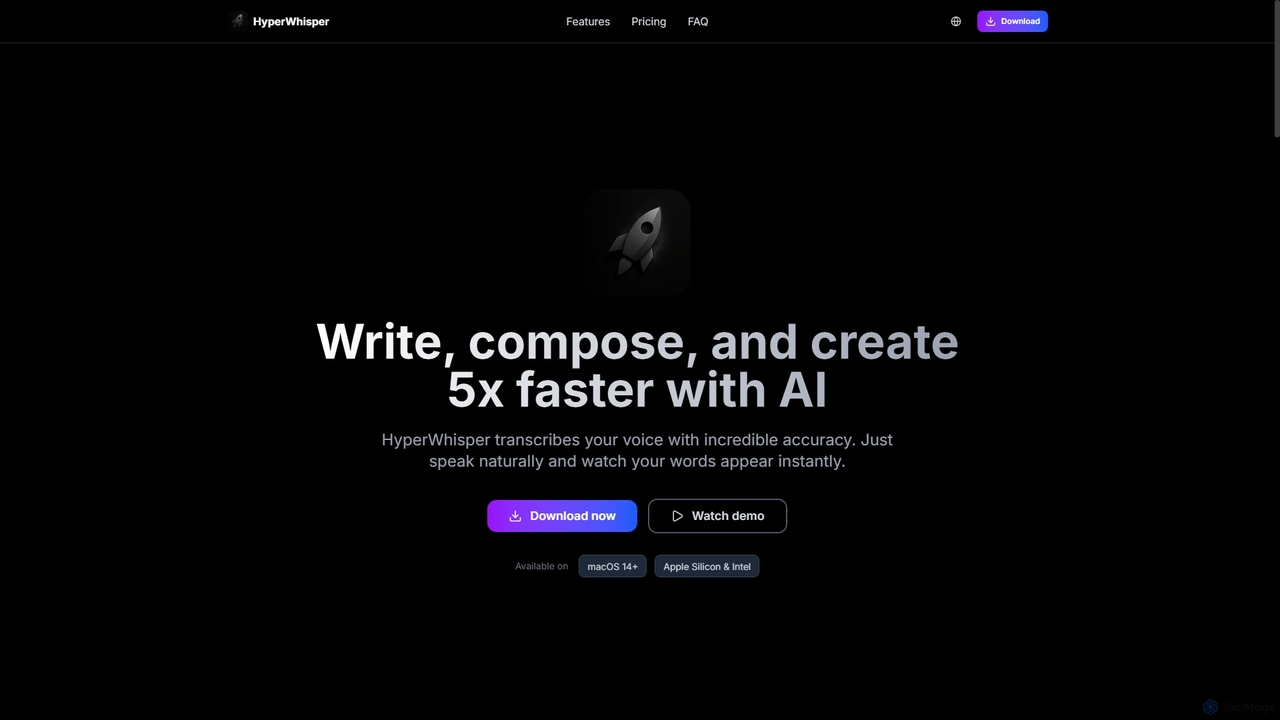
HyperWhisper is an AI-powered voice transcription application for macOS, designed to convert spoken words into text with exceptional …
HyperWhisper is an AI-powered voice transcription application for macOS, designed to convert spoken words into text with exceptional accuracy and speed. It supports over 100 languages, offers robust offline capabilities, and prioritizes user privacy, making it ideal for professionals seeking efficient content creation and note-taking.
About Professional Tools
Professional Tools are a class of advanced AI solutions designed for specialized, high-stakes applications in business, research, and enterprise environments. These tools are built on sophisticated models and prioritize features like data security, scalability, and extensive customization. They enable organizations to automate critical workflows, perform complex data analysis, and integrate AI capabilities directly into their existing systems. Unlike general-purpose tools, professional AI solutions offer robust API access, compliance with industry standards, and dedicated support for mission-critical operations.
Core Features
- Enterprise-Grade Security: Includes features like SSO, role-based access control, data encryption, and compliance with standards such as GDPR or HIPAA.
- Advanced Customization & Fine-Tuning: Allows users to train models on proprietary datasets to perform highly specific tasks relevant to their industry.
- API & System Integration: Provides robust APIs for seamless integration with existing enterprise software like CRMs, ERPs, and internal databases.
- Scalability & Performance: Engineered to handle large volumes of data, high user loads, and complex computational tasks without performance degradation.
- Collaboration & Workflow Management: Offers team-based features, version control for models, and shared workspaces to support collaborative projects.
Use Cases
Professional Tools are widely adopted in sectors requiring precision, security, and scale. For instance, financial institutions use them for real-time fraud detection and algorithmic trading. In healthcare, they assist in medical image analysis and drug discovery. Law firms leverage these tools for eDiscovery and contract analysis, while large engineering firms use them for complex design simulations and predictive maintenance.
How to Choose
Selecting a professional AI tool requires evaluating several key factors. Assess its integration capabilities with your current tech stack. Scrutinize its security protocols and compliance certifications. Consider the tool's scalability to ensure it can grow with your business needs. Evaluate the level of customization and model fine-tuning available. Finally, analyze the total cost of ownership (TCO), including subscription fees, implementation costs, and required technical expertise.

Professional ToolsUse Cases
Automating Financial Fraud Detection
A data science team at a large financial institution is tasked with reducing losses from fraudulent transactions. They use a professional AI platform to build, train, and deploy a machine learning model that analyzes transaction patterns in real-time. By integrating the platform's API with their core banking system, the model flags suspicious activities with over 99.5% accuracy. This allows the fraud investigation team to focus only on high-risk alerts, reducing manual review time by 80% and preventing millions in potential losses annually.
Accelerating Legal eDiscovery Processes
A paralegal team at a corporate law firm faces the challenge of reviewing over two million documents for a major litigation case. They employ a professional AI eDiscovery tool that uses Natural Language Processing (NLP) to scan, categorize, and identify relevant documents based on keywords, concepts, and sentiment. The tool automatically flags privileged information and identifies key evidence chains. This reduces the document review phase from months to weeks, saving over 1,000 billable hours and significantly improving the accuracy of evidence collection.
Optimizing Pharmaceutical Drug Discovery
Researchers at a biotechnology firm use a professional AI platform to accelerate the drug discovery process. The platform analyzes vast datasets of genomic data, molecular structures, and clinical trial results to predict the efficacy and potential side effects of new compounds. By simulating molecular interactions, the AI identifies promising drug candidates much faster than traditional methods. This approach helps the research team prioritize their lab experiments, reducing R&D costs by up to 30% and shortening the timeline for bringing a new drug to market.
Enterprise Customer Service Automation
A global e-commerce company integrates a professional AI chatbot platform into its customer support system. The AI is trained on the company's product catalog, policies, and historical support tickets. It handles over 60% of incoming customer queries, including order tracking, return processing, and product recommendations, across multiple languages. For complex issues, it intelligently gathers initial information before seamlessly escalating the conversation to a human agent. This 24/7 automated support improves customer satisfaction scores by 25% and reduces operational costs for the support center.
Engineering Design and Simulation
An architectural engineering firm uses a professional AI tool for generative design and structural simulation. Engineers input project constraints such as budget, materials, and load-bearing requirements. The AI then generates hundreds of optimized design variations for a building's framework. Each design is automatically simulated for structural integrity, energy efficiency, and material cost. This process allows the team to explore innovative solutions that would be impossible to create manually, leading to a 15% reduction in material costs and improved building performance.
Streamlining Media Production Pipelines
A major film studio employs a suite of professional AI tools to streamline its post-production workflow. An AI video editing tool automates the tedious process of rotoscoping and object removal, saving visual effects artists hundreds of hours per project. Another AI tool analyzes scripts and raw footage to automatically generate rough cuts and suggest optimal camera angles. This integration of AI allows the studio to reduce post-production timelines by up to 40%, enabling faster content delivery and allowing creative teams to focus on higher-value artistic tasks.