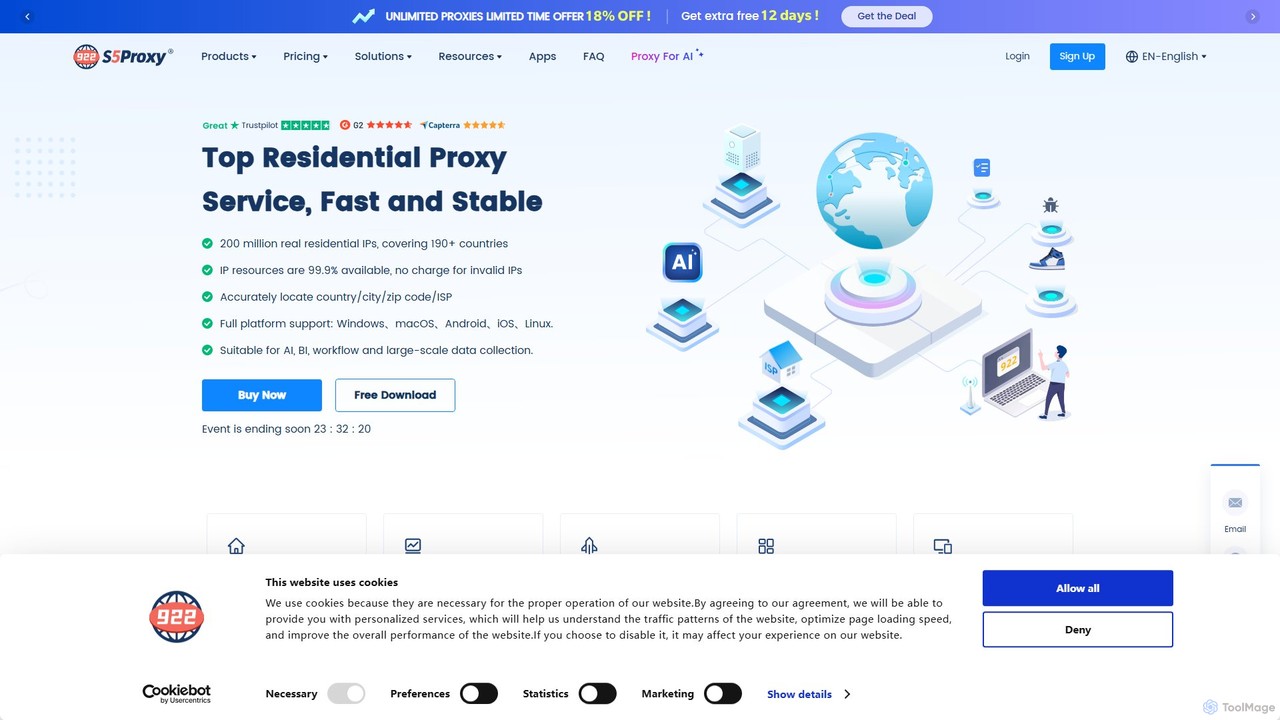
Proxy Services are tools that provide intermediary servers to route internet traffic, enhancing online anonymity, security, and data accessibility. These services act as a gateway between a user and the web, masking the user's original IP address with one from their own network. Modern proxy platforms often leverage intelligent systems to manage vast IP pools, automatically rotate addresses to prevent blocks, and optimize connection success rates for large-scale tasks. They are essential for activities like web scraping, market research, and bypassing geographic restrictions.
Core Features
- Diverse IP Pools: Access to various IP types, including residential, datacenter, mobile, and ISP proxies, to suit different use cases.
- Precise Geo-targeting: Ability to select proxies from specific countries, states, cities, and even mobile carriers.
- Intelligent IP Rotation: Automatic switching of IP addresses for each request or over a set time to avoid detection and CAPTCHAs.
- Sticky Sessions: Option to maintain the same IP address for an extended period, necessary for managing accounts or completing multi-step forms.
- Scraping APIs: Advanced solutions that bundle proxy management, browser rendering, and CAPTCHA solving into a single API call.
Use Cases
Proxy Services are widely used by data scientists for large-scale web scraping, SEO specialists for accurate rank tracking across different regions, and e-commerce businesses for competitor price monitoring. Marketing agencies also rely on them for ad verification and managing multiple social media accounts without triggering security alerts.
How to Choose
When selecting a Proxy Service, consider the required IP type (residential for high anonymity, datacenter for speed). Evaluate the size and geographic diversity of the IP pool. Assess performance metrics like connection speed, success rate, and uptime. Finally, compare pricing models (e.g., per-gigabyte vs. per-IP) and check the quality of documentation and customer support.