
ToolMage
Sign in

Best 1 Candidate Screening AI tools for Recruiting

Popular Candidate Screening AI tools in Recruiting include Flowmingo, helping you work more efficiently.

Flowmingo
Free

Flowmingo

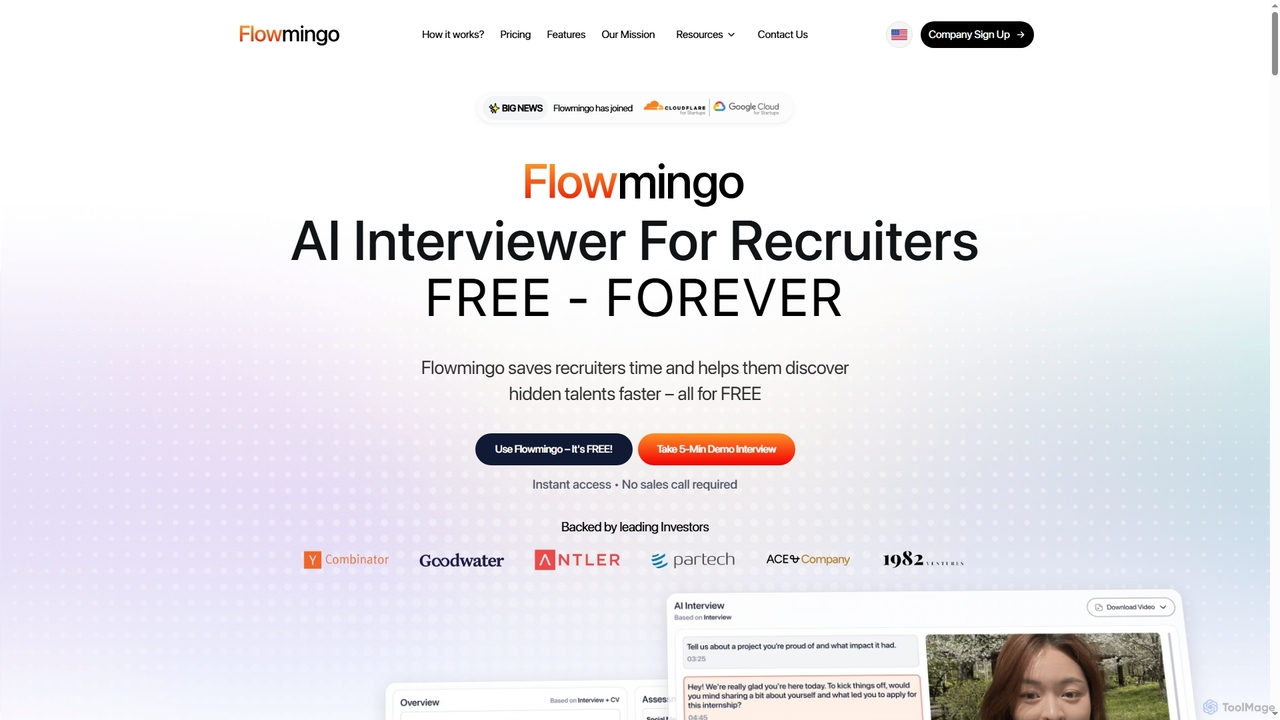
Flowmingo is a leading AI-powered interview platform designed to help recruiters identify top talent faster and more fairly. It offers free, unlimited asynchronous AI interviews, comprehensive candidate evaluations, and advanced proctoring, streamlining the hiring process for teams worldwide.

Talent Acquisition
Visits 142.9KFavorites 156Likes 157

About Candidate Screening

Candidate Screening tools are AI-powered platforms designed to automate and enhance the initial evaluation of job applicants. These tools leverage natural language processing, machine learning, and behavioral analytics to efficiently assess resumes, skills, and cultural fit. They help recruiters quickly identify the most promising candidates from large applicant pools, streamlining the hiring funnel and reducing time-to-hire.

Core Features

  • Resume Parsing & Analysis: Automatically extract and analyze information from resumes, identifying key skills, experience, and qualifications.
  • Skill & Competency Matching: Match candidate profiles against job requirements using AI algorithms to identify best-fit individuals.
  • Automated Pre-screening Questions: Deploy AI chatbots or forms to ask standardized questions and evaluate responses for suitability.
  • Behavioral & Psychometric Assessments: Utilize AI to analyze candidate responses in assessments for personality traits and job-relevant behaviors.
  • Video Interview Analysis: Transcribe and analyze video interviews for keywords, sentiment, and non-verbal cues to aid evaluation.

Applicable Scenarios

Recruitment teams in large enterprises or high-volume hiring environments frequently use these tools to manage thousands of applications. HR departments leverage them to ensure fair and unbiased initial evaluations. Staffing agencies also deploy these solutions to quickly match candidates with client requirements across various roles.

How to Choose

When selecting a Candidate Screening tool, consider its accuracy in parsing diverse resume formats and languages. Evaluate its integration capabilities with existing ATS (Applicant Tracking Systems) and HRIS. Assess the breadth of assessment types offered, such as skill tests or behavioral analytics. Finally, review its compliance with data privacy regulations and its ability to mitigate bias.

Candidate Screening use cases

1

Automated Resume Analysis for High-Volume Roles

HR departments in large corporations use AI candidate screening tools to process thousands of resumes for entry-level or high-volume positions. The AI automatically parses resumes, extracts relevant keywords, and scores candidates based on predefined criteria, such as education, experience, and specific skills. This significantly reduces the manual effort of initial resume review, allowing recruiters to focus on a pre-qualified shortlist and accelerate the hiring cycle by up to 70%.

2

Automating Initial Resume Review

HR managers use AI to automatically parse and rank hundreds of resumes for entry-level positions, identifying candidates whose skills and experience closely match job descriptions. This process significantly reduces the manual effort required, allowing HR teams to focus on more strategic tasks and accelerating the initial screening phase by up to 70%.

3

Pre-screening High-Volume Applicants

Talent acquisition specialists deploy AI chatbots to engage thousands of applicants with pre-screening questions, filtering out unqualified candidates based on essential criteria like work authorization or specific certifications. This ensures that only candidates meeting minimum requirements proceed, drastically reducing the workload for human recruiters and improving efficiency in mass hiring campaigns.

4

Pre-screening Video Interviews for Soft Skills

Recruiters hiring for customer-facing roles, such as sales or customer service, utilize AI candidate screening tools to analyze recorded video interviews. The AI assesses candidates' communication style, tone, and non-verbal cues, providing insights into their soft skills and cultural fit. This allows hiring managers to quickly identify candidates with strong interpersonal abilities before committing to live interviews, ensuring a better match for roles requiring significant human interaction.

5

Skill-based Candidate Matching for Specialized Roles

Technology companies seeking developers with niche programming language expertise or specific certifications leverage AI candidate screening to precisely match skills. The tools can analyze code samples, project portfolios, and technical assessment results, comparing them against highly specific job requirements. This ensures that only candidates with the exact technical proficiencies are forwarded for further consideration, drastically reducing the time spent on evaluating unqualified applicants for highly specialized positions.

6

Reducing Bias in Candidate Evaluation

Diversity & Inclusion officers utilize AI screening tools that anonymize candidate data and focus solely on skills and qualifications, helping to reduce unconscious bias in the initial stages of the hiring process. By standardizing evaluation criteria and removing identifying information, these tools promote a more equitable and fair assessment of all applicants.

7

Assessing Soft Skills via Video Interviews

Hiring teams use AI to analyze recorded video interviews, transcribing responses and identifying patterns in communication style, problem-solving approaches, and cultural fit, beyond just technical skills. This provides deeper insights into a candidate's personality and interpersonal abilities, crucial for roles requiring strong team collaboration and client interaction.

8

Reducing Bias in Initial Candidate Screening

Organizations committed to diversity, equity, and inclusion (DEI) initiatives use AI screening tools to mitigate unconscious bias in the early stages of hiring. These tools can anonymize candidate data, remove identifying information like names or photos, and focus solely on qualifications and skills. By standardizing the evaluation process and reducing human subjective judgment, AI helps create a more equitable playing field, leading to a more diverse and inclusive workforce.

9

Automated Pre-assessment Scoring for Candidate Aptitude

Companies looking to assess specific aptitudes or cognitive abilities for roles requiring critical thinking or problem-solving deploy AI-powered pre-assessments. These tools can administer standardized tests, analyze responses, and provide objective scores, often with detailed reports on candidate strengths and weaknesses. This automates a time-consuming part of the screening process, ensuring that only candidates who meet a certain aptitude threshold are considered for subsequent, more resource-intensive interview stages.

10

Identifying Best-Fit Candidates for Specialized Roles

Recruiters for tech companies use AI to scan candidate portfolios and project experience, matching specific programming languages, frameworks, or methodologies required for highly specialized engineering roles. This precision matching capability ensures that candidates possess the exact technical expertise needed, significantly reducing mis-hires and accelerating the placement of niche talent.

11

Streamlining Global Talent Acquisition

Multinational corporations employ AI screening tools capable of processing resumes and assessments in multiple languages, ensuring consistent and efficient evaluation of candidates from diverse geographical locations. This global capability allows companies to expand their talent pool without increasing manual screening overhead, fostering international recruitment efforts effectively.

12

Streamlining Candidate Communication and Scheduling

Recruitment teams use AI candidate screening tools to automate initial candidate communication and interview scheduling. After an initial screening, AI-powered chatbots can engage with shortlisted candidates, answer common FAQs, and facilitate the booking of interview slots based on recruiter availability. This enhances the candidate experience by providing prompt responses and efficient scheduling, while freeing up recruiters to focus on more strategic tasks rather than administrative overhead.

Candidate Screening FAQ

What are AI Candidate Screening tools?

AI Candidate Screening tools are software solutions that use artificial intelligence to automate and optimize the initial evaluation of job applicants. They analyze resumes, conduct pre-screening assessments, and identify top candidates based on predefined criteria, significantly speeding up the recruitment process and improving candidate quality.

What are AI Candidate Screening tools?

AI Candidate Screening tools are software solutions that use artificial intelligence to automate and optimize the initial stages of the recruitment process. They analyze candidate data, such as resumes, cover letters, and assessment results, to identify the most suitable applicants. These tools typically feature resume parsing, skill matching, and automated pre-assessments, helping organizations streamline hiring, reduce manual effort, and improve the quality of hires by focusing on objective data analysis.

How do AI tools screen candidates?

AI tools screen candidates by employing various technologies. Natural Language Processing (NLP) is used to parse resumes and cover letters, extracting key information and identifying relevant keywords. Machine learning algorithms then compare this data against job descriptions and ideal candidate profiles, scoring applicants based on compatibility. Some tools also use computer vision to analyze video interviews for non-verbal cues and sentiment. This multi-faceted approach allows for a comprehensive, data-driven evaluation.

How do AI Candidate Screening tools reduce bias?

These tools can reduce bias by focusing on objective data points like skills, experience, and assessment scores, rather than subjective factors. Many platforms offer features like anonymized resume review or bias detection algorithms to help ensure a fairer and more equitable evaluation process, promoting diversity and inclusion in hiring.

What are the benefits of using AI for candidate screening?

Using AI for candidate screening offers several significant benefits. It dramatically increases efficiency by automating repetitive tasks like resume review, saving recruiters valuable time. AI can also reduce unconscious bias by focusing on objective data and anonymizing candidate information, leading to more diverse hires. Furthermore, it improves the quality of hire by identifying best-fit candidates more accurately and consistently, enhancing the overall candidate experience through faster responses and streamlined processes.

What's the difference between Candidate Screening and general Recruiting tools?

Candidate Screening tools specifically focus on the *initial evaluation phase* of recruitment, filtering applicants based on qualifications, skills, and cultural fit. General Recruiting tools encompass the entire hiring lifecycle, including sourcing, applicant tracking, interviewing, offering, and onboarding, with screening being just one crucial component within this broader process.

What features should I look for in a Candidate Screening tool?

Key features include robust resume parsing, customizable pre-screening questions, skill assessment capabilities, and seamless integration with your existing Applicant Tracking System (ATS). Tools offering behavioral assessment, video interview analysis, and bias detection algorithms can provide deeper insights and enhance the fairness of your screening process.

How do AI Candidate Screening tools differ from traditional resume parsing software?

While traditional resume parsing software primarily extracts and organizes data from resumes, AI Candidate Screening tools go a significant step further. Traditional parsers focus on data extraction (e.g., job titles, dates, skills) into a structured format. AI screening tools, however, use machine learning and NLP to not only extract but also analyze, interpret, and score this data against job requirements, often incorporating predictive analytics for candidate success. They can assess soft skills from video, detect patterns, and even identify potential biases, offering a much deeper and more intelligent evaluation than basic parsing.

Who benefits most from using AI Candidate Screening tools?

Organizations with high hiring volumes, companies seeking to improve hiring efficiency, and those committed to reducing bias in their recruitment process benefit significantly. Recruiters, HR managers, and talent acquisition teams are the primary users, leveraging these tools to save time, enhance candidate quality, and ensure a more objective initial assessment.

What should I consider when choosing an AI Candidate Screening platform?

When choosing an AI Candidate Screening platform, prioritize the accuracy and explainability of its AI models to ensure reliable and transparent results. Evaluate its integration capabilities with your existing Applicant Tracking System (ATS) for seamless workflow. Consider the customization options for tailoring screening criteria to specific job roles and company culture. Data privacy, security measures, and the platform's commitment to ethical AI practices and bias mitigation are crucial. Finally, assess its scalability to handle varying recruitment volumes and its user-friendliness for both recruiters and candidates.