ToolMage
Sign in

Best 1 Encyclopedia AI tools for Reference

Popular Encyclopedia AI tools in Reference include Britannica, helping you work more efficiently.

Britannica
Freemium

Britannica

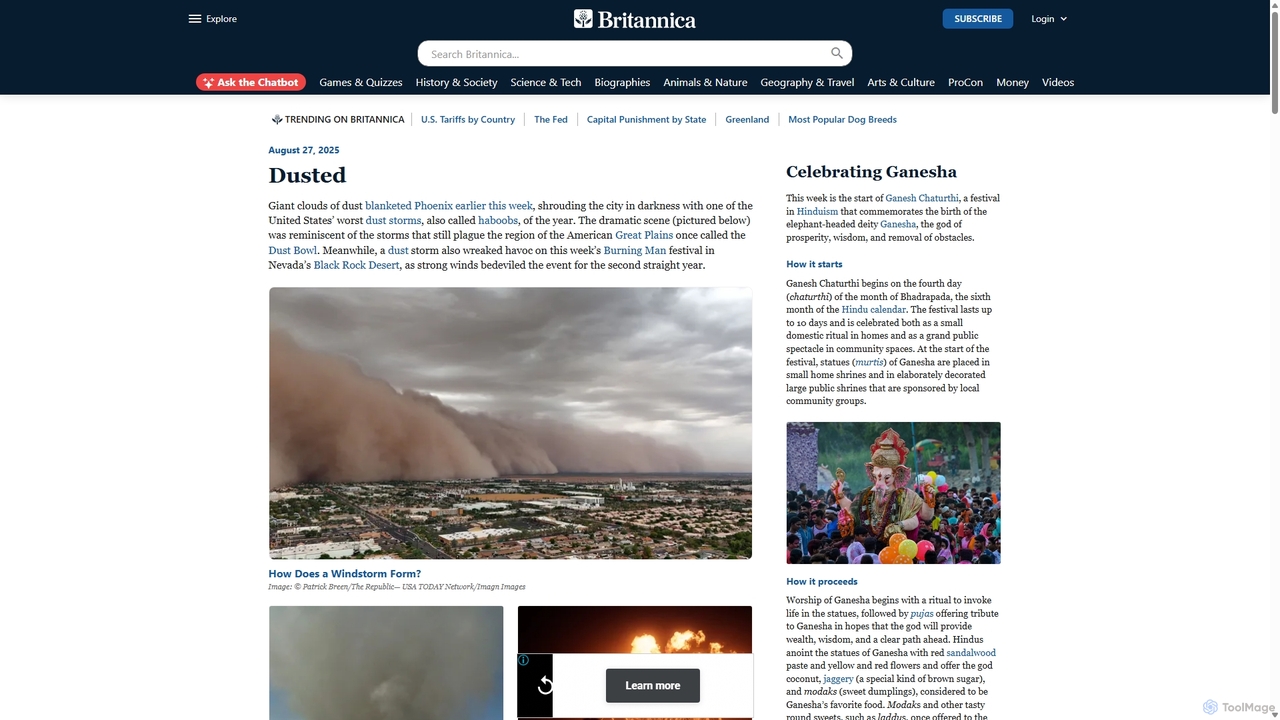
Britannica is a world-renowned knowledge platform that integrates an AI-powered chatbot to provide users with trusted, fact-checked answers from its extensive encyclopedia. It offers in-depth articles, quizzes, and multimedia content, making it an authoritative resource for students, researchers, and lifelong learners.

Research
Visits 33.2MFavorites 130Likes 135

About Encyclopedia

AI Encyclopedia tools are a class of reference platforms that use artificial intelligence to organize, synthesize, and present vast amounts of structured knowledge. Leveraging knowledge graphs and natural language processing, these tools go beyond simple keyword lookups to answer complex questions and reveal relationships between concepts. They are designed for in-depth research, learning, and complex problem-solving by providing verified, context-rich information. Unlike standard search engines, AI Encyclopedias prioritize accuracy and structured exploration over a simple list of web links.

Core Features

  • Natural Language Querying: Ask complex, conversational questions and receive synthesized answers.
  • Knowledge Synthesis: Generates summaries and explanations by connecting information from multiple sources.
  • Concept Mapping: Visually or textually displays the relationships between different topics and entities.
  • Source Citation: Provides verifiable sources and references for the information presented, ensuring credibility.
  • Structured Data Exploration: Allows users to navigate through a structured knowledge base rather than unstructured web pages.

Use Cases

These tools are valuable in academic research, corporate intelligence, and professional services. Researchers use them to accelerate literature reviews, while business analysts leverage them for market analysis. They are also used by content creators and journalists for rapid, in-depth fact-checking and background research.

How to Choose

When selecting an AI Encyclopedia, consider the scope and depth of its knowledge base—whether it's general or specialized. Evaluate its query understanding and the quality of its synthesized answers. The transparency of its sourcing and citation is critical for trust. Also, assess the user interface for ease of navigation and data exploration.

Featured tool rankings

Encyclopedia use cases

1

Academic Literature Review Acceleration

A graduate student researching quantum computing uses an AI Encyclopedia to quickly understand core concepts. Instead of reading dozens of papers, they ask, 'What is the relationship between quantum entanglement and quantum computing algorithms?' The tool provides a synthesized summary with diagrams and citations to seminal papers, saving weeks of initial research and providing a structured learning path.

2

Market & Competitor Intelligence Analysis

A business strategist needs to understand the landscape for a new product in the renewable energy sector. They use an AI Encyclopedia to query key competitors, technological trends, and regulatory frameworks. The tool generates a connected map of companies, their patented technologies, and recent market news, providing a comprehensive overview for strategic planning without manually collating data from multiple sources.

3

In-depth Journalistic Fact-Checking

An investigative journalist is writing a piece on a complex geopolitical event. They use an AI Encyclopedia to cross-reference names, dates, and claims. The tool provides sourced information and highlights connections between different entities and events, ensuring the article's accuracy and providing deeper context that might have been missed through conventional web searches.

4

Corporate Knowledge Base Navigation

A new engineer at a large tech company needs to understand a legacy software system. They query the company's internal AI Encyclopedia: 'Explain the architecture of Project X and its main dependencies.' The tool retrieves and synthesizes information from internal design documents, code repositories, and meeting notes, providing a clear, consolidated explanation that accelerates their onboarding process.

5

Advanced Scientific Concept Exploration

A high school biology teacher prepares a lesson on CRISPR gene editing. To create engaging material, they use an AI Encyclopedia to explore the history, mechanisms, and ethical implications of the technology. The tool provides structured explanations, visual aids, and links to recent research, enabling the teacher to build a comprehensive and up-to-date lesson plan.

6

Legal & Patent Prior Art Search

A patent lawyer is assessing the novelty of a new invention. They use a specialized AI Encyclopedia for legal and technical documents to search for prior art. By querying the core concepts of the invention, the tool surfaces related patents, academic papers, and technical publications, significantly streamlining a traditionally time-consuming and complex search process.

Encyclopedia FAQ

What is an AI Encyclopedia?

An AI Encyclopedia is an advanced reference tool that uses AI to provide structured, synthesized answers to complex questions. Unlike traditional encyclopedias, it dynamically connects concepts, generates summaries, and allows for natural language queries, acting as an interactive knowledge exploration system.

How does an AI Encyclopedia differ from a standard search engine?

The primary difference lies in structure and intent. A search engine indexes the web and returns a list of links, leaving the user to synthesize information. An AI Encyclopedia uses a curated or structured knowledge base to provide a direct, synthesized answer with verifiable sources, focusing on accuracy and conceptual understanding over broad discovery.

How to choose the right AI Encyclopedia tool?

When choosing, consider these factors:

  • Knowledge Domain: Ensure its database covers your field of interest (e.g., general, scientific, legal).
  • Source Transparency: Check if it provides clear citations and references to verify information.
  • Query Complexity: Test its ability to understand and answer nuanced, multi-part questions.
  • User Interface: The interface should facilitate easy exploration of related topics.

Who can benefit from using AI Encyclopedia tools?

A wide range of users can benefit, including students and academics for research, business professionals for market intelligence, journalists for fact-checking, and anyone seeking in-depth, reliable information on complex topics. They are particularly useful for tasks that require understanding relationships between concepts, not just isolated facts.

Is the information from AI Encyclopedias reliable?

Reliability depends on the tool's design. High-quality AI Encyclopedias prioritize trustworthiness by using curated knowledge bases from reputable sources and providing clear citations for all information presented. Always check the tool's sourcing methodology and cross-reference critical information, just as you would with any reference tool.