
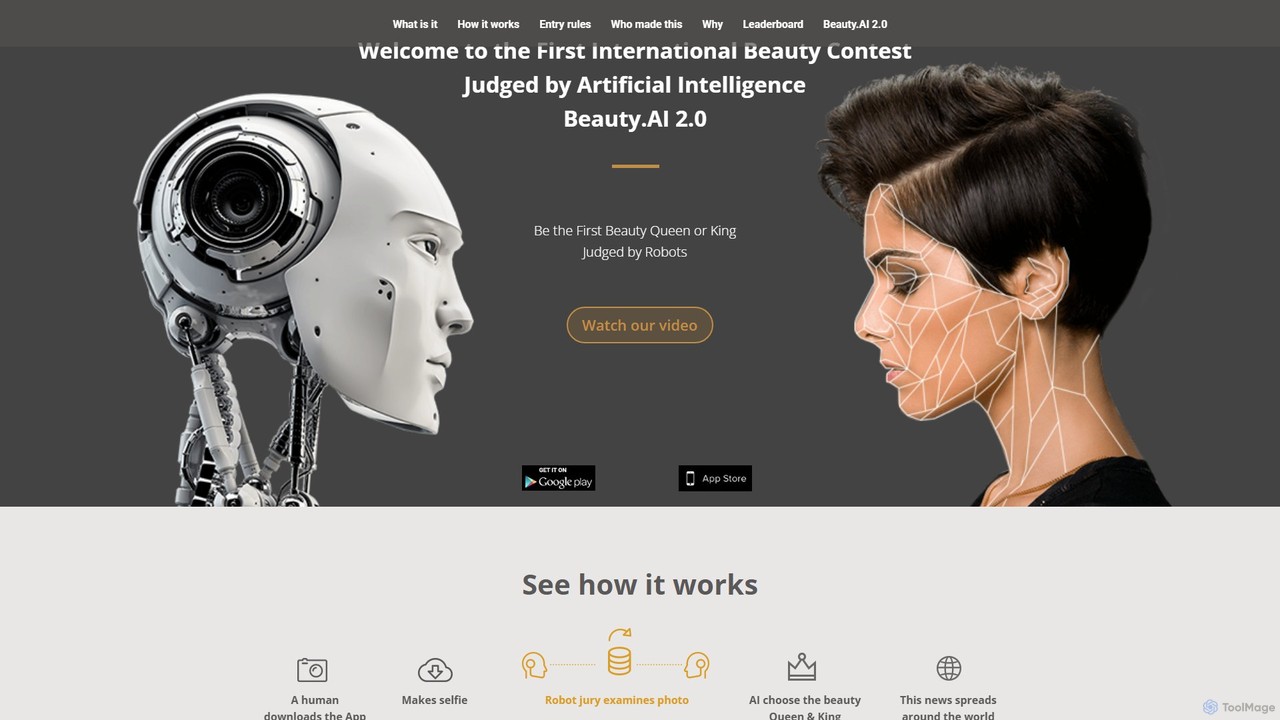
Beauty.AI
Beauty.AI is a pioneering platform that hosted the world's first international beauty contest judged by artificial intelligence. It …
Beauty.AI is a pioneering platform that hosted the world's first international beauty contest judged by artificial intelligence. It uses advanced algorithms to analyze facial features from selfies, aiming to find objective links between perceived beauty, health, and aging.
About Data Science
Data Science tools are AI-powered platforms designed to extract knowledge and insights from structured and unstructured data. They leverage machine learning algorithms to automate complex tasks like data cleaning, feature engineering, model building, and deployment. These tools empower users to uncover hidden patterns, make accurate predictions, and drive data-informed decisions without requiring deep coding expertise. Their primary value lies in accelerating the entire data science lifecycle, from raw data to actionable models.
Core Features
- Automated Machine Learning (AutoML): Automatically selects, trains, and tunes the best machine learning models for a given dataset.
- Data Preparation and Cleaning: Provides functions for handling missing values, normalizing data, and transforming variables.
- Predictive Modeling: Enables the creation and deployment of models for forecasting, classification, and regression tasks.
- Interactive Data Visualization: Generates dynamic charts, graphs, and dashboards to explore data and communicate findings effectively.
- Model Deployment and Monitoring: Simplifies the process of putting models into production and tracking their performance over time.
Use Cases
These tools are widely used across various industries. In finance, they are applied for credit scoring and fraud detection. Marketing teams use them for customer segmentation and churn prediction. In healthcare, they assist in disease prediction and treatment effectiveness analysis. As part of the broader Research category, Data Science tools provide the quantitative engine for hypothesis testing and discovery.
How to Choose
When selecting a Data Science tool, consider your team's technical skill level (no-code, low-code, or code-first). Evaluate its integration capabilities with your existing data sources like databases and cloud storage. Assess the breadth of its algorithm library and whether it supports the specific models you need. Finally, consider its scalability for handling large datasets and its ease of model deployment.
Data ScienceUse Cases
Predicting Customer Churn for a SaaS Company
A marketing analyst at a subscription-based software company needs to proactively reduce customer churn. Using an AI Data Science tool, they upload historical user activity data, subscription plans, and support ticket information. The platform's AutoML feature automatically processes the data and builds several classification models to predict the likelihood of a customer churning in the next 30 days. The analyst can then identify high-risk customers and target them with retention campaigns, such as special offers or proactive support, effectively reducing revenue loss.
Optimizing Retail Inventory with Sales Forecasting
A retail operations manager wants to optimize stock levels to prevent overstocking and stockouts. They use a data science platform to connect to their historical sales database. The tool allows them to build a time-series forecasting model that predicts future demand for various products based on seasonality, past sales trends, and promotional events. The manager receives weekly demand forecasts, enabling them to make more accurate purchasing decisions, improve cash flow, and ensure popular items are always available for customers.
Automating Credit Risk Assessment for Loans
A financial institution aims to speed up its loan approval process while maintaining accuracy in risk assessment. A credit analyst uses a no-code data science tool to build a predictive model. They input a dataset containing historical loan data, including applicant attributes (income, credit score, age) and loan outcomes (default or paid). The tool guides them to train a model that generates a risk score for new applicants in real-time. This automates the initial screening, allowing analysts to focus on complex cases and significantly reducing decision time from days to minutes.
Analyzing Clinical Trial Data for Efficacy
A biomedical researcher is analyzing data from a clinical trial to determine a new drug's effectiveness. They use a data science tool to integrate diverse datasets, including patient demographics, dosage information, and biomarker readings. The platform helps them perform statistical analysis and build a model to identify which patient subgroups respond best to the treatment. Interactive visualizations allow the researcher to explore correlations between variables, accelerating the discovery of critical insights and helping to prepare findings for publication more efficiently.
Personalizing E-commerce Product Recommendations
An e-commerce data scientist wants to improve the product recommendation engine on their website. Using a data science platform, they combine user browsing history, purchase data, and product metadata. They then build and train a collaborative filtering model that identifies patterns in user behavior to suggest relevant products. The model is deployed via an API and integrated into the website, providing real-time, personalized recommendations to shoppers. This leads to increased user engagement, higher conversion rates, and a larger average order value.
Detecting Anomalies in Financial Transactions
A cybersecurity analyst at a bank is tasked with identifying fraudulent transactions in real-time. They use an AI data science platform to analyze a continuous stream of transaction data. The analyst trains an anomaly detection model on historical data of legitimate transactions. Once deployed, the model monitors new transactions and flags any that deviate significantly from normal patterns, such as unusually large amounts or transactions from atypical locations. This allows the security team to investigate potential fraud immediately, minimizing financial losses for the bank and its customers.