getdewey
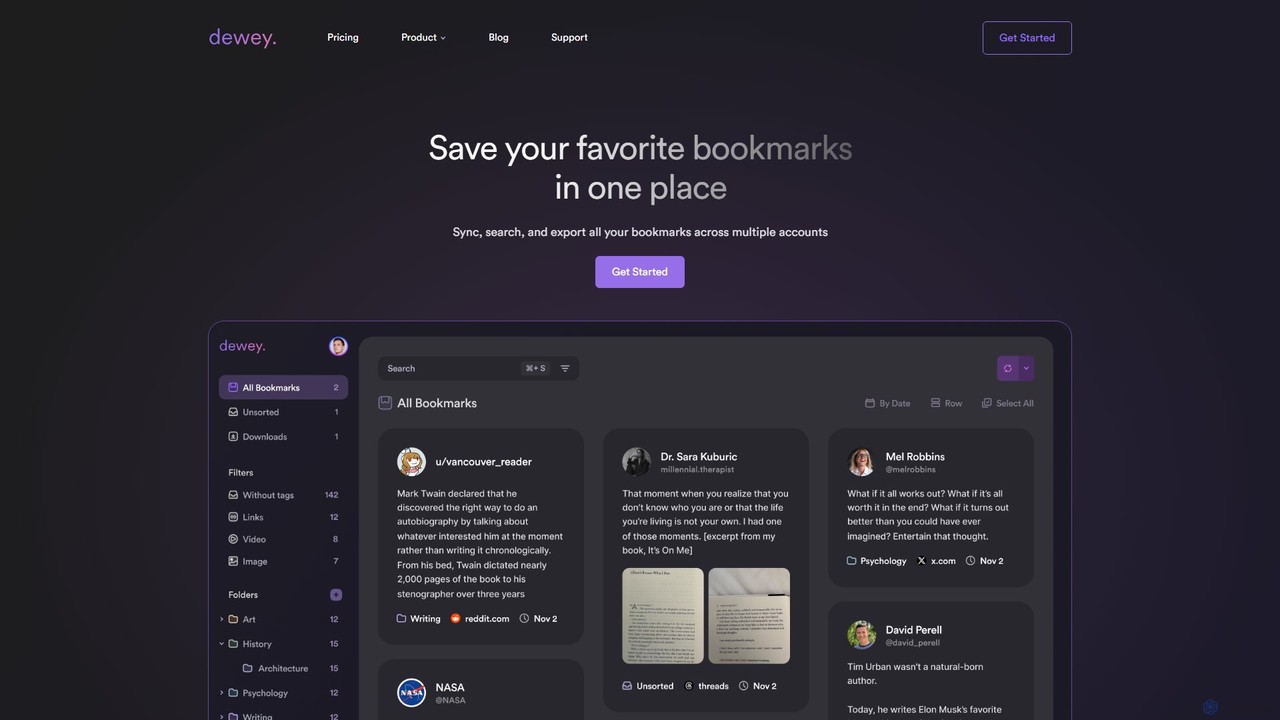
getdewey is an AI-powered bookmark manager that centralizes your saved content from Twitter/X, LinkedIn, TikTok, and the web. …
getdewey is an AI-powered bookmark manager that centralizes your saved content from Twitter/X, LinkedIn, TikTok, and the web. It allows you to search, organize with tags and folders, annotate, and export your bookmarks to tools like Notion and Google Sheets, transforming your saved links into a powerful, searchable knowledge base.
About Knowledgemanagement
Knowledge management tools are AI-powered platforms designed to systematically organize, store, retrieve, and share information within an organization or for personal use. These tools leverage advanced AI capabilities like natural language processing (NLP) and machine learning to extract insights, categorize content, and personalize access to vast amounts of data. They enable users to transform raw data and unstructured information into actionable knowledge, fostering better decision-making and innovation. By centralizing and making knowledge easily accessible, these solutions significantly enhance productivity and collaboration, especially in research-intensive environments.
Core Features
- Intelligent Content Categorization: Automatically tags, classifies, and organizes diverse content types (documents, videos, audio) using AI.
- Advanced Semantic Search: Allows users to find relevant information not just by keywords, but by understanding the context and meaning of queries.
- Automated Knowledge Extraction: AI identifies and extracts key facts, entities, and relationships from unstructured text, summarizing complex information.
- Personalized Knowledge Delivery: Recommends relevant information and insights to users based on their roles, projects, and past interactions.
- Collaborative Knowledge Sharing: Provides platforms for teams to contribute, review, and update shared knowledge bases efficiently.
Applicable Scenarios
Knowledge management tools are invaluable for organizations dealing with large volumes of information, such as R&D departments, legal firms, and customer support centers. They help research teams consolidate findings, enable legal professionals to quickly access case precedents, and empower support agents with instant answers. These tools are also crucial for onboarding new employees by providing a structured repository of company policies and best practices.
How to Choose
When selecting a knowledge management tool, consider its AI capabilities for content analysis and search accuracy, its integration with existing enterprise systems, and the scalability of its storage and user management. Evaluate the ease of content contribution and retrieval, the security features for sensitive information, and the flexibility of its customization options to fit specific organizational workflows and knowledge types.

KnowledgemanagementUse Cases
Streamline Research Findings Consolidation
Research teams use AI knowledge management to automatically ingest, categorize, and cross-reference scientific papers, experimental data, and project reports. This centralizes disparate information, allowing researchers to quickly identify patterns, avoid redundant work, and accelerate discovery processes by making all relevant knowledge instantly searchable and accessible.
Enhance Customer Support Efficiency
Customer service departments deploy these tools to build intelligent knowledge bases that empower agents with instant, accurate answers to complex queries. AI-driven search and recommendation engines guide agents to the most relevant articles, troubleshooting guides, or product specifications, significantly reducing resolution times and improving customer satisfaction.
Accelerate Employee Onboarding & Training
HR and training departments leverage knowledge management platforms to create comprehensive, easily navigable repositories of company policies, procedures, and training materials. New hires can independently access critical information, reducing the burden on trainers and accelerating their integration into the company by providing personalized learning paths.
Facilitate Legal Document Discovery
Legal professionals utilize AI knowledge management to efficiently organize, search, and analyze vast libraries of legal documents, case precedents, and contracts. The tools can identify relevant clauses, extract key entities, and highlight relationships between documents, drastically cutting down the time spent on discovery and due diligence processes.
Optimize Product Development Documentation
Engineering and product teams use these tools to manage design specifications, technical documentation, user manuals, and bug reports. AI helps in linking related documents, ensuring version control, and making it easy for developers to find specific code snippets or design decisions, thereby improving collaboration and product quality.
Support Strategic Decision-Making with Insights
Business leaders and analysts employ knowledge management systems to aggregate market research, competitive intelligence, and internal performance data. AI capabilities can then analyze this consolidated information to identify trends, predict outcomes, and provide data-driven insights, supporting more informed strategic planning and business development initiatives.