
ChatLaw
ChatLaw is an AI-powered legal assistant designed to streamline legal research, document drafting, and case analysis. It provides …
ChatLaw is an AI-powered legal assistant designed to streamline legal research, document drafting, and case analysis. It provides lawyers, students, and businesses with instant, accurate answers to complex legal questions and automates routine legal tasks, significantly boosting productivity and efficiency.
Case Radar
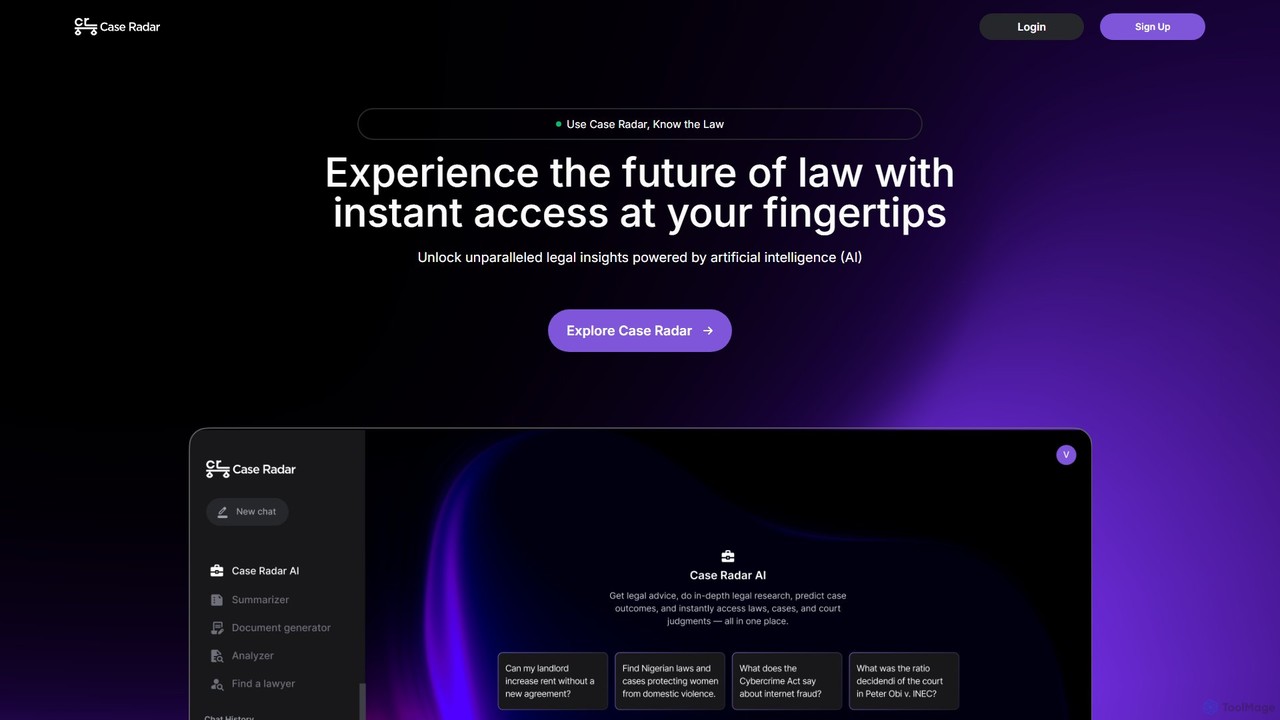
Case Radar is an AI-powered legal technology platform designed for lawyers, law students, and the public. It offers …
Case Radar is an AI-powered legal technology platform designed for lawyers, law students, and the public. It offers instant access to legal insights, document summarization, legal document generation, and AI-driven analysis, aiming to enhance legal practice efficiency and make law more accessible.

Paxton
Paxton is an all-in-one AI legal assistant designed to streamline legal workflows. It automates document drafting, provides in-depth …
Paxton is an all-in-one AI legal assistant designed to streamline legal workflows. It automates document drafting, provides in-depth document analysis, and conducts contextual legal research, catering to various legal fields like personal injury, family, and corporate law. It serves as a powerful tool for legal professionals to enhance efficiency and accuracy.
About Legal Research
Legal Research AI tools are specialized artificial intelligence applications designed to streamline and enhance the process of finding, analyzing, and interpreting legal information. These tools leverage advanced natural language processing (NLP), machine learning, and data analytics to process vast quantities of legal documents, including statutes, case law, regulations, and contracts. They empower legal professionals to conduct more efficient and comprehensive research, identify relevant precedents, and gain deeper insights into complex legal issues, significantly reducing the time and effort traditionally associated with legal discovery.
Core Features
- Automated Case Law Analysis: Quickly identifies relevant cases, judicial opinions, and dissenting arguments, highlighting key legal principles and outcomes.
- Contract Review and Analysis: Scans legal agreements for specific clauses, risks, compliance issues, and discrepancies, accelerating due diligence processes.
- Regulatory Compliance Monitoring: Tracks changes in laws and regulations across various jurisdictions, alerting users to potential compliance gaps and obligations.
- Legal Document Summarization: Generates concise summaries of lengthy legal texts, extracting critical information and key arguments.
- Predictive Analytics: Offers insights into potential litigation outcomes, judge behavior, and settlement probabilities based on historical data.
Applicable Scenarios
Legal Research AI tools are indispensable for law firms, corporate legal departments, government agencies, and academic institutions. They are used by lawyers, paralegals, legal tech specialists, and compliance officers to accelerate discovery phases, prepare for litigation, ensure contractual accuracy, and maintain adherence to evolving regulatory frameworks. These tools transform time-consuming manual tasks into efficient, data-driven processes.
How to Choose
When selecting an AI Legal Research tool, consider its data coverage (jurisdictions, document types), accuracy of AI algorithms in identifying relevant information, integration capabilities with existing legal software, and user interface intuitiveness. Evaluate the tool's ability to handle specific legal domains, its security protocols for sensitive data, and the clarity of its pricing model, including any hidden costs for advanced features or additional users.
Legal ResearchUse Cases
Expediting Case Law Discovery for Litigation
For litigation attorneys, AI legal research tools drastically cut down the time spent sifting through thousands of court documents. By inputting case facts and legal questions, the AI can quickly identify highly relevant precedents, judicial opinions, and dissenting arguments, providing a concise overview of applicable law and potential outcomes. This allows lawyers to build stronger arguments and prepare for court more efficiently, saving hundreds of hours per case.
Streamlining Contract Review and Due Diligence
Corporate legal teams and M&A specialists utilize AI for rapid contract analysis during mergers, acquisitions, or large-scale compliance audits. The AI can automatically extract key clauses, identify anomalies, flag potential risks, and ensure adherence to specific legal standards across hundreds or thousands of agreements. This significantly accelerates the due diligence process, reduces human error, and ensures comprehensive review within tight deadlines.
Monitoring Regulatory Changes for Compliance
Compliance officers and in-house counsel in regulated industries (e.g., finance, healthcare) leverage AI legal research to stay abreast of ever-evolving laws and regulations. These tools automatically track legislative updates across multiple jurisdictions, providing real-time alerts on changes that impact their business. This proactive approach helps prevent non-compliance, mitigates legal risks, and ensures the organization remains compliant without extensive manual effort.
Enhancing Legal Document Summarization and Analysis
Legal professionals often face overwhelming volumes of documents, from discovery materials to expert reports. AI tools can generate concise, accurate summaries of lengthy legal texts, highlighting critical facts, arguments, and conclusions. This capability allows lawyers and paralegals to quickly grasp the essence of complex documents, prioritize their review, and extract key information for briefs or client communications, improving overall productivity.
Predicting Litigation Outcomes and Settlement Probabilities
For strategic planning and risk assessment, AI legal research platforms offer predictive analytics. By analyzing historical case data, judge behavior, and past settlement patterns, these tools can provide data-driven insights into the likely outcomes of litigation or the probability of a successful settlement. This empowers legal teams to make more informed decisions regarding case strategy, resource allocation, and client advice, optimizing their approach to dispute resolution.
Supporting Academic Legal Research and Scholarship
Legal scholars and researchers in universities use AI tools to explore vast legal databases for academic purposes. The AI can help identify emerging legal trends, analyze historical legislative changes, and cross-reference scholarly articles with primary legal sources. This facilitates the discovery of novel research questions, supports the development of comprehensive legal theories, and enhances the efficiency of literature reviews for publications and dissertations.