OpenEvidence
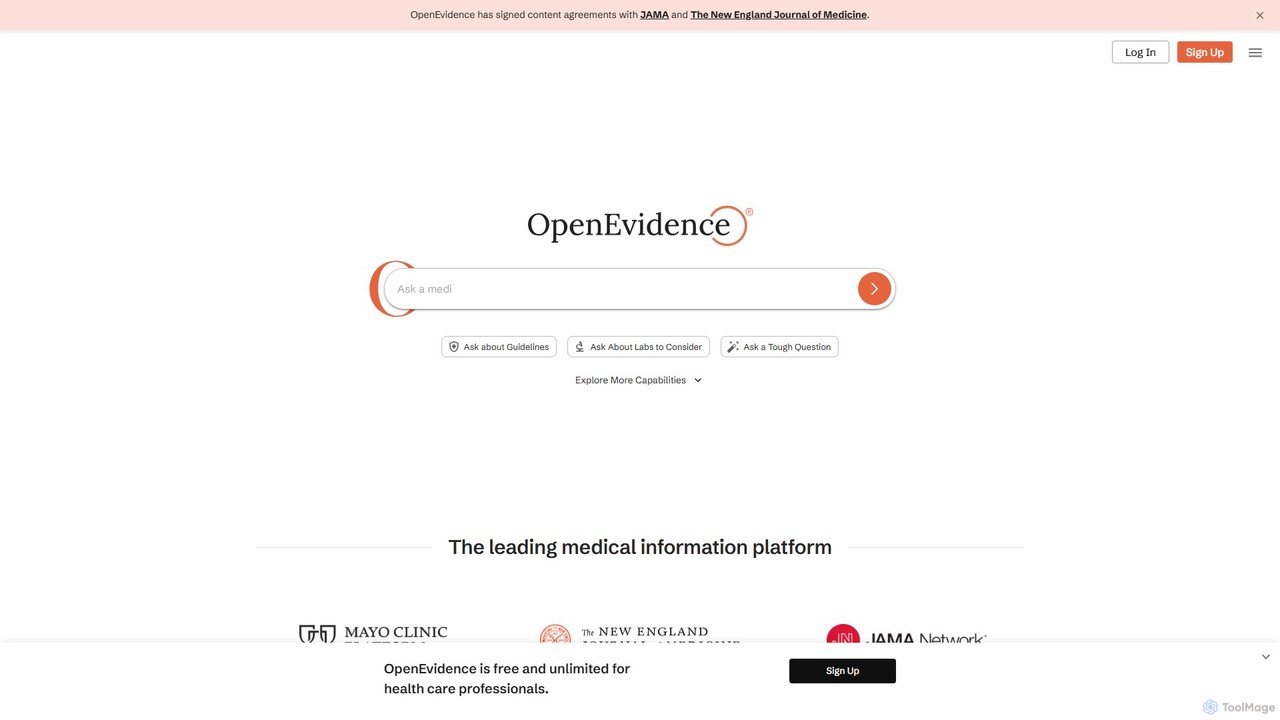
OpenEvidence is a leading AI-powered medical information platform designed for healthcare professionals. It synthesizes vast medical literature from …
OpenEvidence is a leading AI-powered medical information platform designed for healthcare professionals. It synthesizes vast medical literature from top-tier sources like NEJM and JAMA to provide instant, evidence-based answers for clinical decision-making. The platform is HIPAA compliant, offers CME credits, and is free for verified U.S. healthcare providers.
About Literature Synthesis
Literature Synthesis tools are a specialized class of AI research assistants designed to analyze, consolidate, and synthesize information from a large collection of academic documents. These tools leverage Natural Language Processing (NLP) and machine learning to extract key findings, identify recurring themes, and map conceptual connections across multiple papers. Their primary value lies in dramatically accelerating the literature review process, helping researchers uncover hidden patterns, identify research gaps, and build a comprehensive understanding of a field. They transform a mountain of individual studies into a coherent, structured knowledge base.
Core Features
- Thematic Analysis: Automatically identifies and clusters recurring themes, concepts, and arguments from a corpus of texts.
- Multi-Document Summarization: Generates a single, cohesive summary that synthesizes the core findings from numerous sources.
- Concept Mapping: Visually represents the relationships between key concepts, authors, and theories within the literature.
- Contradiction and Gap Detection: Highlights conflicting findings between studies and points out areas that are under-researched.
- Citation Network Analysis: Analyzes citation patterns to trace the intellectual lineage of ideas and identify seminal works.
Applicable Scenarios
These tools are indispensable for academics, PhD students, and researchers in any field conducting systematic or scoping reviews. In medicine and public health, they are used to synthesize clinical trial data for evidence-based practice. Corporate R&D teams use them to analyze patent landscapes and scientific literature to inform innovation strategy. Policy analysts also rely on them to consolidate research for creating evidence-based reports.
Selection Criteria
When choosing a Literature Synthesis tool, consider the scope of its supported databases (e.g., PubMed, Scopus, Web of Science). Evaluate the depth of its analytical features—does it simply summarize or perform true thematic synthesis? Assess its collaboration capabilities for team-based projects and check for robust export options for bibliographies (e.g., BibTeX, RIS) and reports. The user interface and learning curve are also important factors for efficient integration into your research workflow.

Literature SynthesisUse Cases
Accelerating a PhD Literature Review
A doctoral student in social sciences is facing the daunting task of reviewing over 200 papers for their dissertation's literature review chapter. Instead of spending months manually reading and synthesizing, they upload the entire collection to a Literature Synthesis tool. The AI automatically identifies the main theoretical frameworks, key debates, and methodological approaches within the field. It generates a concept map showing how influential authors are connected and highlights several under-explored intersections between topics, providing a clear direction for their original contribution. This reduces the synthesis time by over 70% and helps build a more robust theoretical foundation.
Conducting a Medical Systematic Review
A clinical research team needs to conduct a systematic review on the efficacy of a new class of drugs. They use a Literature Synthesis tool to screen thousands of abstracts from databases like PubMed and Embase. The tool helps them quickly identify relevant studies based on inclusion/exclusion criteria. For the included studies, the AI extracts key data points such as patient demographics, intervention details, and outcomes. It then synthesizes the findings, highlighting consistent results and noting any studies with conflicting outcomes, which streamlines the creation of evidence tables and meta-analysis, ensuring a rigorous and less biased review process.
Mapping the R&D Competitive Landscape
An R&D manager at a tech company wants to understand the state of the art in a specific technology domain before investing in a new project. They use a Literature Synthesis tool to analyze thousands of recent patents and research papers. The tool generates a visual map of key research clusters, identifies the most active companies and academic institutions, and tracks the evolution of core concepts over time. This synthesis reveals an emerging technological approach that competitors have overlooked, providing a strategic advantage and informing the company's R&D roadmap with data-driven insights, saving hundreds of hours of manual analysis.
Creating an Evidence-Based Policy Brief
A policy analyst working for a non-governmental organization is tasked with creating a brief on climate change adaptation strategies. They gather hundreds of reports, academic articles, and government publications. Using a Literature Synthesis tool, the analyst quickly identifies the most frequently cited strategies and categorizes them by effectiveness and region. The tool also highlights conflicting evidence regarding the economic impact of certain policies, allowing the analyst to present a nuanced and balanced view. The final brief is well-supported by a broad range of evidence, synthesized efficiently and accurately, strengthening its credibility with policymakers.
Drafting a Comprehensive Review Article
An established professor aims to write a review article summarizing the last decade of research in their field. They use a Literature Synthesis tool to process over 500 key papers. The AI performs a thematic analysis, identifying major research fronts, declining topics, and emerging trends. It also generates a citation network analysis, visualizing the most influential papers and how they shaped subsequent research. This provides a structured outline for the article and uncovers subtle shifts in the field's focus that would be difficult to spot manually. The professor can then focus on providing high-level interpretation and future directions, rather than getting bogged down in manual categorization.
Scoping an Interdisciplinary Research Project
A team of researchers from biology, computer science, and ethics wants to launch a new project on AI in genomics. To understand the existing landscape, they use a Literature Synthesis tool to analyze papers from all three fields. The tool identifies common terminologies and bridging concepts that connect the disciplines. It also highlights areas where ethical considerations are frequently discussed in computer science papers but are absent in biology literature, revealing a critical research gap. This cross-disciplinary synthesis helps the team define a novel research question that is relevant and impactful for all involved fields, fostering true interdisciplinary collaboration from the outset.