Research Best in category 1 results Neuroscience AI Tool

Popular AI tools in the Neuroscience field of Research include Bethge Lab, etc., helping you quickly improve efficiency.

Free
Bethge Lab

Bethge Lab

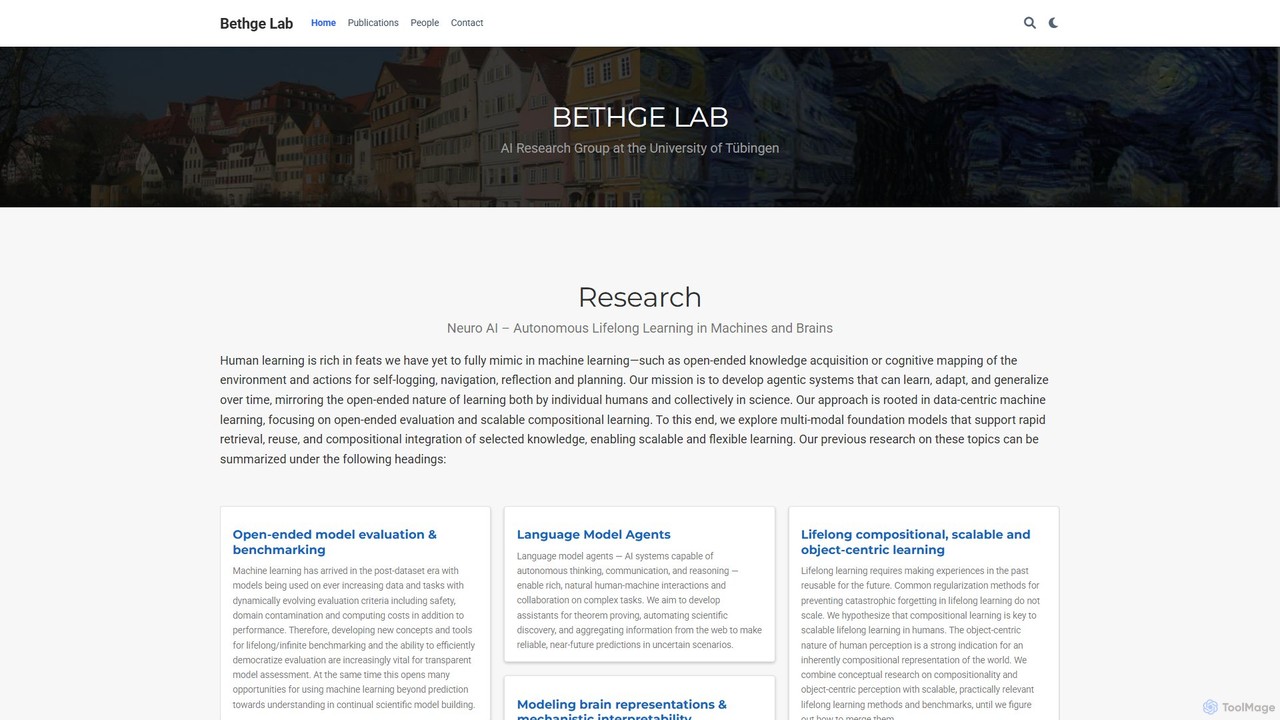
Bethge Lab is a leading AI research group at the University of Tübingen, focusing on the intersection of …

6.7K

About Neuroscience

AI Neuroscience tools are a specialized class of software that applies machine learning and computational models to analyze and interpret complex brain data. These tools leverage advanced algorithms to identify patterns in neural signals from sources like EEG, fMRI, and MEG, or to simulate brain functions. Their primary value lies in accelerating research into brain disorders, enhancing our understanding of cognition, and powering the development of brain-computer interfaces (BCIs). They enable researchers to process vast datasets and uncover insights that are often invisible to traditional analysis methods.

Core Features

  • Neural Signal Processing: Automated analysis and feature extraction from EEG, fMRI, and other neuroimaging data.
  • Computational Brain Modeling: Simulation of neural circuits and cognitive processes to test hypotheses about brain function.
  • Brain-Computer Interface (BCI) Algorithms: Decoding of brain activity to translate user intent into commands for external devices.
  • Neurological Biomarker Discovery: Identification of subtle patterns in data that correlate with diseases like Alzheimer's or epilepsy.
  • Connectome Analysis: Mapping and analysis of neural connections within the brain using AI-driven image segmentation.

Applicable Scenarios

These tools are primarily used in academic research institutions, clinical neurology departments, and biotechnology companies. Neuroscientists use them to model cognitive functions, clinicians to find early diagnostic markers for diseases, and engineers in the neurotech industry to build advanced assistive devices and BCI applications.

Selection Criteria

When choosing an AI Neuroscience tool, consider its compatibility with your specific data modalities (e.g., EEG, fMRI). Evaluate the validation and accuracy of its underlying models. Assess its integration capabilities with existing research software like Python or MATLAB, and consider the computational resources required for its operation. Finally, ensure the tool's focus aligns with your research goals, whether clinical, cognitive, or computational.

NeuroscienceUse Cases

1

Mapping Brain Activity with fMRI Data

A cognitive neuroscientist is investigating memory formation. They use an AI tool to analyze fMRI scans from subjects performing a memory task. The tool employs a convolutional neural network (CNN) to identify subtle, distributed patterns of brain activation that traditional statistical methods might miss. This allows the researcher to map the neural networks involved with higher precision, leading to a publication in a high-impact journal and a deeper understanding of how the brain encodes new memories.

2

Predicting Epileptic Seizures from EEG Data

A clinical research team aims to develop an early warning system for epilepsy patients. They use an AI platform to train a recurrent neural network (RNN) on long-term EEG recordings. The model learns to identify complex temporal patterns that precede a seizure. The resulting algorithm can predict an impending seizure with significant lead time, enabling potential interventions and improving patient safety and quality of life.

3

Simulating Neural Circuits for Drug Discovery

A computational biologist at a pharmaceutical company is testing a new drug for Parkinson's disease. Instead of lengthy in-vivo trials, they use an AI modeling tool to simulate the drug's effect on a detailed virtual model of the basal ganglia. The AI simulates neurotransmitter interactions and neuronal firing rates, predicting the drug's potential to restore normal motor function. This process allows for rapid screening of multiple drug candidates, saving significant time and resources in the preclinical phase.

4

Developing a Brain-Computer Interface for Assistive Tech

A neurotechnology engineer is creating a BCI to help individuals with paralysis communicate. They use an AI toolkit to process real-time EEG signals from a user thinking about specific letters. The tool's machine learning model decodes these signals and translates them into text on a screen. The AI continuously adapts to the user's unique brain patterns, improving decoding accuracy over time and providing a viable new communication channel for those with severe motor impairments.

5

Automating Neuron Tracing in Microscopy Images

A researcher in connectomics studies the brain's wiring by analyzing thousands of high-resolution microscopy images. Manually tracing each neuron is incredibly time-consuming. They employ an AI tool with deep learning algorithms for image segmentation. The tool automatically identifies and traces the complex, branching structures of neurons and synapses, reducing a task that would take months to just a few days. This automation dramatically accelerates the mapping of neural circuits.

6

Identifying Genetic Biomarkers for Alzheimer's Disease

A genetics lab is searching for novel biomarkers for early Alzheimer's detection. They use an AI platform to analyze a massive dataset containing genomic, proteomic, and clinical data from thousands of patients. The AI applies unsupervised learning techniques to cluster patients and identify specific gene expression patterns strongly correlated with disease onset. This discovery helps pinpoint new targets for diagnostic tests and therapeutic development, potentially leading to earlier and more effective interventions.

NeuroscienceFrequently Asked Questions