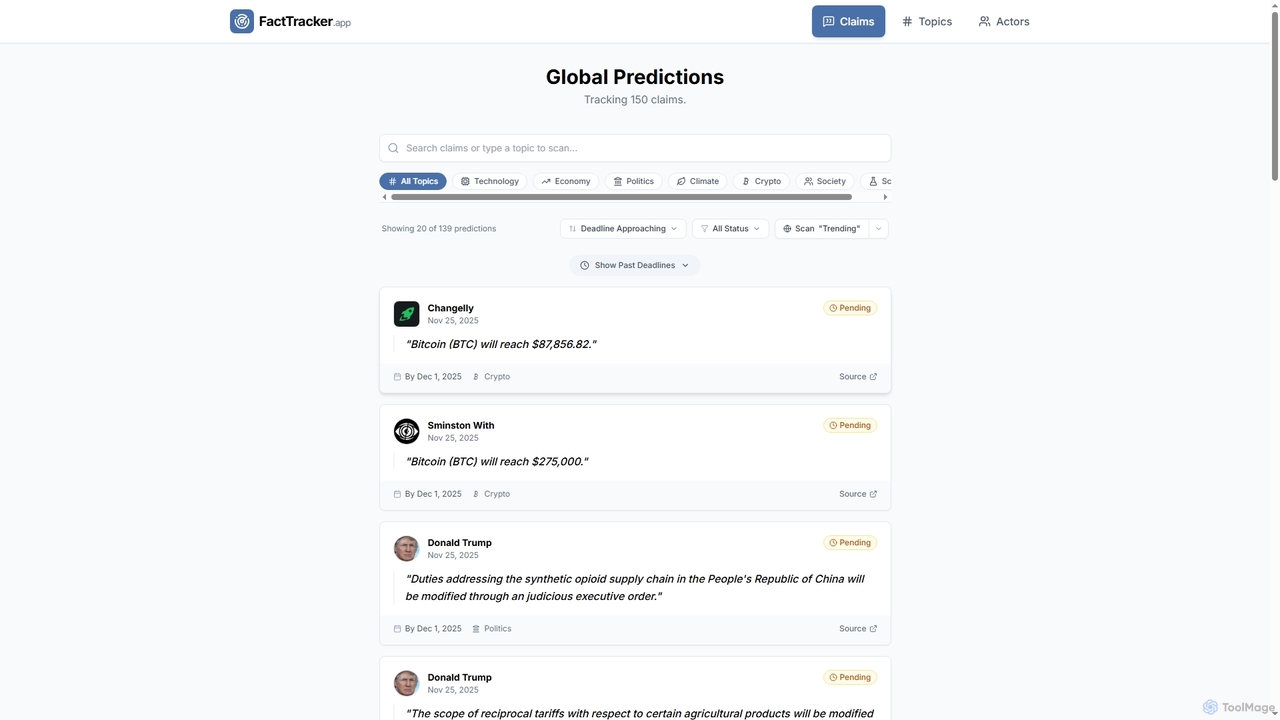
FactTracker
FactTracker is a platform that monitors and evaluates predictions and claims made by various sources across diverse global …
FactTracker is a platform that monitors and evaluates predictions and claims made by various sources across diverse global topics. It tracks these claims against real-world outcomes to reveal who consistently gets reality right, providing transparency and accountability for forecasts.
About Research Tools
Research Tools are AI-powered applications designed to automate and enhance various stages of the research process. They leverage advanced algorithms to efficiently gather, analyze, and synthesize vast amounts of information, providing users with actionable insights and saving significant time. These tools are invaluable for academics, market analysts, and business strategists seeking to make data-driven decisions by streamlining complex data handling. Their core strength lies in transforming raw data into structured, understandable knowledge.
Core Features
- Automated Data Collection: Efficiently extracts and aggregates data from diverse sources like academic papers, web pages, and social media.
- Advanced Data Analysis: Utilizes machine learning for sentiment analysis, trend identification, statistical modeling, and pattern recognition.
- Literature Review & Synthesis: Automatically summarizes research papers, identifies key themes, and helps in synthesizing findings across multiple documents.
- Competitive Intelligence: Monitors competitor activities, market trends, and industry news to provide strategic insights.
- Report Generation: Transforms analyzed data into structured reports, visualizations, and presentations, often with customizable templates.
Use Cases
These tools are widely adopted across various sectors. Academics use them to accelerate literature reviews and identify research gaps. Market researchers leverage them for comprehensive trend analysis and consumer behavior insights. Businesses employ them for competitive benchmarking and strategic planning, while content creators find them useful for topic discovery and audience analysis.
How to Choose
When selecting AI research tools, consider the breadth of data sources it can access, the depth and types of analysis it offers (e.g., qualitative vs. quantitative), its integration capabilities with existing workflows, and the accuracy of its AI models. Evaluate the user interface for ease of use, the level of customization available, and the pricing structure relative to your research needs and budget.
Research ToolsUse Cases
Accelerating Academic Literature Reviews
Academics and students use AI research tools to rapidly search, filter, and summarize thousands of scholarly articles. This allows them to identify key theories, methodologies, and gaps in existing research, significantly reducing the time spent on initial literature synthesis and enabling quicker hypothesis formulation for their studies.
Automating Academic Literature Reviews
An academic researcher needs to review hundreds of papers for a new study. Using AI research tools, they can automatically extract key findings, identify recurring themes, and summarize relevant sections across a vast corpus of literature. This process significantly reduces the manual effort and time spent, allowing the researcher to focus on critical analysis and hypothesis generation, potentially saving weeks of work.
Gaining Market Intelligence & Competitor Insights
Market research teams deploy these tools to monitor industry trends, analyze competitor strategies, and track public sentiment around brands or products. By automating data collection from news, social media, and financial reports, businesses can make informed decisions on product development, marketing campaigns, and strategic positioning.
Conducting Market Trend Analysis
A marketing strategist needs to understand emerging market trends for a new product launch. AI research tools can scan vast amounts of news articles, social media discussions, and industry reports to identify trending topics, consumer sentiment shifts, and competitive activities. This enables the strategist to quickly pinpoint opportunities and threats, informing product positioning and marketing campaign development with data-driven insights.
Automating Data Analysis for Scientific Experiments
Scientists utilize AI research tools to process and interpret large datasets generated from experiments, clinical trials, or simulations. These tools can identify correlations, anomalies, and statistically significant patterns that might be missed by manual analysis, leading to faster discovery and validation of findings across various scientific disciplines.
Gathering Competitive Intelligence
A business development team aims to understand competitor strategies and product offerings. AI research tools can continuously monitor competitor websites, press releases, patent filings, and customer reviews. By analyzing this data, the team gains insights into competitor strengths, weaknesses, pricing strategies, and upcoming innovations, enabling them to refine their own strategic planning and maintain a competitive edge.
Enhancing Grant Proposal & Patent Research
Researchers and innovators employ AI to efficiently search for relevant prior art, existing patents, and funding opportunities. The tools can identify key phrases, related concepts, and potential collaborators, strengthening grant applications and ensuring the novelty of patent claims by providing comprehensive background information and competitive analysis.
Analyzing Customer Feedback for Product Development
A product manager needs to identify common pain points and feature requests from customer feedback. AI research tools can process thousands of customer reviews, support tickets, and survey responses, performing sentiment analysis and topic modeling. This allows the product manager to quickly prioritize development efforts based on quantifiable customer needs, leading to more impactful product improvements and higher customer satisfaction.
Streamlining Qualitative Data Coding & Thematic Analysis
Social scientists and UX researchers use AI to automatically categorize and identify themes within qualitative data such as interview transcripts, open-ended survey responses, or focus group discussions. This accelerates the process of identifying recurring patterns and extracting meaningful insights from unstructured text, saving significant manual effort.
Identifying Emerging Topics for Content Creation
A content creator or marketing team aims to produce highly engaging and relevant content. AI research tools can analyze search trends, social media discussions, and popular articles to identify emerging topics and keywords with high audience interest. This helps the team generate content ideas that resonate with their target audience, improving content performance and driving organic traffic.
Personalized Learning & Content Curation for Students
Students can use AI research tools to find and summarize relevant educational materials, articles, and videos based on their specific learning objectives or assignment topics. This helps them quickly grasp complex subjects and curate personalized study resources, improving learning efficiency and fostering deeper understanding without extensive manual searching.
Streamlining Grant Proposal Research
A non-profit organization is preparing a grant proposal and needs to quickly gather supporting data and evidence. AI research tools can rapidly search for relevant statistics, case studies, and demographic information from government databases, academic journals, and public reports. This accelerates the evidence-gathering phase, allowing the organization to build a stronger, data-backed proposal more efficiently and increase their chances of securing funding.