Top AI Tools
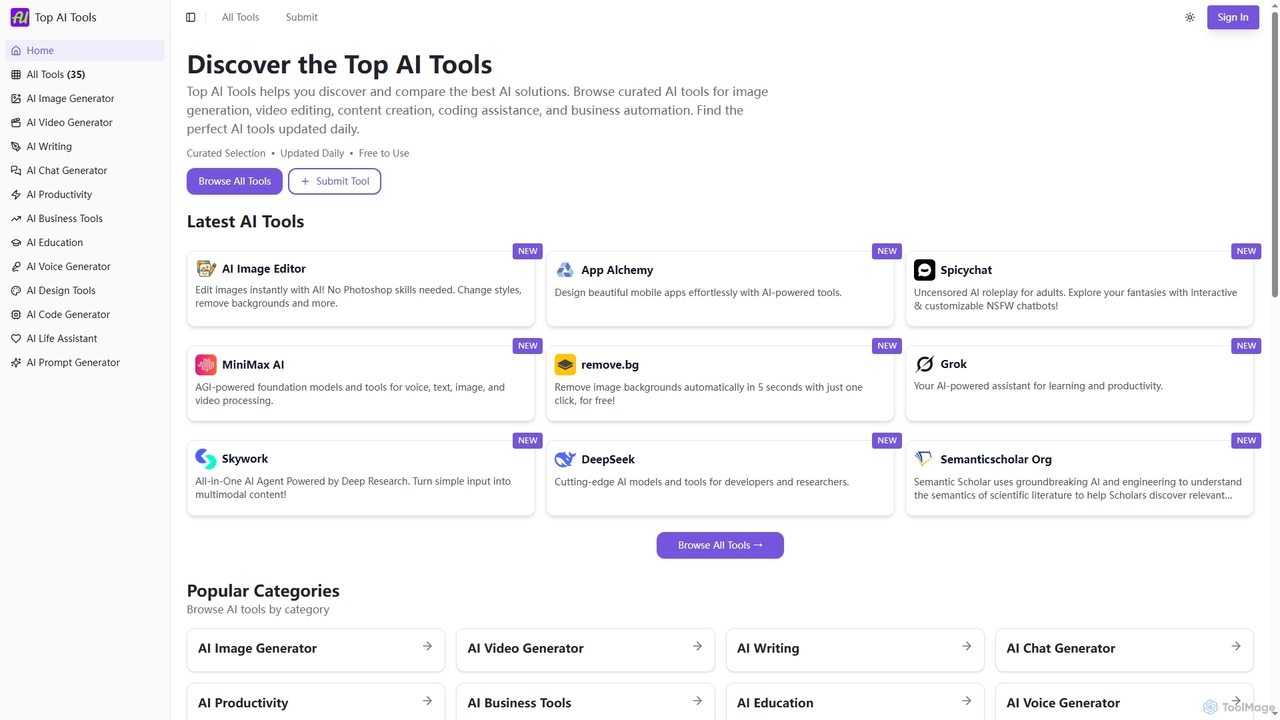
Top AI Tools is a comprehensive, free-to-use directory that helps users discover, compare, and explore the best AI-powered …
Top AI Tools is a comprehensive, free-to-use directory that helps users discover, compare, and explore the best AI-powered software solutions across various categories. It provides curated listings, detailed information on features and pricing, and daily updates to simplify the search for the perfect AI tool for any need.
About Resource Platform
AI Resource Platforms are centralized online hubs that provide access to essential assets for developing, training, and deploying artificial intelligence models. These platforms aggregate a vast collection of pre-trained models, diverse datasets, APIs, and computational resources in one place. Their primary value is to accelerate the AI development lifecycle by eliminating the need to search for and manage scattered components, enabling faster experimentation and innovation. Many also foster a collaborative environment, connecting developers, researchers, and data scientists worldwide.
Core Features
- Model Repository: Access to a large library of pre-trained models for tasks like NLP, computer vision, and audio processing.
- Dataset Hub: A collection of curated, public, and private datasets for training and benchmarking AI models.
- API Marketplace: Discover and integrate third-party AI APIs to add specific functionalities to applications.
- Compute Resources: On-demand access to GPUs and other specialized hardware for model training.
- Community & Collaboration Tools: Forums, collaborative notebooks, and version control for sharing knowledge and projects.
Use Cases
These platforms are widely used by AI researchers for accessing benchmark datasets, data scientists for finding pre-trained models to fine-tune, and software developers for integrating AI capabilities via APIs without deep ML expertise. In academia, they support learning and experimentation, while in enterprises, they facilitate the standardization and discovery of reliable AI components for building commercial applications.
How to Choose
When selecting an AI Resource Platform, consider the breadth and quality of its model and dataset libraries. Evaluate its integration capabilities with your existing development tools and cloud infrastructure. Assess the pricing model, whether it's pay-per-use for APIs and compute, subscription-based, or offers free community tiers. Finally, consider the strength of the community and the quality of documentation and support available.
Resource PlatformUse Cases
Accelerating AI Startup Prototyping
A developer at a tech startup needs to build a minimum viable product (MVP) with an image recognition feature. Instead of training a model from scratch, which requires extensive data and time, they browse a resource platform's model repository. They find a suitable pre-trained computer vision model and integrate it into their application via its API. This approach allows the team to launch a functional prototype in a matter of weeks, not months, significantly reducing time-to-market and conserving valuable startup capital.
Enhancing Academic Research and Experimentation
A university researcher is working on a novel natural language processing (NLP) algorithm. To validate their hypothesis, they need access to large, specialized datasets and significant computational power. They use an AI resource platform to access benchmark datasets like SQuAD or GLUE. The platform also provides on-demand GPU instances, allowing the researcher to train and iterate on their models efficiently without waiting for university-managed hardware. This access accelerates the research cycle, enabling faster validation of results and publication of findings.
AI Skill Development and Lifelong Learning
A professional looking to transition into a data science career uses a resource platform as their primary learning tool. They start with beginner-friendly tutorials and interactive notebooks that explain core machine learning concepts. The platform provides access to a wide variety of clean datasets, allowing them to practice data cleaning, feature engineering, and model building. By participating in community discussions and sharing their projects, they build a portfolio and gain practical, hands-on experience, which is crucial for securing a job in the competitive AI field.
Centralizing Enterprise AI Model Discovery
An MLOps engineer in a large enterprise is tasked with standardizing the process for sourcing third-party AI models. They leverage an AI resource platform as a centralized marketplace. Before a development team can integrate a new model, they must source it from the platform's curated list. The platform allows the engineer to vet models for performance, licensing, and potential biases. This creates a streamlined, secure, and governed process for discovering and deploying AI components across the organization, reducing risk and preventing redundant efforts.
Powering Data Science Competitions
A data scientist participating in a competitive programming event, like a Kaggle competition, uses a resource platform to gain an edge. The platform hosts the competition's dataset and provides collaborative notebooks, allowing them to start coding immediately without complex environment setup. They can explore public notebooks from other competitors to learn new techniques and use the platform's forums to discuss strategies. This integrated environment provides all the necessary tools—data, compute, and community—to build high-performing models and improve their ranking.
Augmenting Apps with Third-Party AI APIs
A mobile app developer, who is not an AI expert, wants to add a real-time language translation feature to their application. They visit an AI resource platform's API marketplace and search for translation services. They compare several APIs based on pricing, language support, and ease of integration. After selecting a suitable pay-as-you-go API, they follow the documentation to integrate it within a few hours. This allows them to enhance their app with advanced AI functionality quickly and cost-effectively, without needing to build or maintain any machine learning infrastructure.