Resources Best in category 2 results Library AI Tool

Popular AI tools in the Library field of Resources include God of Prompt、ModelFusion, etc., helping you quickly improve efficiency.

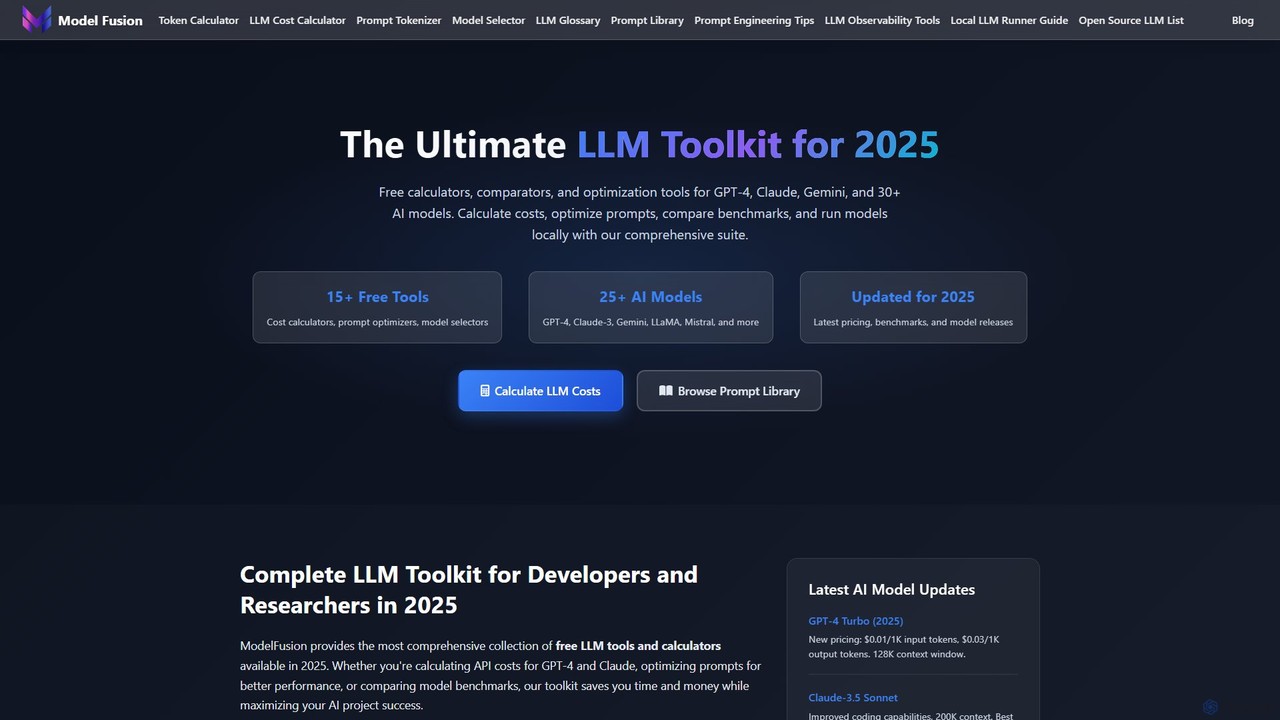
ModelFusion

ModelFusion

ModelFusion is an all-in-one LLM toolkit for developers and researchers. It offers a suite of free tools, including …

2.4K
God of Prompt

God of Prompt

God of Prompt is a comprehensive digital library offering over 30,000 expertly crafted AI prompts for leading models …

118.1K

About Library

AI Libraries are collections of pre-written code, functions, and modules that enable developers to implement complex AI capabilities. These libraries provide optimized, reusable components for tasks like machine learning and deep learning, abstracting away the underlying mathematical complexity. By using AI libraries, developers can significantly accelerate the development cycle, ensure algorithmic reliability, and build sophisticated AI applications more efficiently without starting from scratch. They form a foundational resource for both rapid prototyping and production-grade systems.

Core Features

  • Pre-built Algorithms: Offers a wide range of tested and optimized algorithms for classification, regression, clustering, and more.
  • High-Level APIs: Provides simplified interfaces that make it easier to define, train, and deploy complex models.
  • Hardware Acceleration: Includes optimizations for running computations on GPUs and TPUs, drastically reducing training times.
  • Data Handling Utilities: Contains tools for efficient loading, transformation, and manipulation of large datasets.
  • Extensive Documentation: Supported by comprehensive guides, tutorials, and a strong community for troubleshooting.

Use Cases

AI Libraries are primarily used by software developers, data scientists, and machine learning engineers. They are essential for building custom AI models for natural language processing (NLP), computer vision, predictive analytics, and recommendation systems. Researchers also rely on them to experiment with new neural network architectures and algorithms in academic settings.

How to Choose

When selecting an AI Library, consider the project's primary goal (e.g., computer vision vs. NLP), the programming language of your stack (Python is most common), and the library's ecosystem and community support. Also evaluate its performance, scalability for large datasets, and the steepness of its learning curve. Choosing a library that specializes in your required domain can often provide significant advantages.

LibraryUse Cases

1

Develop a Custom Image Recognition Model

A data science team needs to build a system that identifies specific product defects on a manufacturing line. Using a deep learning library like TensorFlow or PyTorch, they can design, train, and fine-tune a Convolutional Neural Network (CNN). The library provides pre-built layers, optimization algorithms, and tools for data augmentation, which drastically reduces development time compared to implementing the entire network from scratch. The final model can be deployed to analyze real-time video feeds and flag defective items with high accuracy.

2

Build a Sentiment Analysis Application

A software developer is tasked with adding a feature to a social media monitoring tool that gauges public opinion from user comments. Instead of building complex NLP models, the developer uses a specialized library like Hugging Face Transformers. This library provides direct access to state-of-the-art, pre-trained models like BERT. With just a few lines of code, the developer can implement a robust sentiment analysis function, classifying text as positive, negative, or neutral, thus saving weeks of research and development effort.

3

Rapid Prototyping of a Recommendation Engine

A startup wants to quickly test the viability of a personalized content recommendation feature. A machine learning engineer uses a library like Scikit-learn, which is ideal for classical machine learning tasks. They can rapidly implement and compare several recommendation algorithms, such as collaborative filtering or content-based filtering, using the library's standardized API and data processing tools. This allows the team to validate the concept with a functional prototype in days instead of months, making informed decisions before committing to a full-scale implementation.

4

Academic Research in Novel AI Architectures

A university researcher is developing a new type of neural network for medical imaging analysis. They use an AI library like PyTorch for its flexibility and strong support for dynamic computation graphs. The library's automatic differentiation engine handles the complex calculus of backpropagation, allowing the researcher to focus on designing the network architecture and experimentation. They can easily implement custom layers and loss functions, facilitating rapid iteration and exploration of new scientific ideas, which is crucial for publishing cutting-edge research.

5

Create a Predictive Analytics Tool for Business

A business analyst with Python skills is tasked with building a model to predict customer churn. They use a combination of libraries: Pandas for data cleaning and manipulation, and Scikit-learn to train a logistic regression or gradient boosting model. These libraries provide a straightforward workflow from raw data to a trained predictive model. The analyst can easily evaluate model performance using built-in metrics and then deliver actionable insights, such as identifying customers at high risk of leaving, without needing a deep background in theoretical machine learning.

6

Automate Computer Vision Tasks

A developer for a retail analytics company needs to implement a system for counting people in stores from security camera footage. They use a library like OpenCV, which provides a vast collection of functions for real-time computer vision. The developer can leverage pre-built functions for object detection, feature matching, and video stream processing. This allows them to build a robust people-counting application quickly, integrating it with existing camera systems without needing to write low-level image processing algorithms from scratch.

LibraryFrequently Asked Questions