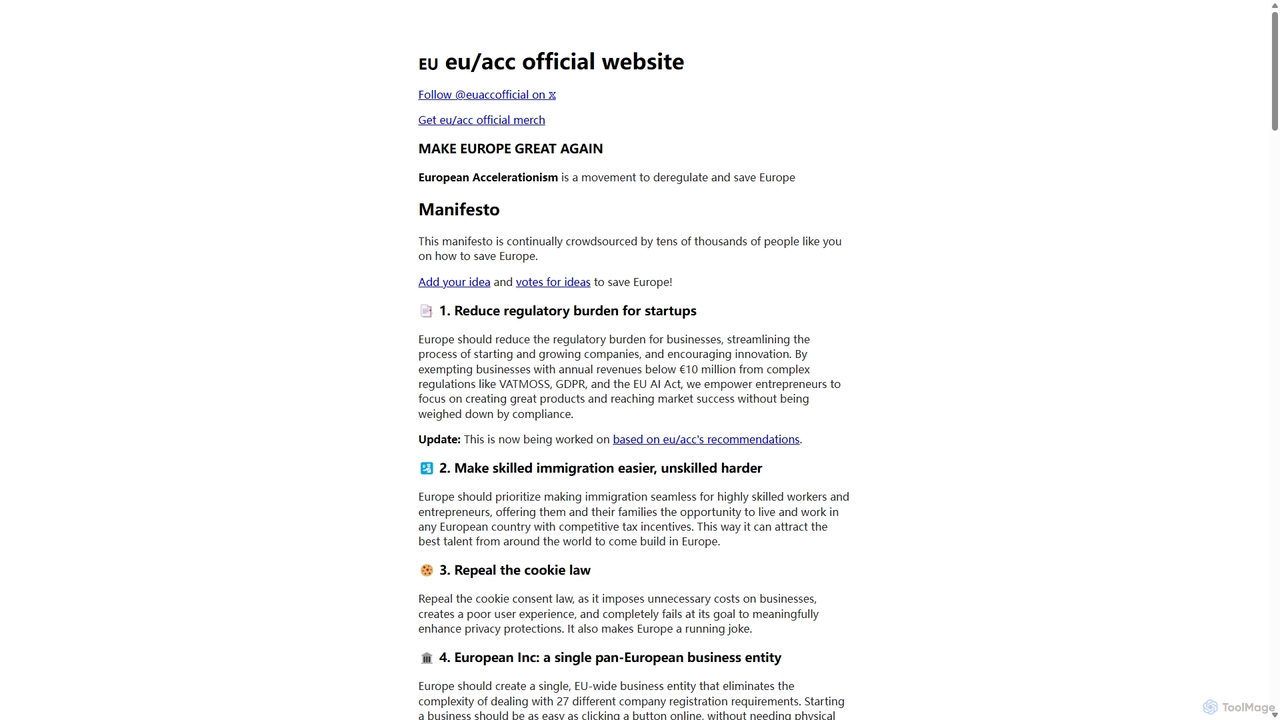
Euacc
Euacc (European Accelerationism) is a policy advocacy platform and movement dedicated to fostering innovation and economic growth in …
Euacc (European Accelerationism) is a policy advocacy platform and movement dedicated to fostering innovation and economic growth in Europe. It promotes deregulation, supports startups, and champions the adoption of advanced technologies like AI through a crowdsourced manifesto and direct political engagement.
About Policy
AI Policy refers to the frameworks, guidelines, and regulations governing the development, deployment, and use of artificial intelligence. These resources are crucial for ensuring AI systems are developed ethically, legally, and responsibly, providing essential guidance within the broader AI resources landscape. They help organizations navigate complex legal landscapes and uphold public trust. Understanding AI policy is vital for sustainable AI innovation.
Core Features
- Ethical Guidelines: Provides principles for fair, transparent, and accountable AI development.
- Regulatory Compliance: Offers insights into legal requirements like data privacy (e.g., GDPR) and industry-specific rules.
- Risk Assessment Frameworks: Helps identify, evaluate, and mitigate potential risks associated with AI systems.
- Data Governance Best Practices: Guides secure and ethical handling of data used in AI models.
- Internal Policy Templates: Supplies structures for organizations to create their own responsible AI usage policies.
Applicable Scenarios
AI policy resources are indispensable for legal and compliance departments ensuring regulatory adherence, for product development teams integrating ethical considerations into AI design, and for executive leadership formulating responsible AI strategies. They also serve government bodies in drafting new legislation and academic researchers studying AI governance.
How to Choose
When selecting AI policy resources, consider their relevance to your industry and geographical region, the depth of coverage across ethical, legal, and technical aspects, and the frequency of updates to reflect evolving regulations. Evaluate the clarity and practicality of the guidance provided, and ensure it aligns with your organization's specific governance needs and risk appetite.
PolicyUse Cases
Ensuring AI Product Regulatory Compliance
Legal and compliance teams utilize AI policy resources to meticulously review new AI products and services, ensuring they adhere to evolving data protection laws like GDPR or CCPA, and industry-specific regulations. This proactive approach helps prevent legal penalties and builds consumer trust by verifying that AI systems operate within established legal boundaries.
Developing Internal Responsible AI Guidelines
Organizations leverage AI policy frameworks to establish their own internal responsible AI guidelines, fostering ethical development and deployment practices. This involves defining principles for fairness, transparency, and accountability, guiding AI developers and product managers in creating AI solutions that align with corporate values and societal expectations.
Assessing and Mitigating AI System Risks
Data scientists and AI ethicists apply policy-driven risk assessment frameworks to identify potential biases, privacy vulnerabilities, or unintended societal impacts within AI models. By systematically evaluating these risks against established policy benchmarks, teams can implement targeted mitigation strategies, enhancing the safety and reliability of AI applications.
Establishing Robust AI Data Governance Strategies
Data privacy officers and IT security teams consult AI policy resources to design and implement comprehensive data governance strategies for AI initiatives. This includes defining protocols for data collection, storage, usage, and deletion, ensuring compliance with privacy regulations and ethical data handling throughout the AI lifecycle, from training to deployment.
Educating Stakeholders on AI Ethics and Usage
Project managers and HR departments use simplified AI policy summaries and training materials to educate employees, partners, and other stakeholders on responsible AI usage and ethical considerations. This ensures a shared understanding of organizational AI principles, promoting a culture of awareness and accountability across all levels of AI interaction.
Monitoring and Adapting to New AI Legislation
Public policy analysts and legal counsel continuously monitor global and local legislative developments in AI, using policy tracking resources to interpret new laws and regulations. This enables organizations to proactively adapt their AI strategies and operations, ensuring ongoing compliance and strategic positioning in a rapidly changing regulatory landscape.