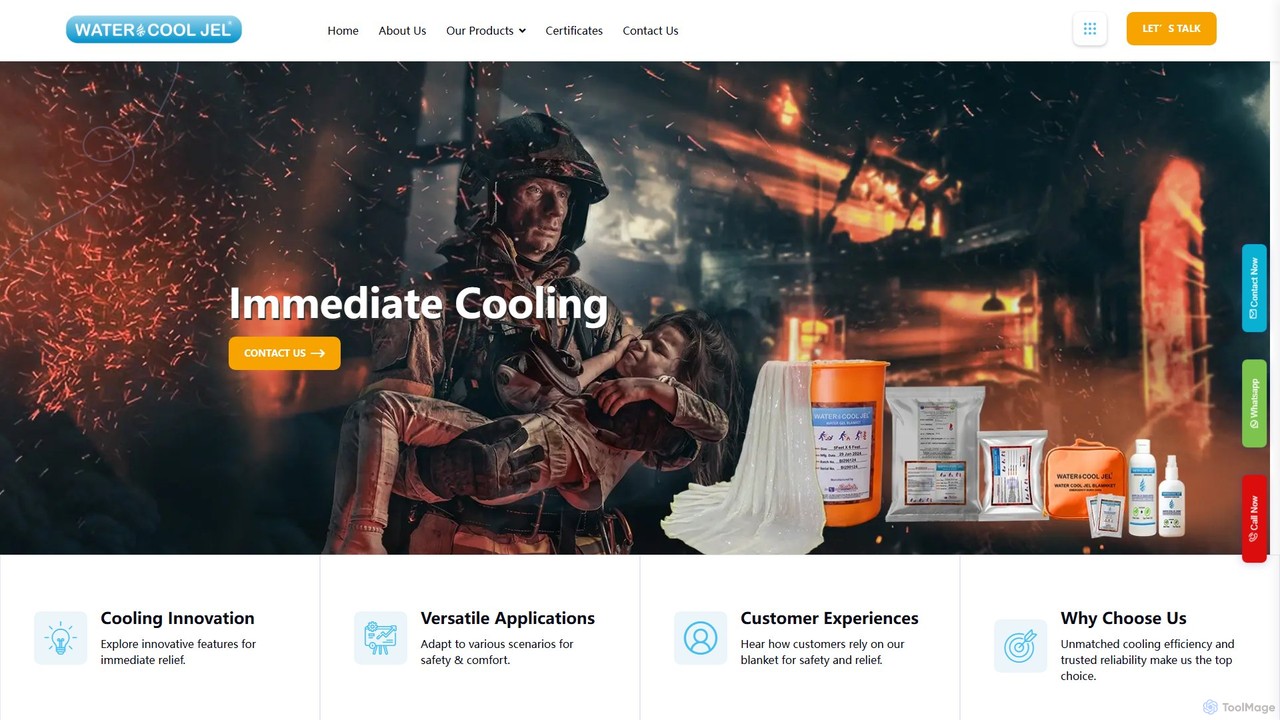
Water-Jel Blanket
Water-Jel Blanket by Balaji Industries is a professional-grade emergency burn care product. This water-based gel-soaked blanket provides immediate …
Water-Jel Blanket by Balaji Industries is a professional-grade emergency burn care product. This water-based gel-soaked blanket provides immediate cooling and pain relief for thermal burns. Designed to be non-adherent, it stops the burning process, protects against contamination, and is essential for first responders, industrial safety, and home first aid kits. Available in various sizes for versatile application.
About Emergency Equipment
Emergency Equipment refers to AI-powered tools designed to enhance preparedness, response, and recovery during critical incidents. These systems leverage advanced data analysis, predictive modeling, and automation to improve situational awareness. They accelerate decision-making and optimize resource deployment across various emergency scenarios, from natural disasters to public safety threats. These tools bolster overall safety infrastructure by providing intelligent support.
Core Features
- Predictive Analytics: Anticipate potential emergencies like natural disasters or equipment failures through data analysis.
- Real-time Monitoring: Analyze sensor data and surveillance feeds for immediate threat detection and anomaly identification.
- Automated Alerting & Communication: Instantly notify relevant personnel and coordinate response efforts across multiple channels.
- Resource Optimization: AI-driven allocation of emergency services, personnel, and supplies based on real-time needs.
- Situational Awareness Platforms: Consolidate diverse data streams into a comprehensive, actionable view of an emergency.
Applicable Scenarios
These tools are vital for urban safety management, aiding in traffic incident response and public security. They are also crucial in industrial facilities for preventing equipment failures and managing chemical spills. Furthermore, they significantly enhance natural disaster response, including flood prediction and wildfire monitoring, by providing timely insights and coordination capabilities.
How to Choose
When selecting AI-powered emergency equipment, prioritize integration capabilities with existing safety infrastructure and communication systems. Evaluate the accuracy and reliability of its data processing and predictive models. Consider scalability and customization options to adapt to different emergency scales and specific organizational needs. Finally, assess the user interface for ease of use by emergency responders and decision-makers, ensuring efficient operation under pressure.
Emergency EquipmentUse Cases
Early Warning for Natural Disasters
Emergency management agencies utilize AI to analyze vast datasets from weather patterns, seismic sensors, and environmental monitors. This enables the prediction of natural disasters like floods, wildfires, or earthquakes with greater accuracy and lead time. By issuing timely, localized alerts, AI tools help evacuate populations and mobilize emergency services proactively, significantly reducing casualties and property damage before an event escalates.
Smart Surveillance for Public Safety
Public safety organizations deploy AI-powered cameras and sensors in urban areas, transportation hubs, and critical infrastructure. These systems continuously monitor for unusual activities, unattended objects, or crowd anomalies, such as sudden surges or aggressive behavior. Upon detection, the AI automatically alerts security personnel, providing real-time visual evidence and location data, enabling rapid intervention and preventing potential threats from escalating into major incidents.
Optimizing Emergency Vehicle Dispatch
Emergency dispatch centers leverage AI algorithms to analyze real-time traffic conditions, incident locations, and the availability of emergency vehicles (ambulances, fire trucks, police cars). The AI rapidly calculates the fastest routes and most efficient deployment strategies, considering factors like road closures, weather, and hospital capacities. This optimization significantly reduces response times, ensuring critical resources reach affected areas more quickly and effectively, ultimately saving lives.
Predictive Maintenance for Industrial Safety
In industrial settings like factories, power plants, and chemical facilities, AI systems monitor the performance of critical machinery and infrastructure. By analyzing sensor data, operational logs, and historical failure patterns, AI can predict potential equipment malfunctions or structural weaknesses before they lead to accidents or catastrophic failures. This allows for proactive maintenance, preventing costly downtime, ensuring worker safety, and averting environmental hazards.
AI-Assisted Search and Rescue Operations
In disaster zones, AI-equipped drones and robots are deployed to assist search and rescue teams. These autonomous units can navigate hazardous terrains, analyze vast areas using thermal imaging and advanced computer vision, and identify signs of life or trapped individuals much faster than human teams alone. The AI processes complex visual and sensor data to pinpoint locations, prioritize rescue efforts, and provide real-time intelligence to ground crews, significantly increasing the chances of survival for victims.
Automated Incident Reporting and Analysis
Emergency services and public safety departments use AI tools to automate the processing of incident reports. AI can ingest data from emergency calls, sensor networks, field reports, and social media, then automatically generate structured summaries, identify key details, and categorize incidents. This automation reduces administrative burden, ensures data consistency, and allows for rapid analysis of trends and patterns, providing valuable insights for improving future emergency protocols and resource allocation strategies.