
Briefing AI
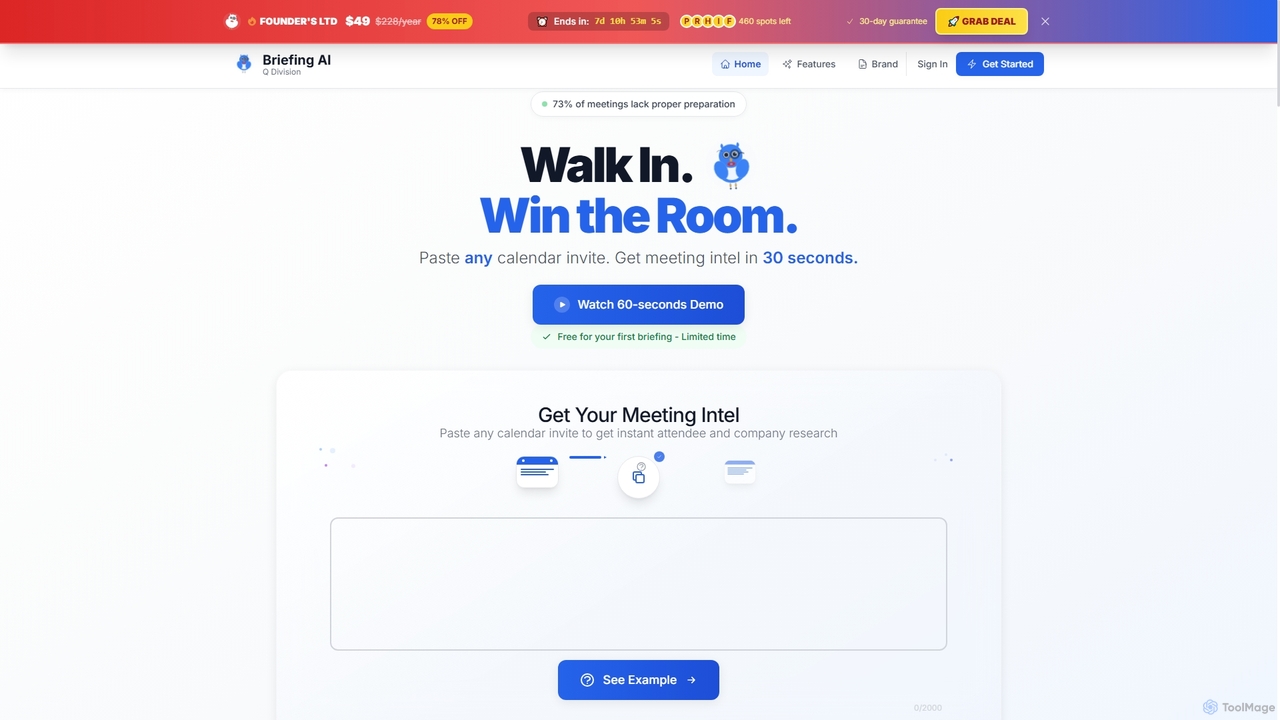
Briefing AI is an AI-powered meeting preparation tool that transforms any calendar invite into a comprehensive intelligence briefing …
Briefing AI is an AI-powered meeting preparation tool that transforms any calendar invite into a comprehensive intelligence briefing in seconds. It provides detailed dossiers on attendees, company context, strategic talking points, and potential red flags, helping professionals like founders, sales teams, and consultants to enter meetings fully prepared and confident.
About Intelligence
Sales Intelligence tools are AI-driven platforms designed to find, analyze, and present data for smarter sales decisions. These tools automatically enrich lead data, identify buying signals, and provide deep insights into prospects and markets. They empower sales teams to move beyond generic outreach by delivering actionable information that helps prioritize high-value leads and personalize communication. This data-driven approach significantly improves targeting accuracy and sales efficiency.
Core Features
- Lead Data Enrichment: Automatically appends and verifies contact, firmographic, and technographic data to incomplete lead profiles.
- Prospecting & ICP Filtering: Identifies and builds lists of potential customers who match your Ideal Customer Profile (ICP).
- Buying Intent Analysis: Tracks online signals to detect prospects who are actively researching solutions, indicating a high propensity to buy.
- Technographic Insights: Reveals the technology stack used by a company, creating opportunities for integration-focused or competitive displacement pitches.
- Account & Contact Tracking: Monitors target accounts for key changes like new hires, funding announcements, or company expansion.
Use Cases
Primarily utilized by B2B sales development representatives (SDRs), account executives (AEs), and sales managers. These tools are crucial for account-based marketing (ABM) strategies, enabling teams to build highly targeted campaigns. Marketing teams also use them to enrich inbound leads before passing them to sales, ensuring a higher qualification rate.
How to Choose
When selecting a Sales Intelligence tool, evaluate the accuracy and breadth of its data. Assess its integration capabilities with your existing CRM (e.g., Salesforce, HubSpot). Consider the user interface's ease of use for daily prospecting tasks. Finally, analyze the pricing model in relation to the quality of leads and the potential return on investment for your sales pipeline.
IntelligenceUse Cases
Build Targeted Outbound Prospecting Lists
A Sales Development Representative (SDR) for a SaaS company needs to build a list of 200 new prospects for an outbound campaign. Instead of manually searching on LinkedIn, they use a Sales Intelligence tool. They define their Ideal Customer Profile (ICP) by filtering for companies in the fintech industry, with 50-250 employees, located in North America, and using a specific payment processing API. The tool instantly generates a list of matching companies and provides verified contact information for key decision-makers like VPs of Engineering and Product Managers, saving hours of manual research.
Prioritize Inbound Leads with Data Enrichment
A marketing team generates 500 inbound leads from a webinar, but they only provide names and email addresses. Before passing them to the sales team, a marketing operations specialist runs the list through a Sales Intelligence tool. The tool automatically enriches each lead with data like company name, employee count, industry, revenue, and the lead's job title. This allows the sales team to immediately identify and prioritize leads from enterprise-level companies or those with decision-making titles, leading to a higher conversion rate and more efficient follow-up.
Identify High-Intent Accounts with Buying Signals
An Account Executive wants to find companies that are actively in the market for a new cybersecurity solution. They set up alerts in their Sales Intelligence platform to track 'buying intent' signals. The platform monitors online activity and flags accounts where multiple employees are visiting competitor websites, reading G2 reviews for their category, or searching for keywords like 'data breach prevention'. This allows the AE to focus their outreach efforts on accounts that are already problem-aware and actively seeking a solution, dramatically shortening the sales cycle.
Personalize Sales Outreach with Technographic Data
A sales representative for a project management software company identifies a promising lead. Using a Sales Intelligence tool, they access the prospect's technographic data and discover the company uses a specific CRM and a communication platform that their software integrates with seamlessly. The rep then crafts a highly personalized email that highlights these specific integrations, explaining how their tool can centralize workflows by connecting with the prospect's existing tech stack. This targeted message stands out from generic pitches and directly addresses the prospect's operational context, increasing the likelihood of a response.
Monitor Key Accounts for Upsell Opportunities
An account manager is responsible for a portfolio of 50 enterprise clients. To stay proactive, they set up alerts for these accounts in a Sales Intelligence platform. The platform monitors news outlets, press releases, and social media. It alerts the manager when one of their clients secures a new round of funding, indicating they have more budget to spend. It also flags news about the client expanding into a new geographic market where the account manager's company offers localized services. These trigger events provide timely and relevant reasons to re-engage the client and propose an upsell or cross-sell.
Prepare for Sales Meetings with Competitive Intel
Before a crucial product demo with a high-value prospect, a sales engineer uses a Sales Intelligence tool to gather competitive intelligence. They quickly find out which of their main competitors the prospect has recently engaged with or evaluated. The tool also provides battle cards with key differentiators, recent customer wins for the competitor, and common objections. Armed with this information, the sales engineer can proactively address potential concerns, highlight their unique strengths against specific rivals, and tailor the demo to showcase features that directly counter the competition's weaknesses, significantly increasing their win rate.