PipeBio
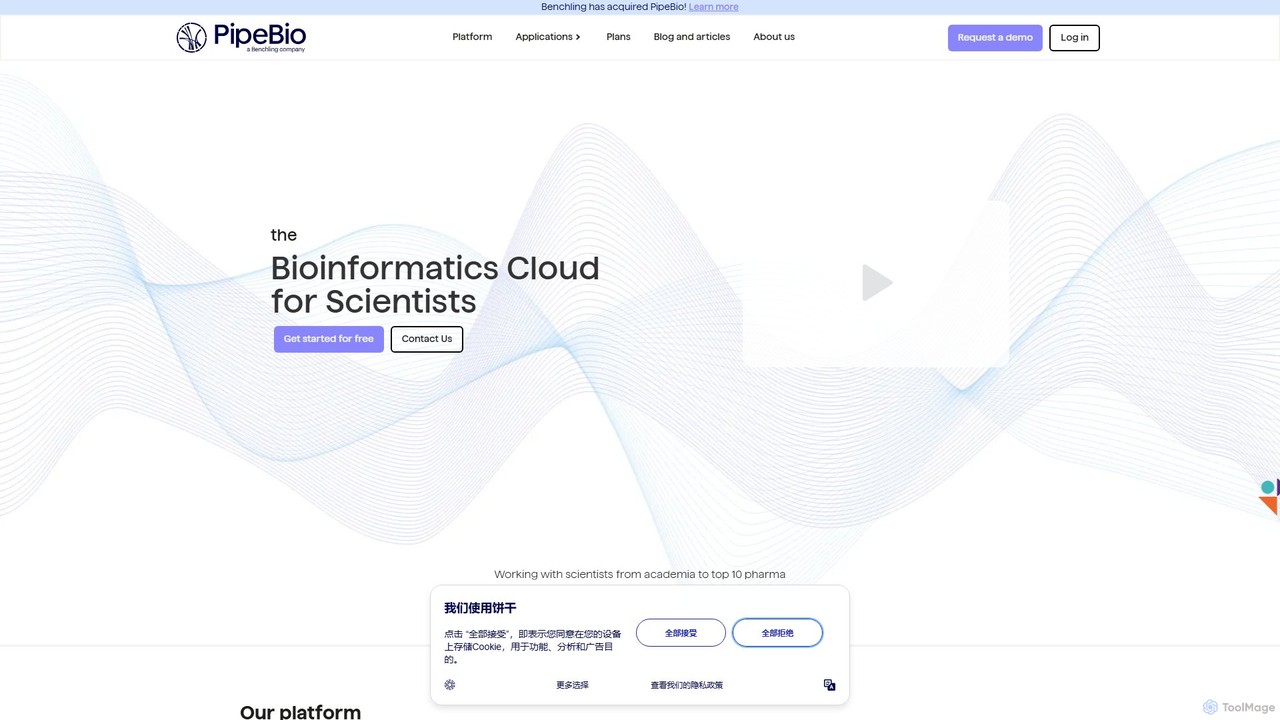
PipeBio is a specialized, cloud-based bioinformatics platform designed for antibody, TCR, and peptide discovery. It enables researchers to …
PipeBio is a specialized, cloud-based bioinformatics platform designed for antibody, TCR, and peptide discovery. It enables researchers to analyze, visualize, and manage large-scale sequence data, integrating seamlessly with functional assay results to accelerate biologics development. Acquired by Benchling, it offers an end-to-end solution for modern drug discovery.
About Bioinformatics
Bioinformatics tools are a class of software that apply computational and AI techniques to analyze complex biological data. They leverage machine learning algorithms to interpret vast datasets from genomics, proteomics, and other 'omics' fields. These tools are crucial for advancing research in medicine, genetics, and drug discovery by uncovering patterns and insights that are impossible to find manually. Their primary advantage lies in accelerating the pace of scientific discovery, from predicting protein structures to identifying genetic markers for diseases.
Core Features
- Sequence Analysis: Analyze DNA, RNA, and protein sequences to identify genes, predict functions, and find variations.
- Protein Structure Prediction: Use deep learning models to accurately predict the 3D structure of proteins from their amino acid sequences.
- Drug Discovery Simulation: Identify potential drug targets and simulate molecular docking to accelerate the development of new therapies.
- Phylogenetic Analysis: Construct evolutionary trees by analyzing genetic data to infer relationships between organisms.
- Gene Expression Analysis: Process and visualize high-throughput sequencing data (e.g., RNA-seq) to understand cellular functions and disease mechanisms.
Use Cases
These tools are essential for academic researchers in molecular biology, scientists in pharmaceutical and biotech companies, and clinicians in personalized medicine. For example, a geneticist might use them to identify disease-causing mutations in a patient's genome, while a drug discovery team could virtually screen thousands of chemical compounds.
How to Choose
When selecting a bioinformatics tool, consider the specific type of biological data you are analyzing (e.g., DNA, RNA, protein). Evaluate the accuracy and validation of the underlying algorithms, often indicated by scientific publications. Check for integration capabilities with public biological databases like NCBI or PDB. Finally, assess whether the tool's interface (GUI vs. command-line) and computational requirements match your team's technical skills and resources.

BioinformaticsUse Cases
Predicting Protein Structures for Drug Design
A biochemist at a pharmaceutical company needs to understand a target protein's structure to design a new drug. Using an AI bioinformatics tool, they input the protein's amino acid sequence. The tool generates a highly accurate 3D model in hours, a process that previously took months with experimental methods. This model allows them to identify potential binding sites and design drug molecules that can interact effectively, significantly speeding up the initial phase of drug discovery.
Identifying Genetic Mutations in Cancer Research
A cancer researcher analyzes whole-genome sequencing data from tumor samples to find mutations driving cancer growth. They use a bioinformatics pipeline to align the patient's DNA sequence to a reference genome and identify variants. AI-powered annotation tools then help filter and prioritize these variants, highlighting mutations that are likely pathogenic. This helps uncover new therapeutic targets and understand cancer progression, paving the way for personalized oncology.
Analyzing Gene Expression for Disease Diagnosis
A clinical scientist studies a rare genetic disorder by comparing gene expression levels between healthy individuals and patients. They use an AI tool to analyze RNA-sequencing (RNA-seq) data, which quantifies the expression of thousands of genes simultaneously. The tool performs differential expression analysis, highlighting genes that are significantly up- or down-regulated in patients. This provides crucial insights into the molecular basis of the disease and can help identify potential biomarkers for early diagnosis.
Constructing Phylogenetic Trees for Viral Evolution
An epidemiologist tracks the evolution of a virus, such as influenza or SARS-CoV-2, during an outbreak. They collect genetic sequences from various samples and use a bioinformatics tool to perform multiple sequence alignment. The tool then applies AI-driven phylogenetic algorithms to construct an evolutionary tree. This tree visualizes how the virus is mutating and spreading, helping public health officials make informed decisions about containment strategies and vaccine development.
Accelerating Metagenomic Analysis of Microbial Communities
An environmental scientist studies the microbial composition of a soil sample to assess its health. The sample contains DNA from thousands of different species. They use a metagenomics analysis tool that employs AI to classify DNA sequences and assign them to specific microbial species (taxonomic binning). This allows for a rapid and comprehensive profile of the microbial community, revealing its diversity and functional potential without needing to culture individual organisms in a lab.
Automating High-Throughput Screening in Drug Discovery
A biotech team is screening a library of millions of chemical compounds for potential drug candidates. Instead of physically testing each one, they use a computational bioinformatics tool. The AI model, trained on existing experimental data, predicts the bioactivity and toxicity of each compound based on its chemical structure. This virtual screening process filters the library down to a few hundred promising candidates for physical lab testing, saving immense time and resources.