Golf
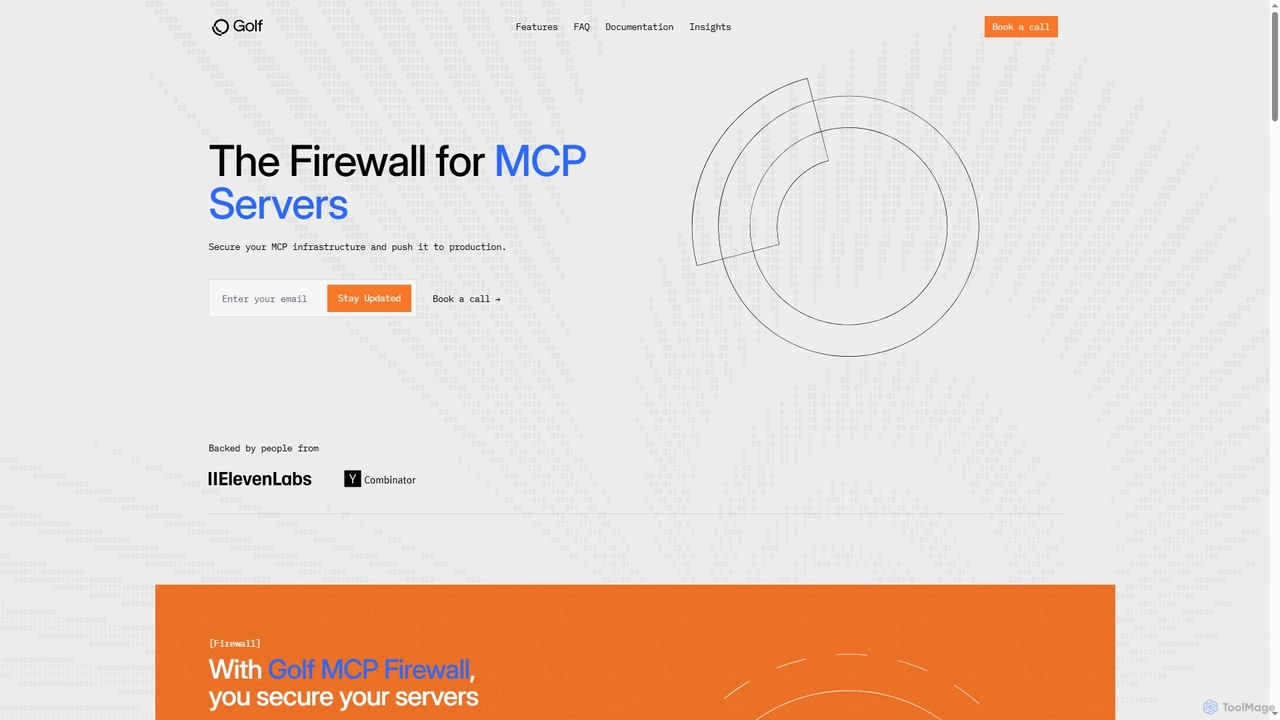
Golf is an enterprise-grade, protocol-aware firewall designed for the Model Context Protocol (MCP). It provides a centralized security …
Golf is an enterprise-grade, protocol-aware firewall designed for the Model Context Protocol (MCP). It provides a centralized security layer to protect MCP servers from specific threats like prompt injection and token hijacking, enabling businesses to securely deploy AI agent infrastructure into production.
About Firewall
AI Firewalls are advanced network security systems that utilize machine learning and artificial intelligence to proactively identify and block sophisticated cyber threats. Unlike traditional firewalls that rely on static rules, these tools analyze network traffic patterns in real-time to detect behavioral anomalies and predict potential attacks. This intelligent approach enables organizations to defend against zero-day exploits, advanced persistent threats (APTs), and other evolving attack vectors. AI-driven analysis provides a dynamic and adaptive security posture that is crucial for modern digital infrastructures.
Core Features
- Behavioral Anomaly Detection: Uses machine learning models to establish a baseline of normal network activity and flags any significant deviations as potential threats.
- Predictive Threat Intelligence: Analyzes global threat data to forecast emerging attack patterns and proactively update security policies.
- Automated Policy Optimization: Intelligently suggests or automatically applies refined security rules based on observed traffic, reducing manual configuration errors.
- Encrypted Traffic Analysis: Inspects encrypted (SSL/TLS) traffic for malicious payloads without requiring full decryption, balancing security and privacy.
- Automated Threat Response: Instantly quarantines compromised devices or blocks malicious IP addresses upon threat detection, minimizing response time.
Applicable Scenarios
AI Firewalls are particularly valuable for organizations with complex IT environments and high-value data assets. They are widely used in sectors like finance, healthcare, and e-commerce to protect against data breaches. Cloud-native businesses and enterprises with extensive IoT networks also leverage these tools to secure dynamic and distributed infrastructures against sophisticated attacks.
Selection Criteria
When choosing an AI Firewall, evaluate its threat detection accuracy, particularly the rates of false positives and false negatives. Assess its performance impact on network latency and throughput. Consider its integration capabilities with your existing security ecosystem (e.g., SIEM, SOAR) and the level of automation it offers for policy management and incident response.
FirewallUse Cases
Protecting Cloud Infrastructure from Zero-Day Attacks
A DevOps team managing a multi-cloud environment for a fintech company uses an AI Firewall to secure their applications. The firewall learns the normal patterns of API calls and data flow between microservices. When a novel malware variant attempts to exploit an unknown vulnerability (a zero-day attack), the AI detects the anomalous outbound traffic to an unrecognized server. It automatically blocks the connection and isolates the compromised container in milliseconds, preventing data exfiltration before security analysts are even alerted.
Securing a Distributed IoT Network in Manufacturing
A smart factory operator deploys an AI Firewall to oversee thousands of connected IoT sensors and machines. The AI establishes a unique behavioral baseline for each device—what it communicates with, when, and how much data it sends. When a group of sensors is compromised and starts participating in a DDoS attack, the firewall detects this abnormal spike in outbound traffic and unusual communication pattern. It automatically isolates the affected devices from the network to prevent disruption to factory operations while flagging them for maintenance.
Automating Security Policy Management for IT Teams
An IT administrator at a rapidly growing company struggles to keep firewall rules updated for new applications and users. They implement an AI Firewall with a policy optimization engine. The AI analyzes traffic flows and identifies redundant, overly permissive, or outdated rules. It then suggests more precise, secure policies, such as restricting database access to only specific application servers. The administrator can review and apply these suggestions with a single click, reducing the risk of misconfiguration and saving hours of manual policy tuning each week.
Preventing Advanced Persistent Threats (APTs) in Government
A government agency's security operations center (SOC) uses an AI Firewall to detect stealthy APT campaigns. Traditional systems miss the low-and-slow tactics used by these attackers. The AI, however, correlates seemingly unrelated, minor security events over weeks. It notices a user account accessing unusual files late at night, followed by small, encrypted data packets being sent to a new external IP. The AI model recognizes this sequence as a known APT tactic, flags the entire chain of events as a high-priority incident, and blocks the command-and-control communication, thwarting the attack.
Enhancing E-commerce Fraud and DDoS Protection
An online retail platform faces sophisticated bot attacks that mimic human shopping behavior to commit fraud, alongside DDoS attacks during flash sales. Their AI Firewall analyzes user behavior beyond just IP addresses, looking at mouse movements, browsing speed, and session patterns. During a sale, it distinguishes between a surge of legitimate customers and a coordinated DDoS attack, throttling malicious traffic while ensuring real shoppers have uninterrupted access. It also identifies and blocks bots attempting automated checkout fraud, reducing financial losses and protecting customer accounts.
Securing Sensitive Patient Data in Healthcare
A hospital network uses an AI Firewall to protect its electronic health record (EHR) system. The AI learns the typical data access patterns of doctors, nurses, and administrative staff. If a compromised user account suddenly starts trying to download thousands of patient records—a behavior inconsistent with their role—the AI flags this as a potential insider threat or account takeover. It can automatically restrict the account's access to the EHR system and alert the security team, preventing a major data breach of sensitive patient information and ensuring HIPAA compliance.