
Optery
Optery is an automated data removal service that helps you reclaim your privacy. It scans over 640 data …
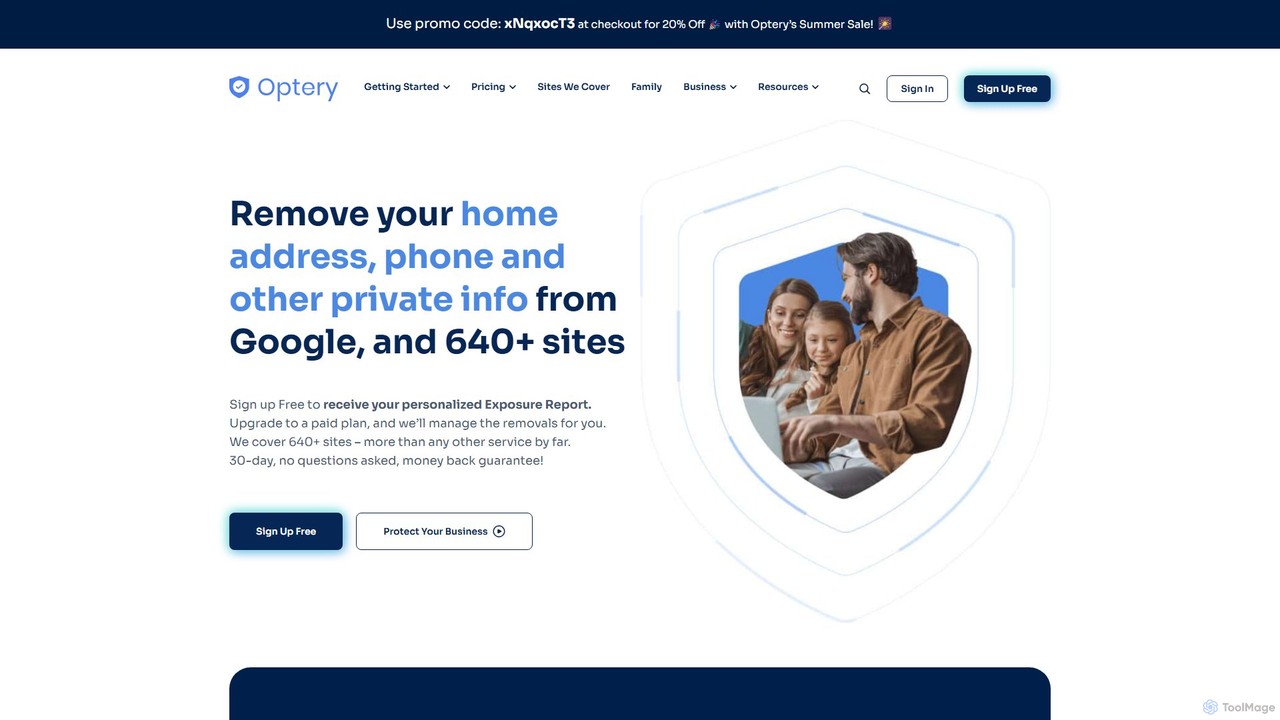
Optery is an automated data removal service that helps you reclaim your privacy. It scans over 640 data broker and people search sites to find your exposed personal information—like your home address, phone number, and email—and automatically submits opt-out requests on your behalf. With both free self-service tools and comprehensive paid plans, Optery reduces your digital footprint, preventing identity theft, spam, and stalking.
About Privacy Protection
AI Privacy Protection tools are a specialized category of security software designed to safeguard personal and sensitive data using artificial intelligence. They employ techniques like data anonymization, differential privacy, and synthetic data generation to minimize privacy risks during data processing and analysis. These tools are crucial for organizations that handle large datasets, enabling them to comply with regulations like GDPR and CCPA while still extracting valuable insights. Their key advantage lies in automating complex privacy-preserving tasks that are difficult to perform manually at scale.
Core Features
- Data Anonymization & Pseudonymization: Automatically removes or replaces personally identifiable information (PII) from datasets.
- Synthetic Data Generation: Creates statistically similar, artificial datasets that contain no real user information for safe testing and analysis.
- Differential Privacy: Adds statistical noise to data outputs to protect individual identities while maintaining overall data accuracy.
- Privacy Risk Assessment: Scans datasets and systems to identify potential privacy vulnerabilities and compliance gaps.
- Consent Management Automation: Automates the process of tracking and managing user consent for data usage across different platforms.
Use Cases
These tools are primarily used in sectors like healthcare, finance, and marketing analytics where large volumes of sensitive user data are processed. For instance, a hospital can use these tools to anonymize patient records for medical research, or a marketing firm can generate synthetic customer data to train recommendation models without using real customer information.
How to Choose
When selecting a tool, consider the specific privacy techniques offered (e.g., anonymization vs. synthetic data). Evaluate its compatibility with your existing data infrastructure and its ability to meet specific regulatory requirements like GDPR or HIPAA. Also, assess the trade-off between the level of privacy protection and the resulting data utility, as stronger protection can sometimes reduce data accuracy for analysis.
Privacy ProtectionUse Cases
Anonymizing Medical Data for Research
A medical research institute needs to analyze patient records to identify disease trends. To comply with HIPAA regulations, they use an AI Privacy Protection tool to automatically process thousands of records. The tool identifies and redacts all Personally Identifiable Information (PII) such as names, addresses, and social security numbers, replacing them with non-identifiable placeholders. This allows researchers to safely work with large-scale health data, accelerating medical discoveries without compromising patient confidentiality.
Generating Synthetic Data for Software Testing
A fintech company is developing a new fraud detection algorithm. They cannot use real customer transaction data for testing due to privacy regulations. Instead, their development team uses a synthetic data generation tool. The tool analyzes the statistical properties of the real data and creates a new, artificial dataset that mimics its patterns, distributions, and correlations. This allows developers to rigorously test their algorithm in a realistic environment without ever exposing sensitive customer financial information, ensuring both security and product quality.
Ensuring GDPR Compliance in Marketing Analytics
A European e-commerce company analyzes customer behavior to personalize marketing. To comply with GDPR, they use a differential privacy tool to query their customer database. When an analyst runs a query, such as 'What is the average purchase value by city?', the tool adds a mathematically calibrated amount of statistical noise to the result. This provides an accurate aggregate insight for business decisions while making it mathematically impossible to reverse-engineer the data to identify any single individual's purchasing habits, thus protecting user privacy by default.
Redacting Sensitive Information from Legal Documents
A law firm needs to share thousands of case documents with external counsel but must first redact all confidential client information. Manually reviewing each document is slow and prone to error. They deploy an AI Privacy Protection tool that uses Natural Language Processing (NLP) to scan documents, identify entities like names, addresses, and financial details, and automatically redact them. This process reduces the time required for document preparation by over 90% and significantly lowers the risk of accidentally disclosing sensitive information.
Protecting Customer Data in a Development Environment
A software company needs realistic data to test a new e-commerce feature. Using a copy of the live production database is a major security risk. To solve this, they use a data pseudonymization tool. The tool creates a copy of the database but replaces real customer names, emails, and phone numbers with fake but structurally valid data. This provides the development team with a high-fidelity dataset for testing that accurately reflects real-world scenarios, without exposing any actual customer PII and maintaining compliance with data protection laws.
Automating User Consent Management
A global media company operates multiple websites and apps, each collecting user data for different purposes. Manually tracking user consent preferences across all platforms is unmanageable and risks non-compliance with privacy laws like CCPA. They implement an AI-powered consent management platform. This tool centralizes consent records, automates the presentation of consent banners based on user location and local laws, and ensures that data processing systems automatically respect user choices (e.g., opt-outs). This streamlines compliance and builds user trust through transparent data handling.