
Simulation Best in category 1 results Orbital Mechanics AI Tool

Popular AI tools in the Orbital Mechanics field of Simulation include Vecteur, etc., helping you quickly improve efficiency.

Vecteur

Vecteur

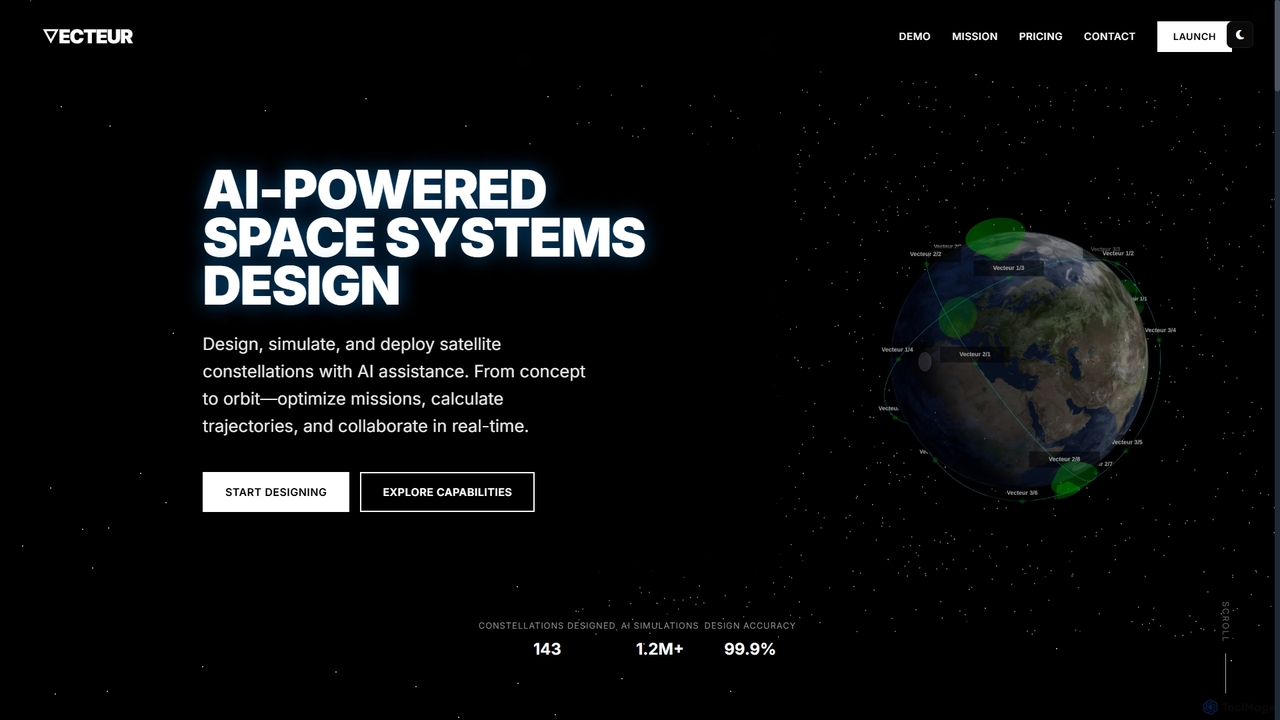
Vecteur is an AI-powered platform revolutionizing space systems engineering, enabling users to design, simulate, and deploy satellite constellations …

2.7K

About Orbital Mechanics

Orbital Mechanics tools are a specialized category of simulation software that use AI and physics models to predict, analyze, and visualize the motion of objects in space. They apply principles of astrodynamics and celestial mechanics to calculate trajectories for satellites, spacecraft, and celestial bodies with high precision. These tools are essential for designing space missions, managing satellite constellations, and ensuring the safety of space operations. Their core value lies in accurately modeling complex gravitational interactions and orbital perturbations over long periods.

Core Features

  • Trajectory Propagation: Accurately calculates the future position and velocity of an object based on initial conditions and force models.
  • Maneuver Planning: Simulates the effects of thrust maneuvers, such as orbit raising or inclination changes, to design efficient trajectories.
  • Perturbation Modeling: Accounts for non-ideal forces like atmospheric drag, solar radiation pressure, and third-body gravity for realistic simulations.
  • Constellation Analysis: Models the collective behavior and coverage of satellite networks, crucial for communications and Earth observation systems.
  • 3D Visualization: Provides interactive 3D rendering of orbits, celestial bodies, and spacecraft for intuitive analysis and presentation.

Use Cases

These tools are primarily used in the aerospace and defense industries by aerospace engineers, mission analysts, and satellite operators. They are also vital in academic research for astronomers and physicists, as well as in the emerging field of space traffic management for tracking space debris and preventing collisions.

How to Choose

When selecting an Orbital Mechanics tool, consider the required fidelity of the physics models (e.g., simple two-body vs. high-precision n-body). Evaluate its capabilities for specific tasks like maneuver optimization or constellation design. Also, assess the user interface, data import/export formats (like TLEs), and integration with other engineering software.

Orbital MechanicsUse Cases

1

Satellite Mission Orbit Design

An aerospace engineer at a satellite manufacturing company is tasked with designing an optimal orbit for a new Earth observation satellite. The mission requires the satellite to pass over specific regions at certain times of day. Using an Orbital Mechanics tool, the engineer can simulate various orbital parameters, including altitude, inclination, and eccentricity. They can model the long-term effects of orbital perturbations to ensure the orbit remains stable over the mission's 10-year lifespan. The tool's visualization features help them demonstrate the satellite's ground track and coverage to stakeholders, confirming that all mission requirements are met before launch.

2

Space Debris Collision Avoidance

A satellite operator for a large communications constellation receives an alert for a potential conjunction (close approach) between one of their active satellites and a piece of space debris. Using an Orbital Mechanics tool, they import the latest trajectory data for both objects. The software performs a high-precision conjunction analysis, calculating the probability of collision and the time of closest approach. Based on the simulation results, the operator designs a small, fuel-efficient avoidance maneuver. They simulate the maneuver to confirm it moves the satellite to a safe trajectory without significantly impacting its service obligations, then upload the commands to the satellite.

3

Interplanetary Mission Trajectory Planning

A mission analyst at a national space agency is planning a robotic mission to Mars. The goal is to find the most fuel-efficient trajectory, which involves complex gravity-assist maneuvers around other planets. The Orbital Mechanics tool is used to model the n-body problem, accurately simulating the gravitational influences of the Sun, Earth, Mars, and other celestial bodies. The analyst can explore various launch windows and trajectory options, such as a Hohmann transfer orbit. The software helps optimize the timing and magnitude of engine burns to minimize propellant usage, which is a critical factor for long-duration deep space missions, ultimately enabling the mission within budget and mass constraints.

4

Academic Research in Celestial Mechanics

A university astrophysics student is working on a thesis about the stability of orbits in a binary star system. Instead of relying solely on theoretical calculations, the student uses an Orbital Mechanics simulation tool to create a dynamic model. They can input the masses and initial positions of the two stars and a hypothetical planet. The software then propagates the orbits over millions of years, visualizing the complex gravitational interactions. The student can run multiple simulations with varying parameters to identify stable orbital zones (also known as 'habitable zones'), providing robust, data-driven evidence to support their research findings and creating compelling visualizations for their thesis defense.

5

Satellite Constellation Coverage Analysis

An engineer at a telecommunications company is responsible for maintaining a global satellite internet constellation. They need to ensure continuous coverage across key markets. Using an Orbital Mechanics tool with constellation analysis features, they can model the entire network of hundreds of satellites. The software visualizes the real-time coverage footprint of the constellation on a 3D globe. The engineer can simulate different scenarios, such as the loss of a satellite or the addition of new ones, to analyze the impact on network availability and latency. This allows them to proactively plan for satellite replacements and optimize orbital phasing to eliminate service gaps.

6

Asteroid Threat Assessment and Deflection Simulation

An astronomer working for a planetary defense program identifies a near-Earth asteroid (NEA) with a trajectory that could potentially intersect with Earth's orbit. They use a high-fidelity Orbital Mechanics tool to precisely propagate the asteroid's orbit over the next century, accounting for subtle gravitational perturbations from all planets. The tool calculates the impact probability for future encounters. If the risk is significant, the team can then use the same software to simulate various deflection strategies, such as a kinetic impactor or a gravity tractor. They can model the change in the asteroid's trajectory resulting from each strategy to determine the most effective method for mitigating the threat.

Orbital MechanicsFrequently Asked Questions