
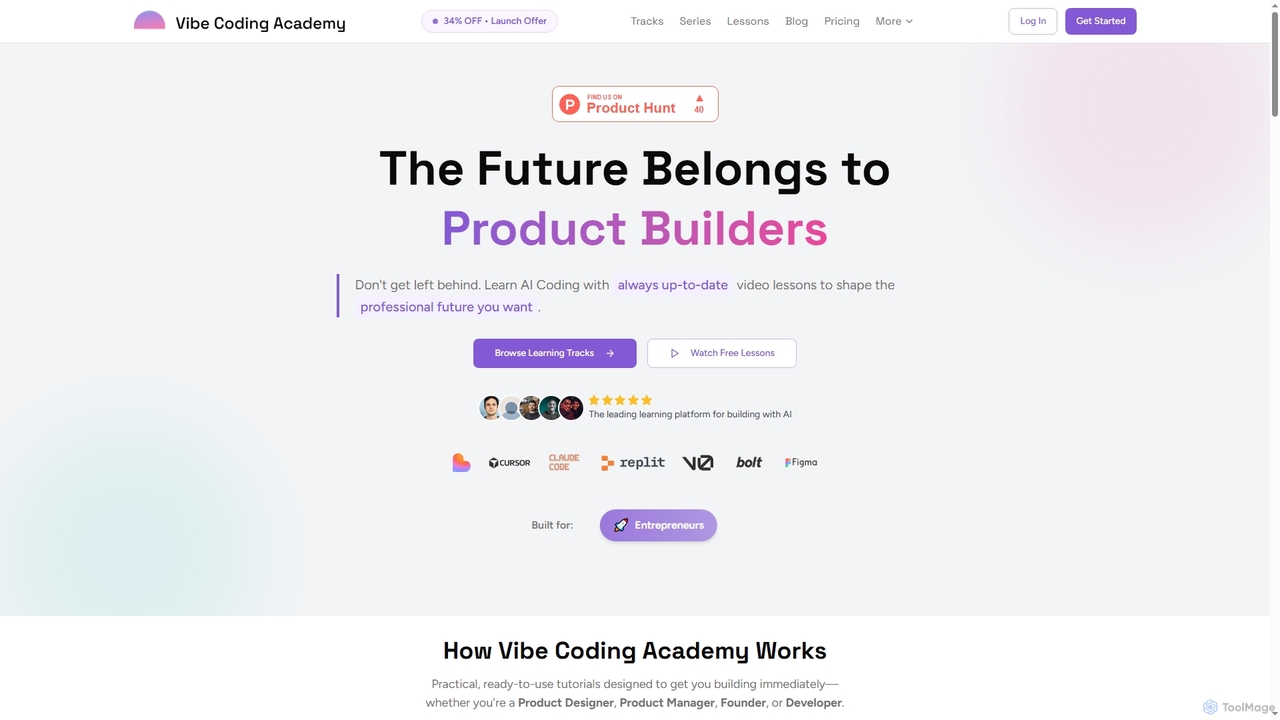
Vibe Coding Academy
Vibe Coding Academy offers AI-powered coding education through practical video tutorials, ready-to-use prompts, and structured learning tracks. It …
Vibe Coding Academy offers AI-powered coding education through practical video tutorials, ready-to-use prompts, and structured learning tracks. It empowers product builders, designers, managers, and engineers to master modern development workflows and ship production-ready applications with AI assistance.
About Ai Development
AI Development refers to the specialized field within software engineering focused on designing, building, training, and deploying artificial intelligence models and applications. These tools leverage machine learning algorithms, deep learning frameworks, and data science principles to create intelligent systems. They enable developers and data scientists to transform raw data into actionable insights and automated decision-making capabilities across various industries. This discipline is a rapidly evolving branch of software development, driving innovation in areas like automation, prediction, and intelligent interaction.
Core Features
- Model Training & Optimization: Tools for efficiently training machine learning models, fine-tuning hyperparameters, and evaluating performance metrics.
- Data Management & Preprocessing: Capabilities for cleaning, transforming, and preparing large datasets for AI model consumption.
- Deployment & MLOps: Features for deploying trained models into production environments, monitoring their performance, and managing the AI lifecycle.
- AI Framework Integration: Support for popular AI frameworks such as TensorFlow, PyTorch, and Scikit-learn, facilitating development.
- Experiment Tracking: Systems to log, compare, and reproduce machine learning experiments, ensuring reproducibility and collaboration.
Applicable Scenarios
AI Development tools are essential for data scientists creating predictive analytics models, software engineers integrating intelligent features into applications, and researchers developing novel AI algorithms. They are used in scenarios ranging from building recommendation systems for e-commerce to developing autonomous driving software and creating advanced natural language processing solutions.
How to Choose
When selecting AI Development tools, consider the supported AI frameworks and programming languages, the scalability of the platform for handling large datasets and complex models, and its MLOps capabilities for seamless deployment and monitoring. Evaluate collaboration features for team-based projects and the availability of pre-built models or APIs to accelerate development.
Ai DevelopmentUse Cases
Developing Personalized Recommendation Engines
E-commerce platforms utilize AI development tools to build and deploy sophisticated models that analyze vast amounts of user behavior data, purchase history, and browsing patterns. These models then generate highly personalized product recommendations, enhancing customer engagement and driving sales. The tools enable rapid iteration on algorithms and seamless integration into existing online storefronts.
Building Custom Recommendation Engines
Data scientists utilize AI development platforms to train sophisticated machine learning models on vast user interaction data, enabling personalized product recommendations for e-commerce or content suggestions for media platforms. This process involves data ingestion, feature engineering, model selection, and iterative training to achieve high relevance and engagement, significantly boosting user satisfaction and conversion rates.
Creating Intelligent Chatbots for Customer Service
Businesses leverage AI development tools to design and train sophisticated natural language processing (NLP) models for chatbots. These AI-powered chatbots can understand complex customer queries, provide accurate and context-aware responses, and automate a significant portion of support interactions, leading to improved customer satisfaction and reduced operational costs.
Automating Image Recognition for Quality Control
Manufacturing engineers deploy computer vision models, developed using AI development tools, to automatically inspect products on assembly lines. By training models on images of defective and flawless items, they can identify anomalies in real-time, reducing manual inspection errors and improving product quality and production efficiency.
Building Predictive Maintenance Systems
Industrial companies utilize AI development platforms to create and deploy models that analyze real-time sensor data from machinery, identifying anomalies and predicting potential equipment failures before they occur. This proactive approach minimizes downtime, reduces maintenance costs, and extends the lifespan of critical assets, optimizing operational efficiency.
Developing Advanced Natural Language Processing (NLP) Chatbots
AI engineers leverage NLP libraries and frameworks within AI development environments to build intelligent conversational agents. These chatbots can understand complex user queries, provide accurate responses, and automate customer support or internal knowledge retrieval, enhancing user experience and reducing operational costs.
Optimizing Computer Vision for Quality Control
Manufacturing firms employ AI development tools to train computer vision models that automatically inspect products for defects, anomalies, or incorrect assembly on production lines. This automation ensures high quality standards, reduces human error, and significantly improves production efficiency and throughput by quickly identifying and flagging issues.
Optimizing Machine Learning Model Performance
MLOps engineers employ specialized AI development tools for experiment tracking, hyperparameter tuning, and model versioning. This allows them to systematically test different model architectures and parameters, identify the most performant configurations, and ensure models remain robust and accurate over time, leading to more reliable AI applications.
Designing Autonomous Driving Algorithms
Automotive engineers and researchers utilize specialized AI development environments to build, simulate, and refine deep learning models for perception, decision-making, and control in self-driving vehicles. These tools provide the computational power and frameworks necessary to process vast amounts of sensor data and ensure the safety and reliability of autonomous systems.
Deploying Predictive Maintenance Models
Industrial data scientists use AI development platforms to build and deploy models that predict equipment failures before they occur. By analyzing sensor data from machinery, these models enable proactive maintenance scheduling, minimizing downtime, extending asset lifespan, and significantly reducing unexpected repair costs.
Implementing Fraud Detection Systems in Finance
Financial institutions develop AI models using specialized tools to analyze transaction data, identify unusual patterns, and flag potential fraudulent activities in real-time. These systems significantly enhance security, protect customer assets, and minimize financial losses by quickly detecting and preventing fraudulent transactions.
Generating Synthetic Data for Model Training
Researchers and developers utilize AI development tools to create high-quality synthetic datasets when real-world data is scarce, sensitive, or biased. This involves training generative models (e.g., GANs) to produce artificial data that mimics the statistical properties of real data, facilitating model training, privacy preservation, and bias mitigation.