ToolMage
Sign in

Best 1 Estimation AI tools for Software Development

Popular Estimation AI tools in Software Development include GoAgile, helping you work more efficiently.

GoAgile
Freemium

GoAgile

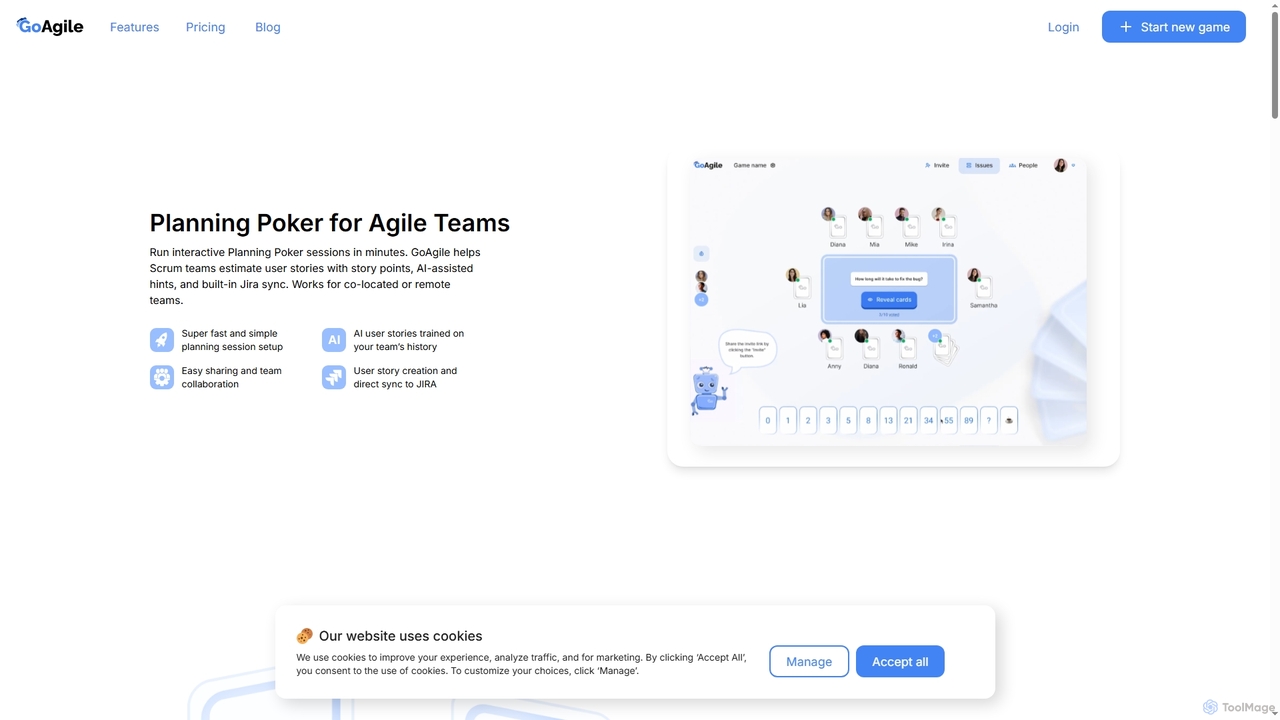
GoAgile is an online Planning Poker tool designed for Agile teams to streamline user story estimation. It features AI-assisted hints, seamless Jira and CSV integration, secure private sessions, and comprehensive analytics, supporting both co-located and remote teams for efficient and accurate sprint planning.

Team Collaboration
Visits 3.9KFavorites 118Likes 117

About Estimation

AI-powered estimation tools are a specialized category of software within the broader field of software development, specifically designed to predict the time, cost, and resources required for various project phases. These advanced tools leverage sophisticated machine learning algorithms, historical project data, and statistical analysis to generate more accurate, objective, and data-driven forecasts compared to traditional manual estimation methods. By providing reliable insights into project scope, complexity, and potential challenges, they empower development teams, project managers, and stakeholders to make informed decisions, optimize resource allocation, set realistic expectations, and proactively mitigate risks throughout the entire software development lifecycle.

Core Features

  • Data-driven Prediction: Analyzes vast amounts of past project data, including task durations, team velocity, scope changes, and defect rates, to identify patterns and generate highly accurate future estimates for new or ongoing projects.
  • Algorithm-based Analysis: Employs advanced machine learning models, such as regression analysis or neural networks, to process complex project variables and identify subtle correlations that human estimators might miss, significantly improving prediction reliability.
  • Scenario Modeling: Offers robust "what-if" analysis capabilities, allowing users to simulate the impact of adjusting key project parameters—like increasing team size, reducing scope, or introducing new technologies—on overall timelines and budgets before committing resources.
  • Risk Assessment & Mitigation: Automatically identifies potential project risks, such as scope creep, technical debt, or resource unavailability, and quantifies their probable impact on project schedules and costs, enabling proactive planning and risk mitigation strategies.
  • Progress Tracking & Re-estimation: Integrates seamlessly with project management and version control systems to track actual progress against initial estimates, automatically re-estimating remaining work based on real-time data and performance metrics.

Applicable Scenarios

AI estimation tools are indispensable for a wide range of roles and scenarios within software development. Project managers utilize them for initial project planning and proposal generation, ensuring competitive and realistic bids. Agile teams leverage these tools for more accurate sprint and release planning, optimizing backlog grooming and capacity allocation. Development leads use them to forecast resource needs and manage team workloads effectively. Furthermore, business analysts and product owners can employ these tools to evaluate the feasibility and cost-effectiveness of new features or product iterations, providing data-backed insights for strategic decision-making and stakeholder communication.

How to Choose

When selecting an AI estimation tool, several critical factors should guide your decision. Prioritize tools with proven accuracy and transparent methodologies, ensuring they utilize robust machine learning models and allow for the integration of your specific historical project data for tailored predictions. Evaluate its integration capabilities with your existing project management ecosystem (e.g., Jira, Azure DevOps, Trello) to ensure seamless data flow and workflow automation. Assess the level of customization offered for project parameters, estimation models, and reporting features, ensuring it can adapt to your unique development processes and provide actionable, easily digestible insights. Finally, consider the user interface's intuitiveness, the vendor's support, and the overall cost-effectiveness relative to the value it provides in improving project predictability and success rates.

Featured tool rankings

Estimation use cases

1

New Project Time & Cost Forecasting

A project manager initiating a new software development project uses an AI estimation tool to quickly generate initial time and cost forecasts. By inputting project scope, team size, and technology stack, the tool analyzes historical data to provide a data-backed baseline for budgeting, resource planning, and setting realistic client expectations, significantly reducing the effort of manual estimation.

2

Agile Sprint & Release Planning

An Agile team lead leverages an AI estimation tool to predict the effort required for user stories in upcoming sprints. The tool learns from past sprint velocities and story complexities, offering more accurate story point estimations. This enables the team to optimize sprint backlogs, commit to achievable goals, and improve the predictability of release cycles, leading to smoother development flows.

3

Resource Allocation Optimization

A development department head utilizes AI estimation to optimize the allocation of developers, QAs, and other specialists across multiple concurrent projects. The tool forecasts resource demand based on project estimates and team availability, identifying potential bottlenecks or underutilized capacities. This ensures efficient resource deployment, prevents burnout, and keeps projects on schedule and within budget.

4

Competitive Bid & Proposal Generation

A business development team preparing a proposal for a new client software project employs an AI estimation tool to generate detailed and competitive time and cost estimates. The tool provides a transparent, data-driven basis for the bid, enhancing credibility and allowing the team to quickly adjust parameters to meet client budget constraints while maintaining profitability, accelerating the sales cycle.

5

Project Risk Identification & Mitigation

A project manager uses an AI estimation tool to proactively identify potential risks that could impact project timelines or budgets. The tool analyzes project parameters against historical failure points, flagging areas like complex integrations or novel technologies as high-risk. This allows the manager to implement mitigation strategies early, such as allocating contingency buffers or conducting proof-of-concept work.

6

Legacy System Maintenance Cost Prediction

An IT operations manager needs to budget for the ongoing maintenance and evolution of a complex legacy software system. An AI estimation tool analyzes historical incident data, change requests, and system complexity metrics to predict annual maintenance costs and effort. This provides a reliable forecast for long-term financial planning and resource allocation for critical infrastructure support.

Estimation FAQ

What are AI-powered estimation tools in software development?

AI-powered estimation tools are specialized software applications that use artificial intelligence, particularly machine learning, to predict the time, cost, and resources needed for software projects. Unlike traditional methods, they analyze vast datasets of past projects, identifying complex patterns and correlations to provide more objective, accurate, and data-driven forecasts, thereby enhancing project planning and execution within the software development lifecycle.

How do AI estimation tools improve the accuracy of project forecasts?

AI estimation tools improve accuracy by leveraging machine learning algorithms to process and learn from extensive historical project data. They can identify subtle relationships between project variables (e.g., scope, team size, technology stack, complexity) and actual outcomes that human estimators might miss. This data-driven approach reduces cognitive biases, provides more consistent predictions, and allows for dynamic re-estimation as project parameters evolve, leading to significantly more reliable forecasts.

How should I choose the right AI estimation tool for my software team?

When selecting an AI estimation tool, consider several factors. First, evaluate its methodology and proven accuracy, ensuring it aligns with your project types and allows for custom data input. Second, check its integration capabilities with your existing project management and development tools (e.g., Jira, GitHub). Third, assess its flexibility in handling different estimation models (e.g., agile, waterfall) and its reporting features for clear insights. Finally, consider the user experience, scalability, and the vendor's support and pricing structure.

What is the difference between AI estimation and traditional estimation methods?

Traditional estimation methods (like expert judgment, analogy, or COCOMO) often rely on human experience, intuition, or predefined formulas, which can be prone to bias and less adaptable to unique project contexts. AI estimation, conversely, uses machine learning to analyze large datasets, learn from past project performance, and identify complex patterns. This results in more objective, data-driven, and continuously improving predictions, reducing human error and providing greater consistency and accuracy, especially for complex or novel projects.

Can AI estimation tools be used for all types of software projects?

While highly versatile, AI estimation tools are most effective when there's sufficient historical data available for the AI model to learn from. They excel in projects with some degree of similarity to past work, such as enterprise application development, web and mobile app creation, or feature enhancements. For entirely novel projects with no comparable historical data, AI tools can still provide valuable insights by leveraging industry benchmarks, but their predictive power is maximized with access to relevant internal project data. They are applicable across agile, waterfall, and hybrid methodologies.