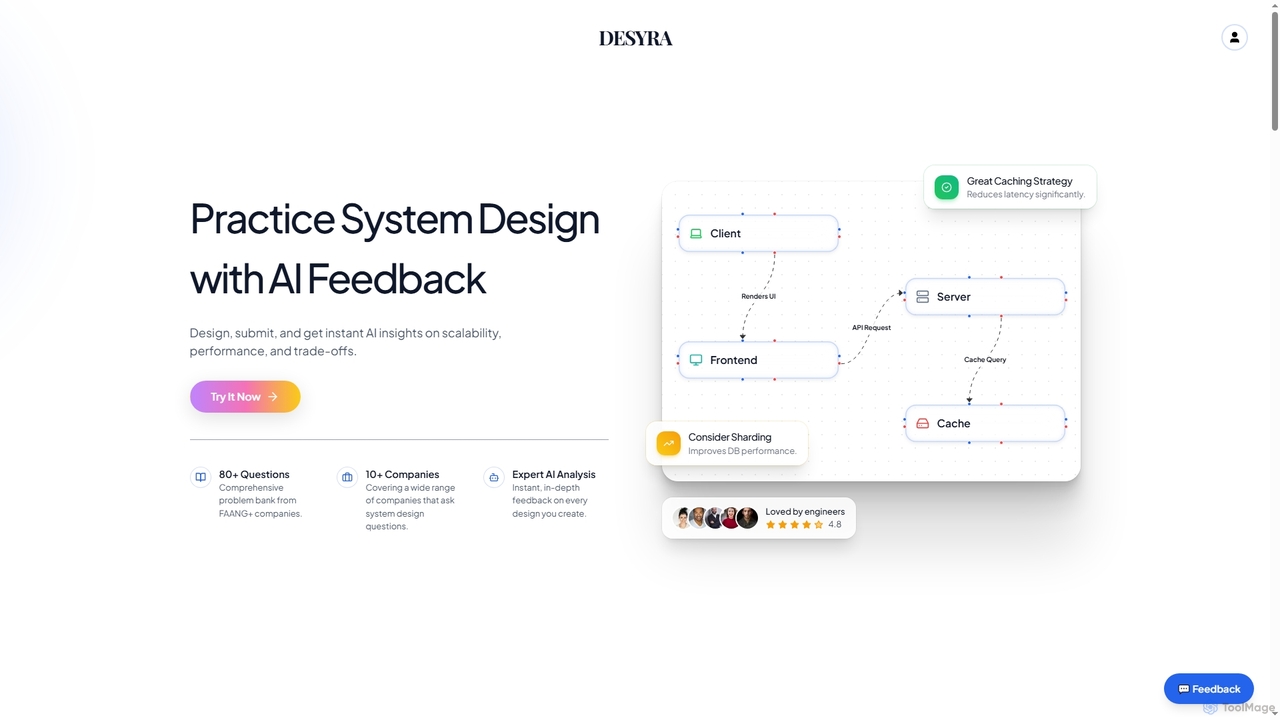
System Design tools are AI-powered platforms that assist in conceptualizing, modeling, and documenting the architecture of complex software systems. These tools leverage artificial intelligence to streamline the design process, offering intelligent suggestions, automated diagram generation, and performance simulations. They enable software architects and developers to create robust, scalable, and maintainable system blueprints, ensuring efficient development and deployment within the broader software development lifecycle. By automating repetitive tasks and providing data-driven insights, they significantly enhance the quality and speed of architectural planning.
Core Features
- Automated Diagram Generation: Automatically creates industry-standard diagrams like UML, ERDs, and flowcharts from textual descriptions, code snippets, or high-level requirements, accelerating initial design phases.
- Performance Simulation & Analysis: Simulates system behavior under various load conditions and traffic patterns to identify potential bottlenecks, predict performance, and optimize resource allocation before implementation.
- Architectural Pattern Suggestions: Recommends suitable architectural patterns (e.g., microservices, event-driven, monolithic) based on project requirements, non-functional attributes like scalability and security, and existing technology stacks.
- Dependency Mapping & Impact Analysis: Visualizes intricate component dependencies across distributed systems and analyzes the potential impact of changes, upgrades, or failures on the overall system stability and functionality.
- Cloud Resource Optimization & Cost Estimation: Suggests optimal cloud infrastructure configurations, services, and deployment strategies for designed systems, providing detailed cost estimations and helping to manage cloud spend effectively.
Applicable Scenarios
System Design tools are indispensable for software architects, lead developers, and enterprise solution architects planning new applications, modernizing legacy systems, or refactoring existing ones. They facilitate collaborative design sessions for distributed teams, help visualize complex distributed systems like microservices architectures, and ensure strict alignment with business requirements, technical constraints, and compliance standards. These tools are particularly useful in agile development environments for rapid prototyping, iterative design improvements, and maintaining up-to-date architectural documentation throughout the project lifecycle.
How to Choose
When selecting a System Design tool, consider its comprehensive diagramming capabilities (UML, C4 model, ERD, custom notations), seamless integration with existing development environments (IDEs, version control, CI/CD pipelines), and robust simulation and analysis features for performance and reliability. Evaluate its support for specific architectural styles (e.g., cloud-native, serverless, event-driven), collaboration features for team-based design, and the ability to generate detailed documentation or even initial code skeletons. Scalability for large, enterprise-level projects, security features, and the pricing model are also crucial factors to ensure it meets both technical and budgetary needs.