Qwizzard
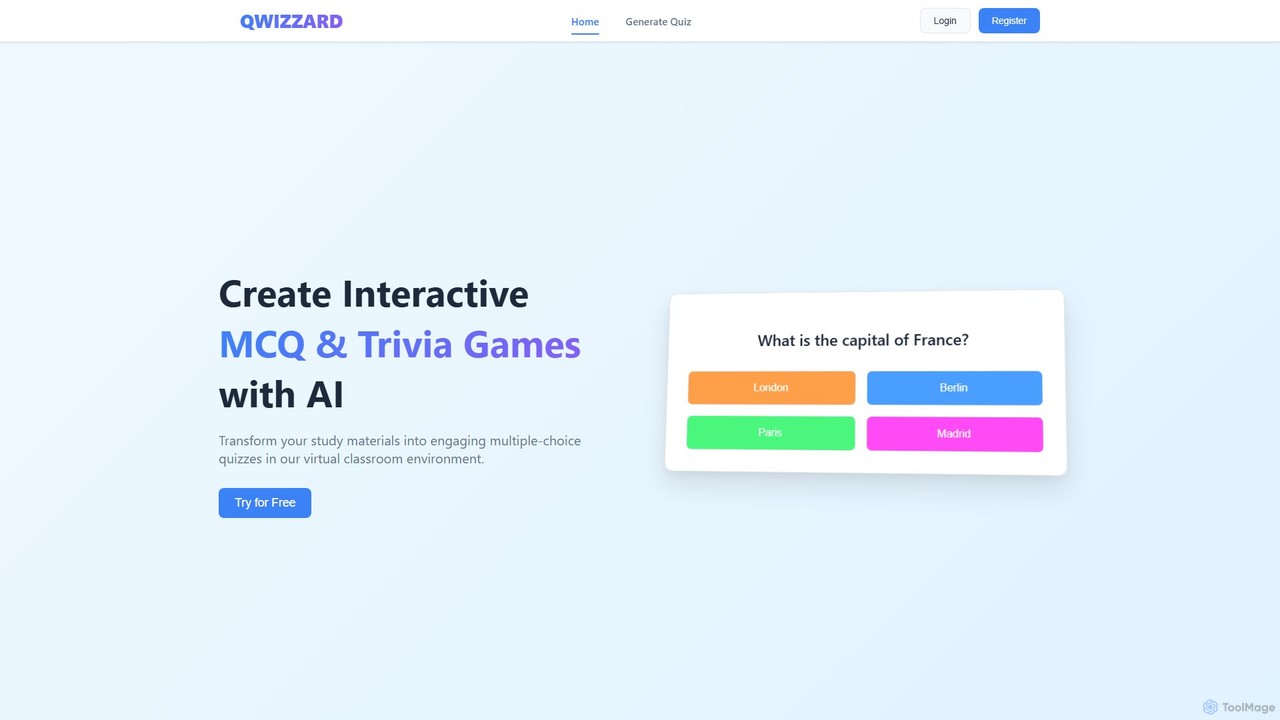
Qwizzard is an AI-powered question generator that transforms your documents, presentations, and study materials into interactive multiple-choice quizzes …
Qwizzard is an AI-powered question generator that transforms your documents, presentations, and study materials into interactive multiple-choice quizzes and trivia games. Ideal for educators, students, and trainers, it saves hours of preparation time and makes learning more engaging and effective through a virtual classroom experience with instant feedback.
About Study Aids
AI Study Aids are specialized tools designed to actively enhance the learning process through intelligent assistance. They utilize natural language processing (NLP) and machine learning to transform static study materials like textbooks, notes, and articles into interactive and digestible formats. These tools help users grasp complex concepts, prepare for exams more efficiently, and deepen their understanding by automating the creation of summaries, quizzes, and flashcards. They function as a personal digital tutor, providing on-demand explanations and personalized learning support.
Core Features
- Automated Summarization: Condenses long documents, lectures, or articles into concise summaries, highlighting key points and main arguments.
- Quiz & Flashcard Generation: Automatically creates practice questions, multiple-choice quizzes, and digital flashcards from uploaded study materials.
- Concept Explanation: Breaks down complex topics, definitions, and theories into simpler, more understandable language.
- Interactive Q&A: Allows users to ask specific questions about their study content and receive instant, context-aware answers.
- Personalized Learning Paths: Adapts to a user's learning pace and performance, suggesting topics to review and focusing on areas of weakness.
Applicable Scenarios
These tools are widely used by high school, college, and university students for exam preparation and homework assistance. They are also valuable for lifelong learners and professionals studying for certifications, enabling them to quickly master new subjects. Researchers use them to rapidly digest dense academic papers, while corporate trainers employ them to create engaging learning modules from existing documentation.
Selection Criteria
When choosing an AI Study Aid, consider the supported subjects (e.g., STEM, humanities, languages). Evaluate the types of input formats it accepts, such as PDF, DOCX, URL, or plain text. Assess the quality and variety of its outputs (summaries, flashcards, quizzes). Finally, consider the user interface's ease of use and whether the pricing model aligns with your budget and study frequency.

Study AidsUse Cases
Efficient Exam Preparation with Practice Quizzes
A university student preparing for a final exam in history uploads several weeks of lecture notes and required reading PDFs into an AI Study Aid. The tool processes the content and generates a series of multiple-choice and short-answer questions. The student uses these quizzes to test their knowledge, identify weak spots, and focus their revision efforts. This method transforms passive reading into an active recall practice, significantly improving retention and reducing study time by focusing only on areas that need improvement.
Understanding Complex Academic Papers
A postgraduate researcher needs to quickly understand the key findings of a dense, 30-page scientific paper. Instead of spending hours reading it, they upload the PDF to an AI Study Aid. The tool generates a one-page summary, extracts the main hypothesis, methodology, and conclusions, and provides simplified explanations for technical jargon. The researcher can then ask specific questions like "What was the sample size for experiment B?" and get an instant answer. This accelerates the literature review process by 80%, allowing the researcher to cover more ground in less time.
Language Learning with Automated Flashcards
A student learning Spanish wants to build their vocabulary. They copy-paste a list of 100 new words and their English translations into an AI Study Aid. The tool instantly generates a deck of digital flashcards. It then uses a spaced repetition algorithm to show the student cards they are about to forget, optimizing memorization. The student can practice on their phone during their commute, turning idle time into productive study sessions. This automates the tedious process of creating physical flashcards and makes learning more efficient and portable.
Getting Homework Help with Step-by-Step Solutions
A high school student is stuck on a complex algebra problem. Instead of just searching for the answer, they input the problem into an AI Study Aid. The tool doesn't just provide the final answer; it generates a detailed, step-by-step explanation of how to solve it. It breaks down each stage of the calculation, explains the relevant mathematical rules, and helps the student understand the underlying logic. This approach fosters genuine understanding rather than simple answer-copying, equipping the student to solve similar problems independently in the future.
Creating Study Guides from Video Lectures
An online learner has a two-hour video lecture to review. They provide the video link to an AI Study Aid. The tool transcribes the entire lecture, identifies key topics, and generates a structured study guide complete with timestamps, summaries of major sections, and a list of key terms. This saves the student hours of manual note-taking and allows them to quickly navigate to specific parts of the video when reviewing. The generated guide serves as a perfect foundation for creating flashcards or practice quizzes later.
Corporate Training and Professional Development
A new employee needs to get up to speed on a 100-page company policy manual. Their manager provides the document to an AI Study Aid. The employee can then interact with the manual conversationally, asking questions like "What is the process for expense reimbursement?" or "Summarize the data privacy policy." This interactive approach is more engaging than passive reading and leads to better retention of critical information. It accelerates the onboarding process and ensures new hires can find answers to their policy questions quickly and accurately.