ToolMage
Sign in

Best 1 Ai Chatbot AI tools for Technology

Popular Ai Chatbot AI tools in Technology include SpeakAI, helping you work more efficiently.

SpeakAI
Freemium

SpeakAI

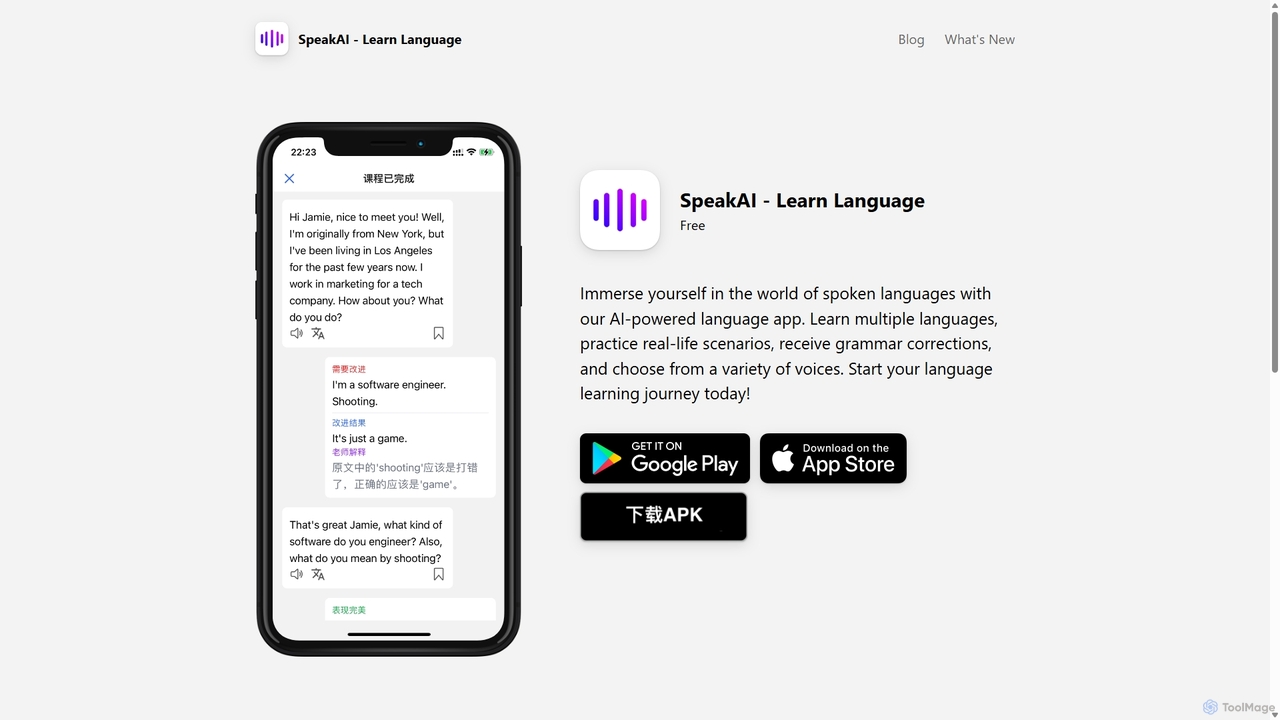
SpeakAI is an AI-powered language learning app designed to improve your conversational skills. Powered by OpenAI, it offers an immersive experience with an AI tutor, real-life scenario courses, and real-time dialogue practice. Receive instant grammar corrections, choose from over 100 voices, and learn languages like Spanish, French, Chinese, and more. It's a personalized, interactive way to achieve fluency anytime, anywhere.

Language Learning
Visits 4.1KFavorites 101Likes 96

About Ai Chatbot

AI Chatbots are intelligent conversational agents designed to simulate human-like interactions through text or voice. They leverage advanced natural language processing (NLP) and machine learning algorithms to understand user queries, interpret intent, and provide relevant, context-aware responses. These tools are transforming customer service, automating support, and streamlining information access across various digital platforms, offering scalable and personalized communication solutions.

Core Features

  • Natural Language Understanding (NLU): Interprets complex human language, including nuances, slang, and intent, beyond simple keyword matching.
  • Contextual Memory: Retains information from previous interactions within a conversation, allowing for more coherent and personalized dialogue.
  • Multi-channel Integration: Seamlessly deploys across websites, messaging apps, social media, and voice assistants to reach users wherever they are.
  • Automated Response Generation: Generates accurate and helpful replies based on vast datasets and learned patterns, often in real-time.
  • Personalization: Adapts responses and recommendations based on user history, preferences, and demographic data for a tailored experience.

Applicable Scenarios

AI Chatbots are widely adopted in industries requiring high-volume, consistent, and personalized customer interactions. They serve as frontline support for e-commerce, providing instant answers to FAQs and guiding purchase decisions. In healthcare, they assist with appointment scheduling and basic symptom checking. For internal operations, they can automate HR queries or provide quick access to company knowledge bases, significantly reducing employee workload.

How to Choose

When selecting an AI Chatbot, prioritize its NLU capabilities to ensure accurate intent recognition and natural conversation flow. Evaluate its integration potential with existing CRM, ERP, or messaging platforms for seamless data exchange. Consider the ease of training and customization, including the ability to define specific knowledge bases and conversational paths. Finally, assess scalability, security features, and the vendor's support for ongoing optimization and maintenance.

Featured tool rankings

Ai Chatbot use cases

1

Automating Customer Support and FAQs

E-commerce businesses and service providers utilize AI Chatbots to handle a high volume of customer inquiries around the clock. By deploying a chatbot on their website or messaging apps, they can instantly answer frequently asked questions about products, shipping, returns, or service details. This reduces the workload on human support agents, provides immediate assistance to customers, and improves overall satisfaction by offering quick, consistent, and accurate information without waiting times.

2

Personalized Sales and Lead Qualification

Sales teams leverage AI Chatbots to engage website visitors, qualify leads, and guide them through the sales funnel. A chatbot can ask targeted questions to understand a visitor's needs, recommend relevant products or services, and even schedule a demo or connect them with a human sales representative when appropriate. This proactive engagement helps capture valuable leads, personalize the initial sales interaction, and improve conversion rates by ensuring only qualified prospects reach human agents.

3

Internal Knowledge Base and HR Support

Large organizations deploy AI Chatbots to serve as an internal knowledge base for employees. Instead of sifting through extensive documentation, employees can ask the chatbot questions about company policies, IT support, HR benefits, or project guidelines. The chatbot provides instant, accurate answers, reducing the time employees spend searching for information and freeing up HR and IT departments from repetitive queries. This enhances employee productivity and satisfaction.

4

Educational Tutoring and Language Learning

Educational platforms and language learning apps integrate AI Chatbots to provide personalized tutoring and practice. Students can interact with a chatbot to ask questions about complex topics, receive explanations, or practice conversational skills in a new language. The chatbot offers immediate feedback, adapts to the learner's pace, and provides a non-judgmental environment for practice, making learning more engaging and accessible outside traditional classroom settings.

5

Healthcare Information and Appointment Scheduling

Healthcare providers utilize AI Chatbots to enhance patient engagement and streamline administrative tasks. Patients can interact with a chatbot to find information about symptoms, common conditions, clinic hours, or medication details. The chatbot can also assist with scheduling, rescheduling, or canceling appointments, sending reminders, and directing patients to the appropriate department or human staff for more complex medical advice. This improves accessibility and efficiency in healthcare services.

6

Content Generation and Creative Brainstorming

Content creators and marketers leverage advanced AI Chatbots for brainstorming ideas, generating drafts, and refining written content. By providing prompts, users can receive suggestions for blog post topics, social media captions, email subject lines, or even initial drafts of articles. These chatbots can help overcome writer's block, explore different angles for a story, and quickly produce various content variations, significantly accelerating the content creation process and enhancing creativity.

Ai Chatbot FAQ

What is an AI Chatbot?

An AI Chatbot is a computer program designed to simulate human conversation through text or voice interactions. It uses artificial intelligence, specifically natural language processing (NLP) and machine learning, to understand user input, interpret intent, and generate relevant, human-like responses. Unlike traditional rule-based chatbots, AI chatbots can learn from interactions, handle more complex queries, and provide a more personalized and dynamic conversational experience.

How do AI Chatbots differ from traditional rule-based chatbots?

The primary difference lies in their intelligence and flexibility. Traditional rule-based chatbots operate on predefined scripts and keywords; they can only answer questions for which they have explicit rules. AI Chatbots, however, use natural language processing and machine learning to understand the intent behind a user's query, even if the exact phrasing isn't in their database. This allows them to handle more varied and complex conversations, learn from new data, and provide more human-like and adaptable responses, making them suitable for dynamic and evolving interactions.

What are the key benefits of implementing an AI Chatbot?

Implementing an AI Chatbot offers several key benefits. Firstly, it provides 24/7 availability, ensuring customers receive instant support regardless of time zones. Secondly, it significantly reduces operational costs by automating routine inquiries and freeing up human agents for more complex tasks. Thirdly, AI chatbots enhance customer satisfaction through quick, consistent, and personalized responses. They also improve lead generation and qualification, gather valuable customer data, and can be scaled easily to handle fluctuating demand without additional staffing.

How can I choose the right AI Chatbot for my business?

Choosing the right AI Chatbot involves evaluating several factors. First, define your specific use cases and target audience to ensure the chatbot's features align with your needs. Look for strong natural language understanding (NLU) capabilities to accurately interpret user intent. Consider its integration with your existing systems (CRM, helpdesk) and the ease of customization for your brand's voice and knowledge base. Assess scalability, security, and the vendor's support. Finally, compare pricing models and consider a trial period to test its effectiveness in your environment.

Can AI Chatbots handle complex or nuanced conversations?

Yes, modern AI Chatbots are increasingly capable of handling complex and nuanced conversations, far beyond simple keyword matching. Thanks to advancements in large language models (LLMs) and deep learning, they can understand context, infer intent, and even detect sentiment. While they may still struggle with highly abstract or emotionally charged human interactions, their ability to process complex queries, maintain conversational flow, and provide detailed, relevant information is continually improving, making them effective for a wide range of sophisticated tasks.