Moodfol
Moodfol is an AI-powered trading and emotional journal designed to help traders connect their emotions with their trades. …
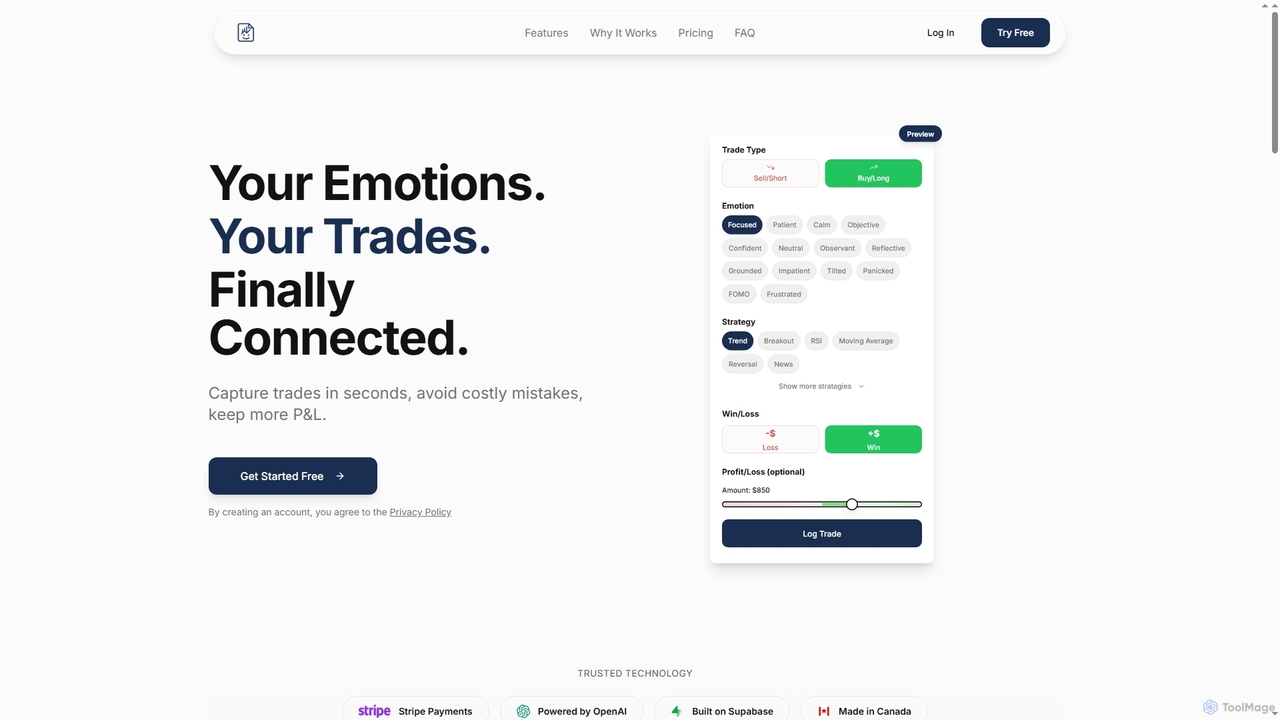
Moodfol is an AI-powered trading and emotional journal designed to help traders connect their emotions with their trades. It captures trades quickly, provides personalized insights, and helps identify profit-killing or profit-making patterns, fostering discipline and improving trading performance.
About Journaling
AI Journaling tools for trading are specialized platforms that systematically record, analyze, and optimize trading activities. These tools leverage AI to automatically import trade data from brokers, identify performance patterns, and provide data-driven insights that go beyond manual logging. They help traders understand their psychological biases, refine strategies, and improve decision-making consistency. The primary value lies in transforming raw trade history into actionable intelligence for performance improvement.
Core Features
- Automated Trade Import: Connects directly with brokerage accounts to sync trade history automatically, eliminating manual entry.
- Advanced Performance Analytics: Calculates key metrics like win rate, profit factor, expectancy, and maximum drawdown.
- AI-Powered Pattern Recognition: Identifies recurring successful setups and costly mistakes in your trading behavior.
- Psychological Analysis: Allows tagging trades with emotions to analyze and mitigate behavioral biases like fear of missing out (FOMO) or revenge trading.
- Strategy Backtesting Support: Uses historical journal data to validate and refine trading strategies.
Use Cases
These tools are essential for active retail and professional traders across various markets, including stocks, forex, cryptocurrencies, and futures. Day traders use them for intensive post-session reviews, while swing and position traders analyze longer-term performance and strategic adherence. They are crucial for any trader committed to a data-driven improvement process.
How to Choose
When selecting a tool, consider its broker compatibility and the reliability of data synchronization. Evaluate the depth of its analytics and the quality of AI-driven insights. Also, assess the customization options for tags and notes, the user interface, and the platform's data security protocols to protect your sensitive trading information.

JournalingUse Cases
Conducting a Post-Trade Performance Review
A day trader completes their trading session and needs an objective performance analysis. Using an AI journaling tool, they automatically sync all trades from their broker. The platform instantly generates reports visualizing entry and exit points on charts, calculates Profit and Loss (P&L) for each setup, and flags trades that deviated from their predefined strategy. This process transforms a time-consuming manual review into a quick, data-driven feedback loop, enabling the trader to identify specific mistakes and successful patterns from the day's activity within minutes.
Identifying Psychological Trading Biases
A swing trader suspects that emotional decisions are impacting their profitability. They use the journaling tool to tag each trade with psychological labels like 'FOMO entry,' 'Revenge trade,' or 'Overconfident.' Over time, the AI analytics reveal a clear pattern: trades tagged as 'Revenge trade' after a loss have an 80% lower win rate. This data-backed insight provides concrete evidence of a costly behavioral bias, prompting the trader to implement a mandatory cooling-off period after any significant losing trade to improve discipline.
Optimizing Trading Strategy Parameters
A forex trader wants to refine their moving average crossover strategy. Using their AI journal, they filter all trades executed with this specific setup. The tool's analytics allow them to compare performance based on different parameters they've logged, such as time of day, currency pair, or market volatility conditions. The AI might highlight that the strategy's profit factor is significantly higher during the London session compared to the Asian session. This enables the trader to make a data-driven decision to focus on trading this strategy only during its most profitable hours.
Preparing for a Weekly Market Review
A part-time stock trader needs an efficient way to prepare for their weekend analysis. Instead of manually compiling data from their broker into a spreadsheet, they use an AI journaling tool. With one click, the tool generates a comprehensive weekly report summarizing key metrics like total P&L, win rate, and average risk-reward ratio. It also highlights the best and worst performing trades with attached charts and notes. This automated process saves hours of administrative work and allows the trader to focus their limited time on strategic planning and identifying areas for improvement for the week ahead.
Sharing Trade Logs with a Mentor for Feedback
A novice trader is working with a mentor to improve their skills. They use an AI journaling platform that allows them to create a secure, read-only link to their trade history. The mentor can then access a detailed dashboard with all trades, associated charts at the time of execution, performance statistics, and the trader's personal notes. This facilitates a highly effective feedback process, as the mentor can analyze actual trade data and provide specific, actionable advice on strategy execution and risk management, rather than relying on subjective recollections from the mentee.
Tracking Risk Management Consistency
An options trader aims to strictly adhere to their risk management rule of never risking more than 1% of their account on a single trade. Their AI journal automatically calculates the potential risk for each trade upon import. The platform's dashboard includes a widget that tracks adherence to this rule over time and flags any trade that exceeded the 1% threshold. This provides an objective, visual measure of discipline, helping the trader quickly identify moments of weakness and reinforce their commitment to sound risk management practices, which is critical for long-term survival in trading.