token_counter
A free, privacy-focused online tool for accurately calculating text token counts for a wide range of Large Language …
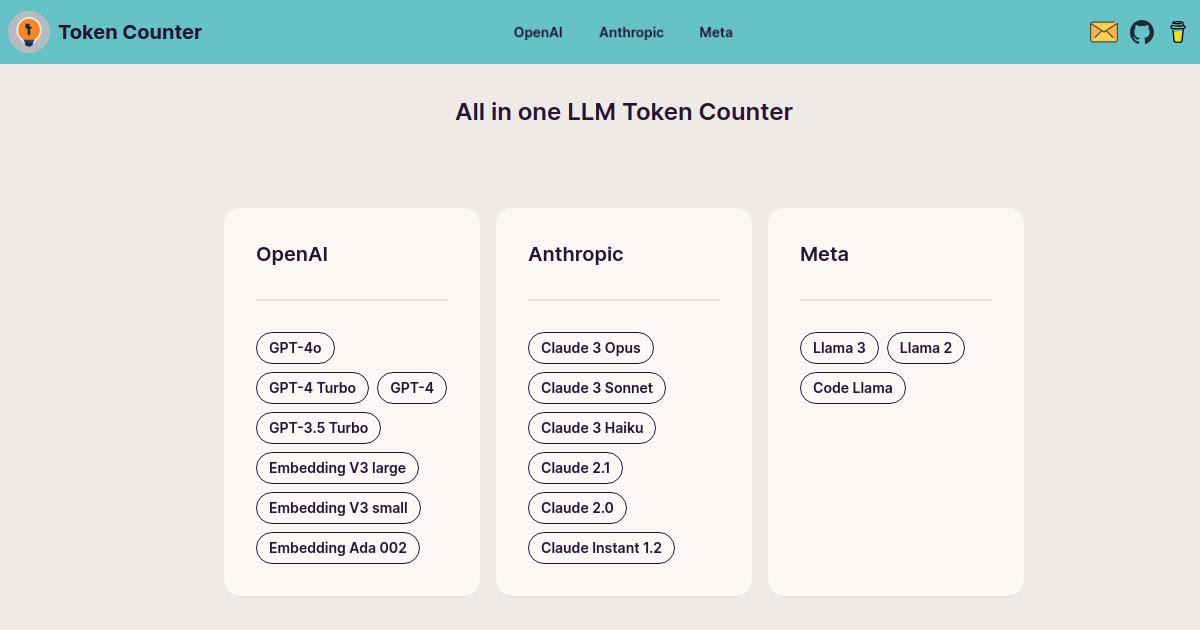
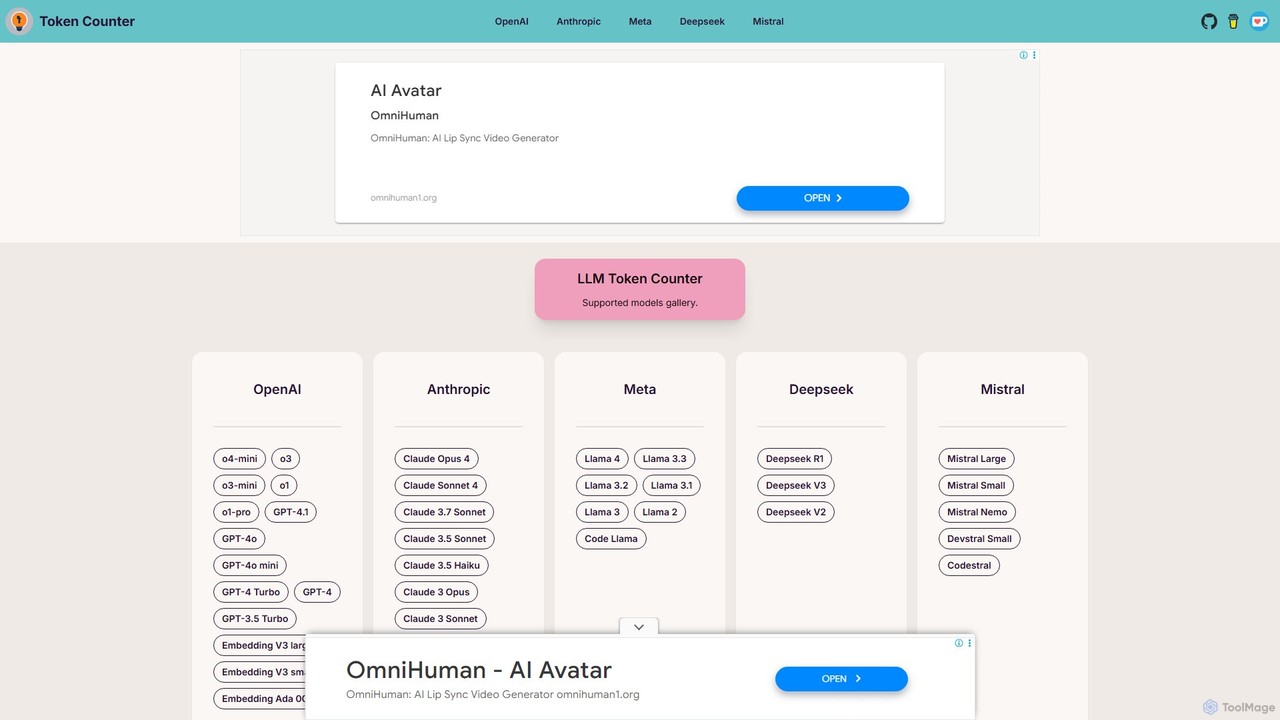
A free, privacy-focused online tool for accurately calculating text token counts for a wide range of Large Language Models (LLMs). It supports popular models from OpenAI, Anthropic, Meta, Mistral, and more. By performing all calculations directly in your browser, it ensures your prompts remain confidential. This is an essential utility for developers, writers, and researchers to manage LLM context windows, prevent errors, and optimize API usage without compromising data security.
About Calculators
AI Calculators are specialized tools that leverage artificial intelligence models to perform complex estimations, forecasts, and simulations. Unlike traditional calculators limited to predefined formulas, these tools analyze multiple variables and historical data to provide nuanced, data-driven insights. They are widely used for financial modeling, business forecasting, and scientific analysis, enabling users to make more informed decisions based on predictive outcomes. The core advantage lies in their ability to handle uncertainty and complex interdependencies that simple spreadsheets cannot easily model.
Core Features
- Predictive Modeling: Utilizes machine learning algorithms to forecast future trends and outcomes based on input data.
- Multi-Variable Analysis: Simultaneously processes a wide range of interconnected variables to produce a holistic calculation.
- Scenario Simulation: Allows users to create and compare different "what-if" scenarios to assess potential impacts.
- Domain-Specific Logic: Incorporates specialized knowledge and models for specific industries like finance, marketing, or real estate.
Use Cases
AI Calculators are valuable across various sectors. Financial analysts use them for investment return and risk assessment. Marketers rely on them to forecast campaign ROI and customer lifetime value. In sustainability, they help calculate carbon footprints and environmental impact. Individuals also use them for complex personal finance planning, such as retirement and mortgage affordability.
How to Choose
When selecting an AI Calculator, consider its specialization; ensure it matches your specific domain (e.g., finance, logistics). Evaluate the required input data and its compatibility with your existing sources. Assess the transparency of the model—how clearly it explains its results. Finally, consider its integration capabilities with other software and platforms for a seamless workflow.
CalculatorsUse Cases
Forecast Marketing Campaign ROI
A marketing manager plans a new digital campaign. Instead of relying on simple spreadsheets, they use an AI ROI calculator. They input key variables like ad spend, target channels, expected conversion rates, and customer acquisition cost. The AI model, trained on historical industry data, simulates potential outcomes, providing a projected ROI range and identifying the most promising channels. This allows the team to allocate their budget more effectively before launch.
Dynamic Retirement Savings Planning
An individual planning for retirement uses an AI-powered calculator to get a more realistic forecast. They input their current age, savings, income, and desired retirement lifestyle. The tool goes beyond simple interest calculations by simulating market volatility, inflation rates, and potential changes in living expenses based on economic models. The output provides a probability of success and suggests dynamic adjustments to their savings strategy over time.
Analyze Real Estate Investment Potential
A real estate investor evaluates a potential property. They use an AI investment calculator that analyzes more than just mortgage payments. It incorporates local market trends, predicted rental demand, property tax fluctuations, and estimated maintenance costs. By simulating various economic scenarios (e.g., interest rate hikes, rental market downturns), the tool provides a comprehensive risk assessment and a more accurate projection of long-term profitability and cash flow.
Estimate Software Development Costs
A project manager needs to provide a cost and timeline estimate for a new software feature. They use an AI estimation calculator, inputting details like project complexity, team size, programming languages, and required integrations. The tool leverages data from thousands of past software projects to predict the most likely development effort in hours and associated costs. This provides a data-backed estimate that is more reliable than manual guesswork.
Assess Corporate Carbon Footprint
A sustainability officer is tasked with measuring their company's environmental impact. They use an AI carbon footprint calculator that connects to various data sources, including supply chain logistics, energy consumption bills, and employee travel records. The AI model calculates the total greenhouse gas emissions, identifies the biggest contributing factors, and simulates the potential impact of mitigation strategies, such as switching to renewable energy or optimizing shipping routes.
Determine Loan Affordability and Risk
A financial advisor helps a client understand their mortgage capacity. They use an AI loan affordability calculator that assesses income stability, credit history, debt-to-income ratio, and projected future expenses. The AI model also factors in macroeconomic indicators to evaluate risk under different economic conditions. The result is not just a maximum loan amount but a detailed breakdown of affordability, helping the client make a financially sound decision.