Models
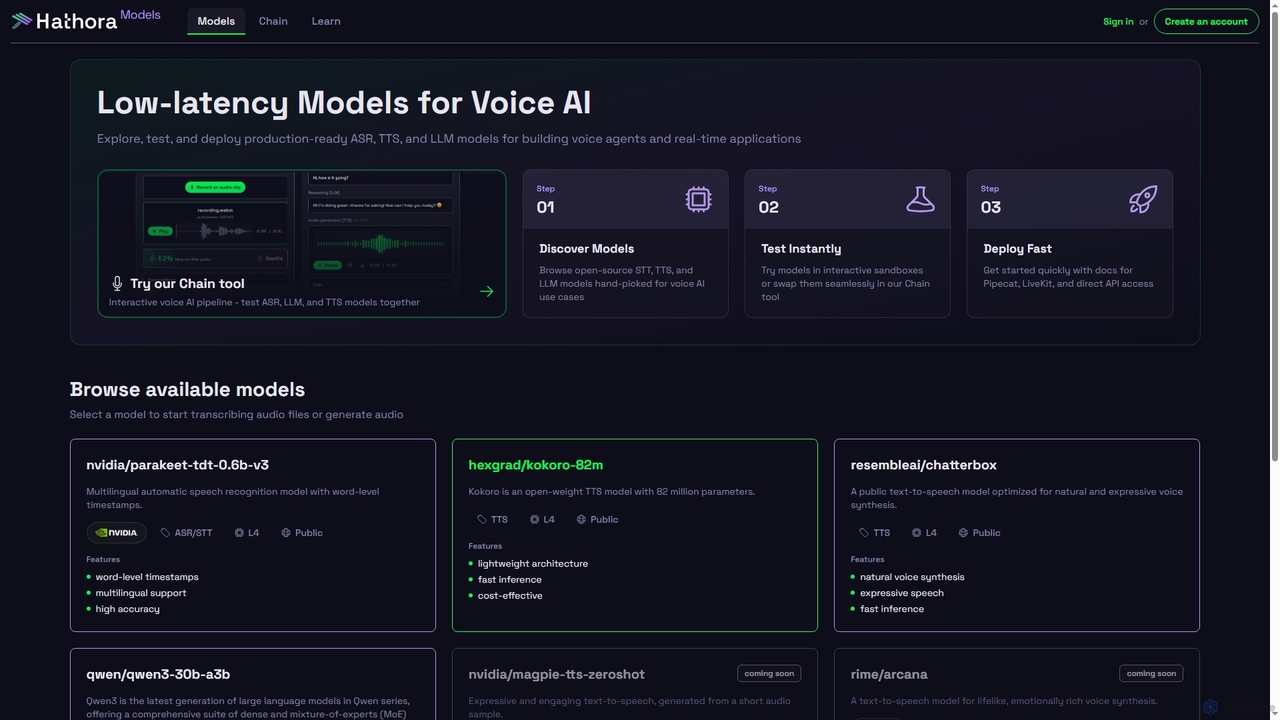
Models by Hathora offers a curated catalog of low-latency ASR, TTS, and LLM models optimized for voice AI …
Models by Hathora offers a curated catalog of low-latency ASR, TTS, and LLM models optimized for voice AI and real-time applications. Developers can explore, test, and deploy production-ready models quickly, featuring interactive sandboxes and direct API access for seamless integration into voice agents and other applications.
About Speech Recognition
Speech Recognition tools are AI-powered applications that convert spoken language into written text. Leveraging advanced Automatic Speech Recognition (ASR) technology, these tools enable machines to understand and process human speech. They provide immense value by automating transcription, facilitating voice commands, and enhancing accessibility across various digital platforms.
Core Features
- High Accuracy Transcription: Converts audio to text with high precision, even in challenging acoustic environments.
- Speaker Diarization: Identifies and separates different speakers in multi-participant conversations.
- Real-time Processing: Transcribes speech instantly for live captions, voice assistants, and interactive applications.
- Language & Accent Support: Recognizes and processes speech in multiple languages and diverse regional accents.
- Custom Vocabulary: Allows users to add specific terms, names, or jargon for improved accuracy in specialized domains.
Use Cases
Speech recognition is crucial for automating meeting minutes, powering virtual assistants, and generating video captions. It's widely adopted by content creators for accessibility, customer service centers for call analysis, and developers for building voice-controlled applications.
How to Choose
When selecting a speech recognition tool, prioritize transcription accuracy, real-time capabilities, and the breadth of supported languages and accents. Evaluate its custom vocabulary features, ease of integration with existing systems, data privacy policies, and pricing models based on usage volume or features.
Speech RecognitionUse Cases
Automating Meeting Minutes and Transcriptions
For corporate professionals and teams, speech recognition tools can automatically transcribe live meetings or recorded audio, converting spoken discussions into searchable text. This saves hours of manual note-taking, ensures no key points are missed, and allows for easy sharing and archiving of meeting summaries, significantly boosting productivity and record-keeping efficiency.
Generating Video Subtitles and Captions
Content creators, educators, and media professionals utilize speech recognition to quickly generate accurate subtitles and captions for videos. This enhances accessibility for hearing-impaired audiences, improves SEO for video content by making it searchable, and allows for easy translation into multiple languages, significantly expanding content reach globally and engaging a wider audience.
Powering Voice Assistants and Smart Devices
Developers and tech companies integrate speech recognition APIs into voice assistants, smart home devices, and automotive systems. Users can control devices, search for information, or execute commands using natural language, creating intuitive and hands-free user experiences. This enables seamless interaction with technology, from setting alarms to playing music, purely through voice commands.
Transcribing Customer Service Calls for Analysis
Customer support centers employ speech recognition to transcribe customer interactions, converting spoken conversations into text logs. This enables sentiment analysis, keyword tracking for quality assurance, agent training, and provides valuable insights into customer needs, common issues, and service trends. The transcribed data helps improve service quality and operational efficiency.
Dictation for Document Creation and Content Drafting
Writers, journalists, and professionals who frequently create long-form documents can use speech recognition for dictation. By speaking their thoughts directly into a microphone, they can rapidly draft emails, reports, articles, or creative content, often at a faster pace than typing. This improves efficiency, reduces typing fatigue, and allows for a more natural flow of ideas during the content creation process.
Voice Control for Accessibility and Hands-Free Operation
Individuals with mobility impairments or those seeking hands-free operation leverage speech recognition for controlling computers and applications. This allows them to navigate interfaces, open programs, input text, and execute complex commands using only their voice, significantly enhancing accessibility and enabling a more natural and efficient interaction with technology, especially in environments where manual input is challenging.